

news +insights
Update: New York Data Center Pause Holds as Cost Rules Take Shape
New York's pause on state environmental permits for new hyperscale data centers remains in place, and the state has now laid out the cost terms that are likely to follow it: a community investment benchmark of $1 million per megawatt, power supply rules still being written by utility regulators, and a proposed repeal of state sales tax exemptions for the largest facilities. Governor Kathy Hochul reviewed those pieces on October 6, 2026 at Fishkill Farms in East Fishkill, Dutchess County, alongside U.S. Representatives Alexandria Ocasio-Cortez and Pat Ryan Governor's Office, Oct. 6.
This post is an update to our earlier coverage of the moratorium, which you can read here: New York's data center moratorium and Western New York construction jobs. That post covered the Legislature's bill and the jobs debate. This one covers what has changed since: the executive order is in force, the Community Investment Framework has been published, and the remaining rules now have a clearer shape. The October 6 event itself did not create a new ban, a final rule or a new deadline FingerLakes1.
What Is New
- The Community Investment Framework is out. Empire State Development's framework was announced on September 15, 2026. Its core benchmark is $1 million in community investment per megawatt of utility demand, so a 50 megawatt facility would point to $50 million Governor's Office, Sept. 15.
- Power supply terms are being drafted. Hochul said the Public Service Commission is developing requirements under which data centers would supply their own energy or pay a premium to draw from the grid FingerLakes1. No rates, formulas or effective dates have been announced FingerLakes1.
- The sales tax push continues. The Governor is pursuing legislation to repeal state sales tax exemptions for massive data centers Governor's Office, Oct. 6. That requires action by the Legislature, and the exemptions have not been repealed FingerLakes1.
- Local moratoria are running longer than the state's. Hochul pointed to East Fishkill, where the Town Board unanimously adopted a three-year local moratorium after a proposal she said would need one gigawatt of power FingerLakes1.
Where the Permit Pause Stands
The Governor signed the executive order on July 14, 2026 Governor's Office, July 14. While the Department of Public Service prepares a Generic Environmental Impact Statement on data centers, the Department of Environmental Conservation will not issue discretionary permits that were not already deemed complete Governor's Office, July 14. The state has said that study will take up to a year, and that the moratorium lifts once the standards are final Governor's Office, July 14. The pause covers facilities of 50 megawatts or more and reaches only discretionary DEC approvals Hodgson Russ.
Two points matter for scheduling. First, the pause is not a permanent ban and does not shut down existing facilities FingerLakes1. Second, lifting it does not clear a project to build. Projects will still need state and local approvals afterward, and the order does not settle local zoning disputes FingerLakes1. The Governor's office has not published the status of individual applications FingerLakes1.
The Community Investment Framework in Detail
The framework is guidance for local governments negotiating with data center developers, owners and operators. It is not a binding regulation Governor's Office, Sept. 15. It applies to projects covered by the executive order's moratorium Governor's Office, Sept. 15. A draft outline released in July drew public comment through August 13 before the final version was issued Hodgson Russ.
Beyond the per megawatt benchmark, the framework covers:
- Labor standards: prevailing wages for construction workers, local hiring commitments and engagement with organized labor Governor's Office, Sept. 15. The July announcement also described project labor agreements, apprenticeships and workforce development as priorities Governor's Office, July 14.
- Where the money goes: public infrastructure such as roads, water, sewer, parks and transit, along with housing, workforce training, schools, child care, broadband, public safety and small business support Governor's Office, Sept. 15.
- Good neighbor commitments: water consumption, noise, lighting, building design and landscaping Governor's Office, Sept. 15.
- Reporting: annual disclosure of employment, water and utility use, energy demand and environmental impacts Governor's Office, Sept. 15.
- Confidentiality: a recommendation that localities limit non-disclosure agreements to proprietary information Governor's Office, Sept. 15.
Attorneys at Hodgson Russ, reviewing the July outline, noted that the recommended contribution is well above typical host community agreements, and that it is unclear whether the framework will be written into state regulations Hodgson Russ. Hochul said the aim is to help smaller municipalities, some with part-time staff, negotiate with large technology companies FingerLakes1.
Power Supply and Grid Costs
The ratepayer protection work runs through the Department of Public Service's Energize NY proceeding, which the state says will require data centers to pay more for energy or supply their own Governor's Office, July 14. The July order also directed the department to consider a New York Grid Acceleration Fund that would require data centers to invest in grid infrastructure, an insurance pool to guard against speculative large loads, and approaches that would have data centers fund new clean generation dedicated to their operations, including on-site distributed energy and battery storage Governor's Office, July 14.
At the October 6 event, Hochul also described a possible requirement that developers contribute to broader grid improvements. That approach is still in development FingerLakes1.
The East Fishkill Example
East Fishkill's Town Board passed its freeze in June. It bars data centers above 20 megawatts through July 2029 WAMC. The proposal that prompted it was a 1,000 megawatt facility from Treetop Development, which WAMC reported has since been removed from the New York Independent System Operator's interconnection queue WAMC. The town's measure is separate from the state pause FingerLakes1. Hochul summed up the state's position this way: "Data centers will only go in communities that want them" FingerLakes1.
Fishkill Farms owner Josh Morgenthau, who hosted the roundtable, said communities need to grow but that development "needs to be thoughtful" Governor's Office, Oct. 6. Assemblymember Didi Barrett said more work remains and listed ratepayer protections, host community benefits, renewable energy requirements and labor standards as priorities from the Legislature's Responsible Data Center Development Act Governor's Office, Oct. 6. The Governor also outlined a separate schedule for the state's AI safety law, which regulates AI developers and not facilities FingerLakes1.
Implications for Owners, Developers, Contractors and Subs
- Permit timing: A covered project without a complete DEC application before July 14 should not plan on a discretionary state permit until the environmental study is final, which the state has framed as up to a year from the order. Local approvals are a separate track and, in towns like East Fishkill, a longer one. Check both the state threshold of 50 megawatts and any local threshold, which may be lower.
- Power supply terms: Pro formas should carry two cases, self-supplied generation or a premium grid rate, plus a possible grid contribution. If the rules favor dedicated generation and storage, the construction scope on these sites grows to include on-site power plants, battery systems and substations, which is meaningful work for electrical, civil and mechanical trades.
- Tax cost of equipment: If the Legislature repeals the exemptions, state sales tax would apply to purchases that are now exempt. Servers, electrical gear and cooling equipment make up a large share of data center cost, so owners should model the project both ways and watch how any bill treats projects already under contract.
- Host community agreements: The $1 million per megawatt figure is a recommendation, but local boards now have a published number to open with. On a 100 megawatt project, simple arithmetic puts that at $100 million. Developers should expect it to appear in negotiations and should budget for reporting and good neighbor commitments.
- Contractors and subs: Expect prevailing wage, local hiring and apprenticeship terms to show up in host agreements and flow down into bid documents. Firms that want this work when the pause lifts should have certified payroll systems and apprenticeship participation in order.
- Smaller and excluded projects: The state pause targets hyperscale facilities. Projects below the threshold are outside it, though local rules may still apply.
What to Watch
- Publication of the draft and final Generic Environmental Impact Statement, which controls when the state pause ends Governor's Office, July 14.
- Public Service Commission action on self-supply, premium rates and grid contributions FingerLakes1.
- A sales tax repeal bill and its effective date, if one is introduced in the next legislative session Governor's Office, Oct. 6.
- Whether the Community Investment Framework stays as guidance or is tied to state approvals Hodgson Russ.
- More towns adopting their own moratoria with lower thresholds and longer terms WAMC.
Bottom Line
Nothing changed in law on October 6, but the outline of New York's post-moratorium rules is now visible FingerLakes1. Large data centers that move forward in the state should expect a longer approval path, higher power costs or self-supplied generation, a published benchmark for community payments, labor standards in host agreements, and the possible loss of a sales tax exemption Governor's Office, Sept. 15 Governor's Office, Oct. 6. Most of those terms are still proposals, so the practical step for now is to price them as scenarios instead of certainties.
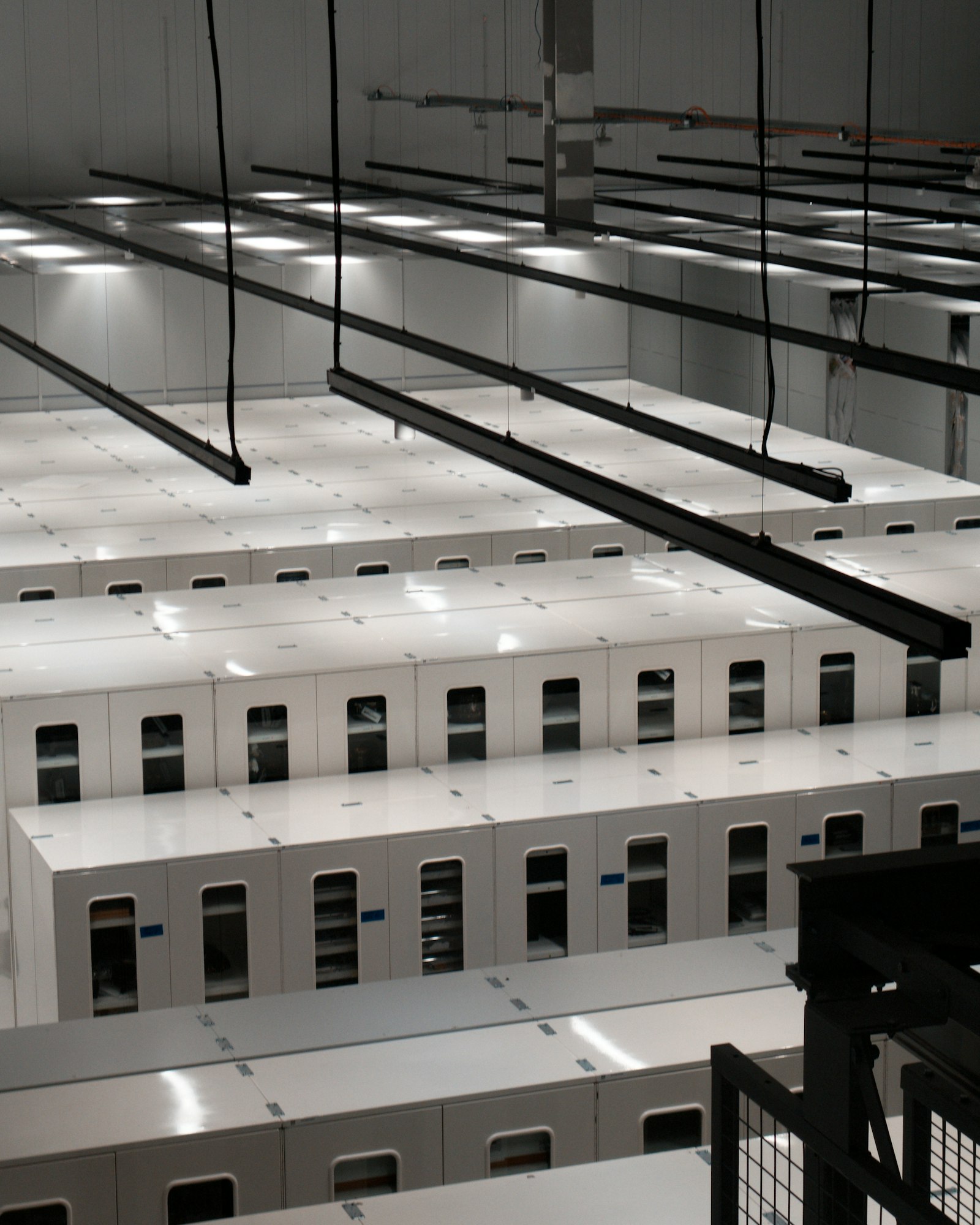
Image credit: Tony Marinescu on Unsplash. Free-license stock photo of a data center, not a New York facility. Image from Unsplash.
Sources
- New York Governor's Office, Governor Hochul and Representatives Ocasio-Cortez and Ryan Highlight New York's Nation-Leading Data Center Moratorium (October 6, 2026): https://www.governor.ny.gov/news/governor-hochul-and-representatives-ocasio-cortez-and-ryan-highlight-new-yorks-nation-leading
- New York Governor's Office, Governor Hochul Announces Community Investment Framework (September 15, 2026): https://www.governor.ny.gov/news/governor-hochul-announces-strongest-community-investment-framework-nation-protect-communities
- New York Governor's Office, First Statewide Moratorium on New Hyperscale Data Centers Launched by Governor Kathy Hochul (July 14, 2026): https://www.governor.ny.gov/news/first-statewide-moratorium-new-hyperscale-data-centers-launched-governor-kathy-hochul
- FingerLakes1, Hochul highlights data center permit pause, plans to protect utility customers: https://www.fingerlakes1.com/2026/10/07/hochul-highlights-data-center-permit-pause-plans-to-protect-utility-customers/
- FingerLakes1, Hochul defends data center permit pause after Hudson Valley farm roundtable: https://www.fingerlakes1.com/2026/10/07/hochul-defends-data-center-permit-pause-after-hudson-valley-farm-roundtable/
- Hodgson Russ, New York State Issues Data Center Community Investment Framework Policy Outline: https://www.hodgsonruss.com/newsroom/publications/new-york-state-issues-data-center-community-investment-framework-policy-online
- WAMC, East Fishkill passes 3-year data center freeze: https://www.wamc.org/2026-06-26/east-fishkill-passes-3-year-data-center-freeze



Let's connect
For organizations planning commercial, industrial, or infrastructure work, we will review the project and recommend the appropriate delivery approach.

Join our team
If you hold yourself to careful, accountable work, you already work the way we do.