
news +insights
2027 Construction Outlook: Economists See Cooling, Not Collapse
The 2027 construction outlook from the industry's leading economists is a cooling market, not a collapsing one. At ConstructConnect's Fall 2026 Construction Economy Outlook, held in partnership with the American Institute of Architects (AIA) and the Associated General Contractors of America (AGC), economists described a market that is growing on paper but straining in practice, with data centers carrying most of the growth while costs, rates and planning activity work against everything else (ConstructConnect News). ConstructConnect forecasts total U.S. construction starts to rise 6.9% in 2027, with GDP growth of 2.4% (ConstructConnect News).
The webcast took place on November 12, and ConstructConnect published its detailed readout on November 19 (ConstructConnect News). The panel included ConstructConnect Chief Economist Michael Guckes, AIA Chief Economist Richard Branch, AGC Chief Economist Ken Simonson and ConstructConnect Director of Content Acquisition Kristy O'Brien. WCG covered the same group's spring session in ConstructConnect's warning to pick your subcategory and geography; this fall edition updates that picture heading into 2027.
Real Nonresidential Activity May Be Bottoming
Branch said inflation-adjusted nonresidential building spending has declined for about two years, and that it now looks like real activity is bottoming out, while cautioning that one or two months do not make a trend (ConstructConnect News).
The AIA/Deltek Architecture Billings Index, which looks roughly a year ahead for nonresidential construction, offers little relief. A reading of 50 or above signals growth, but the index sat at 46.6 in July, 47.2 in August and 44.7 in September (ConstructConnect News). AIA's July consensus forecast calls for nonresidential building spending to slip 0.3% in 2026 and rise 3.0% in 2027, and Branch said the risk to that forecast tilts to the downside (ConstructConnect News). WCG reported that July forecast in AIA Panel Cuts 2026 Nonresidential Outlook to -0.3%, Raises 2027 to 3.0%.
Data Centers Are Doing the Heavy Lifting
Guckes said nonresidential starts reached $756 billion through September, up 27%, or $157 billion. Data centers accounted for more than half of that gain, about $90 billion, for a total of $135.8 billion in data center starts (ConstructConnect News).
The scale has grown fast. Guckes noted that the first $1 billion data center project broke ground in 2022, the first $10 billion project came in 2025, and about eight gigawatts of new data centers started that year. He said January 2026 alone saw more data center starts than all of 2024 (ConstructConnect News).
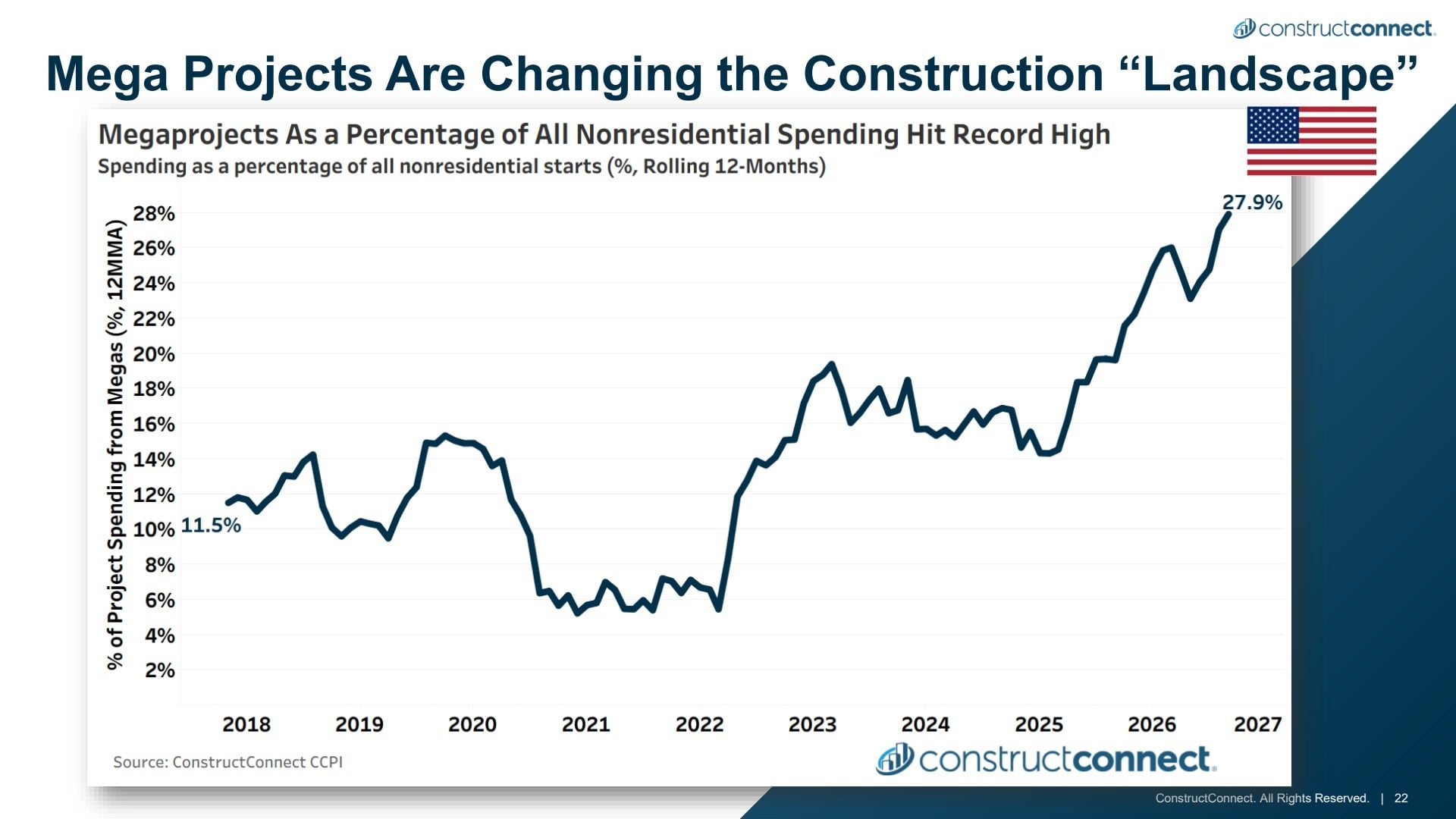
- Megaprojects: projects of $1 billion or more made up 27.9% of nonresidential starts on a rolling 12-month basis, up from roughly 10% to 12% before COVID (ConstructConnect News).
- Private office, including data centers: up 173.0% (ConstructConnect News).
- Power infrastructure: up 167.4% (ConstructConnect News).
- Manufacturing: down 5.3% (ConstructConnect News).
Census Bureau spending data tells the same story. Simonson said data center spending rose 90% year over year and 920% since January 2020, which he called the largest and most sustained increase he has seen for any project type in his 25 years at AGC. Other private nonresidential construction fell 3.9% (ConstructConnect News). The concentration of dollars in a few very large jobs matches what WCG described in Megaprojects Hold One in Four Nonresidential Construction Dollars.
Fewer Projects, Bigger Dollars
Guckes called the shift a transformation in the industry. He said the number of nonresidential building projects has declined over the last several years even as dollars have accelerated (ConstructConnect News). His advice to midsize and smaller contractors and trade specialists was that relationships and partnerships may matter more in today's market than they did years ago (ConstructConnect News).
That is a practical point for regional firms. When a larger share of spending sits in megaprojects, much of the work flows through a small number of general contractors and construction managers, and smaller firms reach it as subcontractors, joint venture partners or specialty suppliers rather than as primes.
Bidding Is Up, but Planning Is Down
O'Brien said U.S. projects with a bid date rose 4.5% from January through October 2026, but newly published planning projects fell 17.9% (ConstructConnect News).
- Public planning dropped 30.5%, while private planning rose 5.9%.
- Industrial planning jumped 270% and data center planning rose 111%.
- Warehouse planning slid 14%.
Those figures come from O'Brien's presentation (ConstructConnect News). She cautioned that a strong planning pipeline does not mean every project has cleared the financing hurdle (ConstructConnect News). A drop in new planning today generally shows up as fewer bid opportunities a year or two out, so the current bid volume may not last.
Materials Costs Are Outrunning Bid Prices
O'Brien said construction material prices rose 11.0% year over year, about double the 5.4% increase in bid prices. Diesel reached $6.32 a gallon, compared with $3.62 a year earlier (ConstructConnect News).
Simonson cited the Producer Price Index for nonresidential construction inputs, up 12%, with steel mill products up 28%, copper and brass up 30% and diesel up 115% (ConstructConnect News). When input costs rise twice as fast as bid prices, contractor margins absorb the difference, especially on fixed-price work signed months earlier.
Labor and Wages
Construction wages rose 5.2%, compared with 3.3% for the private sector overall. Simonson's figures show 35% of construction trade workers are foreign-born, nearly double the 18% share across all workers (ConstructConnect News). That makes immigration policy a direct labor supply issue for contractors, alongside the tightening shown in recent job openings and quits data.
Interest Rates and Housing
The Federal Reserve raised rates 25 basis points in September. On November 12, Freddie Mac's 30-year mortgage rate stood at 7.11%, and new-home sales were at a 16-year low (ConstructConnect News).
Branch said mortgage rates would need to fall to about 6% to stabilize home sales and to about 5.5% to create growth. Reaching 5.5%, he said, would require inflation to move back near the Fed's target and the 10-year Treasury yield to fall by roughly 100 to 110 basis points, which he called a lot given current conditions (ConstructConnect News).
Canada: Big Budget, Thinner Pipeline
Canada's November 5 budget plan describes an investment supercycle of $330 billion to $553 billion CAD. Guckes said megaprojects account for 45.2% of Canadian nonresidential construction, and O'Brien said Canadian bidding rose 5.7% this year while new planning projects fell 21.5%. Canada's Parliamentary Budget Officer cut its 2026 GDP forecast to 0.9% (ConstructConnect News).
Is the Data Center Boom Durable?
Simonson said he has never seen more uncertainty or volatility in his 25 years as AGC's chief economist (ConstructConnect News). The panel split on how much risk local data center moratoriums pose.
- Branch said spending is a lagging indicator because many data center projects have already broken ground. He expects any moratorium effect to show up in 2028 spending data and described 2028 as more likely flat than a decline (ConstructConnect News).
- Simonson described the outlook as closer to a coin flip, noting that localities benefit from the taxes data centers pay now that tax abatements are gone, and that both an upswing and a sudden drop are possible (ConstructConnect News).
- Guckes agreed with Branch that moratoriums are not a major concern, saying the political pushback has come too late to stop the buildout (ConstructConnect News).
Guckes said the metric to watch is financing for data centers after they are built. He tied it to token prices, the basic data units AI systems process: token prices affect revenues, and revenue projections affect how much debt financing operators can raise (ConstructConnect News). Local resistance is already visible in Western New York, as covered in Buffalo's move toward a two-year data center moratorium.
Implications for Owners, Developers, Contractors and Subs
- Owners and developers: with materials up about 11% and bid prices up about 5%, today's bids may understate where pricing goes next. Carry escalation and contingency on projects that will be bid or bought out in 2027.
- General contractors: fixed-price risk is rising. Escalation clauses for steel, copper and fuel, and shorter bid validity periods, protect margins when inputs move faster than contract values.
- Midsize firms and trade specialists: follow Guckes's advice on relationships. Teaming with larger primes on data center, power and industrial work is the most direct path into the segments still growing.
- Everyone: watch planning data, not only bid boards. A 17.9% drop in new planning projects, and a 30.5% drop in public planning, points to a thinner pipeline later in 2027 and 2028 outside the data center and industrial categories.
What to Watch
- Monthly Architecture Billings Index readings for a move back toward 50.
- Mortgage rates relative to the 6% and 5.5% thresholds Branch identified.
- Data center financing conditions and any new local moratoriums.
- The panel's next update, scheduled for May 13, 2027 (ConstructConnect News).
Bottom Line
The economists' 2027 picture is a market held up by data centers and power work, with nonresidential building outside those segments flat to soft, materials costs running ahead of bid prices and new planning activity falling. ConstructConnect still forecasts starts up 6.9% in 2027, but the gains are concentrated, and firms outside the growth segments should plan for tighter margins.
Key Questions
What is the construction outlook for 2027?
ConstructConnect forecasts total U.S. construction starts up 6.9% in 2027, and AIA's consensus calls for nonresidential building spending to rise 3.0% in 2027 after a 0.3% dip in 2026, with risk tilted to the downside (ConstructConnect News).
How much are data centers driving construction in 2026?
Data centers accounted for about $90 billion of the $157 billion gain in U.S. nonresidential starts through September 2026, reaching $135.8 billion in starts, according to ConstructConnect's Michael Guckes (ConstructConnect News).
How much have construction material prices increased?
Construction material prices rose 11.0% year over year, about double the 5.4% rise in bid prices, and AGC's Ken Simonson cited nonresidential input prices up 12% with steel mill products up 28% (ConstructConnect News).
Will data center construction slow down in 2027?
AIA's Richard Branch expects a cooling rather than a collapse, with any moratorium effects showing up in 2028 spending, while AGC's Ken Simonson said both an upswing and a sudden drop are possible (ConstructConnect News).
Related Coverage
- ConstructConnect's Blunt Warning to the Industry: Pick Your Subcategory and Your Geography, or Fall Behind
- AIA Panel Cuts 2026 Nonresidential Outlook to -0.3%, Raises 2027 to 3.0%
- Megaprojects Hold One in Four Nonresidential Construction Dollars as August Sets Record
- Buffalo Moves Toward Two-Year Data Center Moratorium, Local Law Still Needed
Image credit: ConstructConnect, slide from the Fall 2026 Construction Economy Outlook. Image from the source article.
Sources
- ConstructConnect News, 'Cooling' but 'Not Collapsing': What AIA, AGC, and ConstructConnect Economists Expect for 2027 Construction, https://news.constructconnect.com/cooling-but-not-collapsing-what-aia-agc-and-constructconnect-economists-expect-for-2027-construction



Let's connect
For organizations planning commercial, industrial, or infrastructure work, we will review the project and recommend the appropriate delivery approach.

Join our team
If you hold yourself to careful, accountable work, you already work the way we do.