
news +insights
Architecture Billings Fall to 44.7 in September as Design Contracts Drop
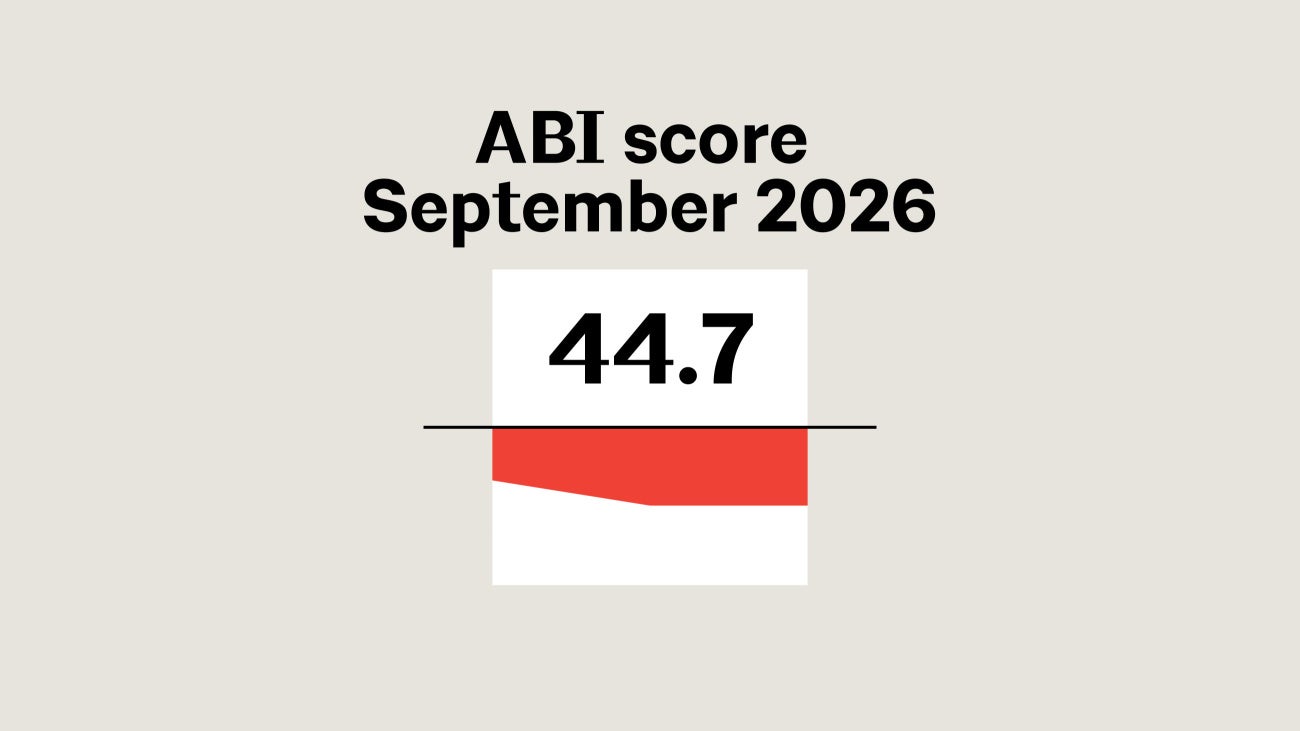
Architecture firm billings fell further in September, with the AIA/Deltek Architecture Billings Index dropping to 44.7 from 47.2 in August, according to data the American Institute of Architects released Wednesday, October 21. The September reading reflects the largest share of firms reporting declining billings since May (AIA).
The index is one of the industry's earliest signals for nonresidential work: the AIA says it predicts nonresidential construction activity roughly nine to twelve months ahead (AIA). A weaker September reading points to a thinner pipeline of projects reaching bid and groundbreaking through 2027.
What Happened
The AIA and Deltek published the September 2026 Architecture Billings Index on Wednesday. The headline score fell 2.5 points to 44.7, extending the soft conditions the AIA described a month earlier, when the August reading came in at 47.2 (AIA). Trade coverage the same day confirmed the decline and the underlying figures (Architectural Record; Residential Design).
Two forward looking measures in the release pulled in opposite directions. The project inquiries index rose modestly to 53.2, meaning more firms saw an increase in clients asking about new work. The design contracts index, which tracks the value of newly signed design agreements, fell to 43.7 (AIA). In practical terms, owners are still exploring projects but are slower to commit fees to them.
AIA Chief Economist Richard Branch described the conditions plainly: "This is an increasingly difficult environment for architecture firms" (AIA). He also said there is little reason to expect meaningful improvement in the near term (Residential Design).
What Is Confirmed
The September release includes the following figures, all reported by the AIA (AIA):
- National billings index: 44.7, down from 47.2 in August.
- Project inquiries: 53.2, a modest increase.
- Design contracts: 43.7, a decline.
- Regions: West 50.7, Midwest 50.6, South 43.1 and Northeast 39.1. The Northeast posted the weakest billings, the South continued to soften, and the Midwest and West were described as stable.
- Sectors: commercial/industrial 50.9, institutional 47.6, multifamily residential 42.9 and mixed practice 41.5. Commercial/industrial firms showed modest growth for a second straight month, while institutional and multifamily firms declined again.
- Backlog: the average firm backlog was 6.2 months at the end of the third quarter, down from 6.6 months at the end of the first quarter.
The AIA notes that its regional and sector scores are three month moving averages, so they may not average out to the national score. Backlog detail varied widely by firm type. Firms with annual billings of $5 million or more held steady at 8.1 months, and institutional firms held at 8.0 months. The smallest firms, with billings under $250,000, saw backlog rise from 3.1 to 3.8 months. Multifamily residential firms had the sharpest drop of any group, falling from 6.2 months in March to 4.8 months in September (AIA).
What It Means for Owners and Contractors
For the Northeast, the regional number is the one to note. A three month average of 39.1 is the weakest of the four regions by a wide margin, and it suggests fewer design packages moving toward bid in New York and neighboring states into next year. That fits with other signals this blog has tracked, including builder confidence falling to 29 in October and September housing starts falling 5.2 percent.
The sector split matters as much as the headline. Commercial/industrial is the only sector above 50, which lines up with the continued flow of manufacturing, data center and logistics projects. General contractors and subcontractors focused on industrial and commercial work have the most visible near term pipeline. Those who depend heavily on multifamily work face the clearest slowdown: a design backlog of 4.8 months for multifamily firms points to fewer apartment projects reaching construction in 2027.
The contrast between rising inquiries and falling contracts is worth watching for owners planning capital projects. Owners appear to be scoping work but delaying the commitment to full design. For owners who are ready to move, a softer design market can mean more attention from design teams and, later, more competitive bidding from contractors with open capacity.
Contractor backlog has so far held up better than architecture billings. Associated Builders and Contractors reported that contractor backlog rose to 8.7 months in September, led by data center work, and the Dodge Momentum Index rose 2.4 percent in September on institutional planning. The billings data suggest that strength is concentrated in a narrow set of project types rather than spread across the market.
What to Watch
- The October index, expected from the AIA in November, will show whether September was a low point or part of a longer slide.
- Design contracts versus inquiries. If inquiries keep rising, contracts typically follow. If inquiries roll over, the pipeline weakens further.
- Northeast conditions, where billings are weakest and where public and institutional funding may need to carry more of the load.
- Multifamily backlog, which has fallen fastest of any sector and is the clearest early warning for residential contractors.
Related Coverage
- Architecture Billings Have Now Contracted for 42 of the Last 43 Months: What That Means for the Construction Pipeline
- AIA Panel Cuts 2026 Nonresidential Outlook to -0.3%, Raises 2027 to 3.0%
- Contractor Backlog Rises to 8.7 Months in September as Data Centers Lead
- Dodge Momentum Index Rises 2.4% in September as Institutional Planning Leads
Image credit: American Institute of Architects (AIA). Image from the source article.
Sources
- AIA, "Architecture Billings Decline Further Amid Weak Market Conditions": https://www.aia.org/about-aia/press/architecture-billings-decline-further-amid-weak-market-conditions
- AIA, "Architecture firms continue to face soft business conditions": https://www.aia.org/about-aia/press/architecture-firms-continue-face-soft-business-conditions-0
- Architectural Record, "Architecture Billings Index Continues to Dip": https://www.architecturalrecord.com/articles/18483-architecture-billings-index-continues-to-dip
- Residential Design, "ABI September 2026: Architecture Billings Decline Further Amid Weak Market Conditions": https://residentialdesignmagazine.com/abi-september-2026-architecture-billings-decline-further


Let's connect
For organizations planning commercial, industrial, or infrastructure work, we will review the project and recommend the appropriate delivery approach.

Join our team
If you hold yourself to careful, accountable work, you already work the way we do.