

news +insights
Contractor Backlog Falls to 8.1 Months in October as Data Center Gap Widens
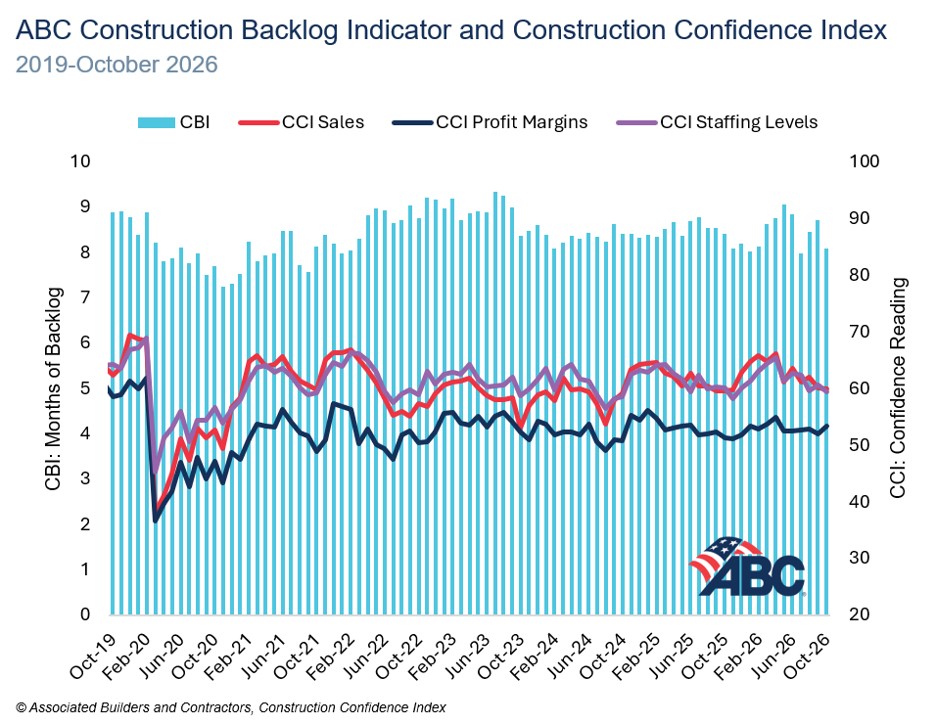
The ABC backlog indicator fell to 8.1 months in October 2026, down 0.6 months from September, as contractors without data center work saw their pipelines shrink while data center builders stayed booked nearly a year out, according to Associated Builders and Contractors (ABC).
What Happened
Associated Builders and Contractors released its Construction Backlog Indicator on Tuesday, Nov. 10, reporting an average of 8.1 months of backlog among member contractors in October. The reading was 0.6 months lower than September and 0.3 months lower than October 2025 (ABC). The survey behind the figures ran from Oct. 20 to Nov. 3 (ABC).
The drop ends a short run of gains. Backlog had climbed to 8.5 months in August and 8.7 months in September, as WCG reported in Contractor Backlog Rises to 8.7 Months in September as Data Centers Lead. Construction Dive described October as the month the growth streak was snapped (Construction Dive).
ABC Chief Economist Anirban Basu said, “Backlog fell sharply in October, returning to levels not consistently observed since last winter” (ABC). He attributed most of the decline to “worsening prospects for the 88% of contractors not under contract to work on data centers” (Construction Dive).
The Data Center Divide Gets Wider
The split between contractors with and without data center work is now the main story in the survey. About 88% of respondents are not under contract for data center work, and their average backlog fell from 8.3 months in September to 7.6 months in October (ABC). Contractors that do have data center work saw backlog rise from 11.3 months to 11.5 months, and ABC noted that most of those firms have annual revenue above $100 million (ABC).
That leaves a gap of roughly four months between the two groups, wider than the roughly three-month gap ABC reported in September. In practical terms, large firms with hyperscale and colocation contracts are committed well into 2027, while the majority of contractors are working through shorter pipelines and competing harder for the next job.
Where Backlog Fell and Where It Rose
- Infrastructure: backlog dropped from 9.4 months to 8.7 months, the lowest level since May 2025 (Construction Dive).
- Commercial and institutional: backlog fell to 8 months (Construction Dive).
- Heavy industrial: backlog rose to a 15-month high, the one major segment to improve (ABC).
ABC's text release does not give a numeric heavy industrial figure or regional breakdowns. Those details may appear in the tables and time series ABC posted with the release, and they are not confirmed here.
Confidence: Margins Up, Sales and Staffing Down
ABC's Construction Confidence Index moved in two directions. Expectations for profit margins improved in October, while expectations for sales and staffing levels declined. All three readings remain above 50, the threshold that indicates contractors expect growth over the next six months (ABC).
Basu called the margin improvement encouraging given recent increases in materials prices and borrowing costs, but noted that about 1 in 4 contractors still expect margins to shrink over the next six months (ABC). Construction Dive also reported weaker sales and staffing expectations alongside improved margin optimism (Construction Dive).
Implications for Owners, Developers, Contractors and Subs
For owners and developers planning commercial, institutional or infrastructure work outside the data center market, the October numbers point to a more favorable bidding climate. Contractors with shorter backlogs tend to sharpen pricing and offer more schedule flexibility to fill their calendars. Owners with funded projects may find this a good window to bid, while still expecting materials escalation to show up in contingencies.
For manufacturers and processors, the heavy industrial reading cuts the other way. Backlog in that segment is at a 15-month high, which suggests industrial contractors and the specialty trades that support plant work are getting busier. Plant expansions scheduled for 2027 may benefit from locking in a builder and long-lead equipment sooner rather than later.
For general contractors and subcontractors without data center exposure, falling backlog combined with lower staffing expectations signals caution on hiring. The labor picture is already soft: the October federal jobs report showed construction losing 3,000 jobs, as covered in October Jobs Report 2026: Construction Sheds 3,000 Jobs as Payrolls Rise 165,000. Firms that can qualify for data center packages, or for the industrial work that is growing, have the clearest path to steady volume.
What to Watch
- Whether November backlog stabilizes or continues to fall for contractors outside the data center market.
- Whether local opposition to data center projects, which voters expressed in several Nov. 3 ballot measures, starts to show up in data center backlog.
- Upcoming producer price and construction spending data, which will show whether the materials cost pressure Basu described is easing.
Bottom Line
The ABC backlog indicator dropped to 8.1 months in October, and nearly all of the decline came from the 88% of contractors without data center contracts. Heavy industrial work is the bright spot, infrastructure backlog is at its lowest since May 2025, and contractors are more upbeat on margins even as they expect weaker sales and staffing.
Key Questions
What was the ABC Construction Backlog Indicator in October 2026?
Associated Builders and Contractors reported that its Construction Backlog Indicator fell to 8.1 months in October 2026, down 0.6 months from September and 0.3 months from October 2025, based on a survey conducted Oct. 20 to Nov. 3 (ABC).
Why did construction backlog fall in October 2026?
ABC attributed the decline mainly to the 88% of contractors without data center contracts, whose backlog fell from 8.3 months to 7.6 months, while firms with data center work rose from 11.3 months to 11.5 months (Construction Dive).
Which construction sectors gained backlog in October 2026?
Heavy industrial backlog rose to a 15-month high in ABC's October 2026 survey, while infrastructure fell to 8.7 months, its lowest since May 2025 (ABC).
Do contractors expect profit margins to grow?
ABC's Construction Confidence Index showed improved profit margin expectations in October 2026, with all readings above 50, but about 1 in 4 contractors still expect margins to shrink over the next six months (ABC).
Related Coverage
- Contractor Backlog Rises to 8.7 Months in September as Data Centers Lead
- October Jobs Report 2026: Construction Sheds 3,000 Jobs as Payrolls Rise 165,000
- Skanska Q3 2026 Report: Record SEK 328 Billion Backlog Led by U.S. Data Centers
- Data Center Ballot Measures: Voters Back Limits in Nearly Every 2026 Local Vote
Image credit: Associated Builders and Contractors. Image from the source article.
Sources
- Associated Builders and Contractors, “ABC’s Construction Backlog Indicator Drops in October,” https://www.abc.org/News-Media/News-Releases/abcs-construction-backlog-indicator-drops-in-october
- Construction Dive, “Construction backlog growth streak snapped in October,” https://www.constructiondive.com/news/construction-backlog-decline-october-2026/874316/

Let's connect
For organizations planning commercial, industrial, or infrastructure work, we will review the project and recommend the appropriate delivery approach.

Join our team
If you hold yourself to careful, accountable work, you already work the way we do.