

news +insights
Update: Senate Passes Permitting Reform Bill 62-33, Sends It to the House
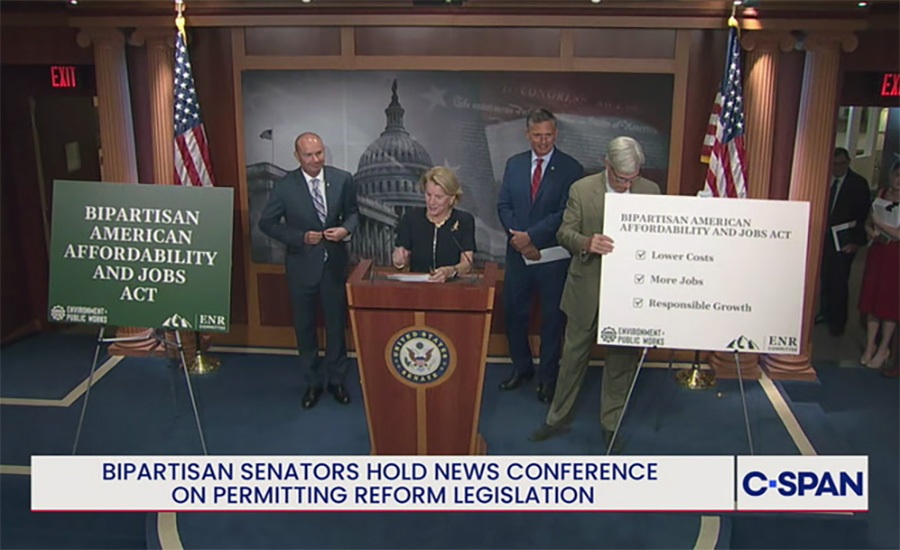
Update: The Senate permitting reform bill has passed. The U.S. Senate approved the Bipartisan American Affordability and Jobs Act of 2026 late on Thursday, November 19, by a 62-33 vote, sending the federal permitting overhaul to the House (ENR). The bill would shorten federal environmental reviews, set a 150-day deadline for many permitting lawsuits and make it harder for agencies to pull permits from projects that already hold federal approvals (ENR).
This is an update to WCG’s October coverage of the same legislation, Senate Permitting Bill Sets 150-Day Lawsuit Window and Permit Certainty Rules, which walked through the bill as introduced. What is new is the floor vote, the final Senate text and the path that remains in the House.
What Happened
The bill, S. 5653, was introduced on September 30 by the leaders of the Senate Environment and Public Works Committee and the Senate Energy and Natural Resources Committee (NACo). Its lead authors are Sens. Mike Lee of Utah, Shelley Moore Capito of West Virginia, Martin Heinrich of New Mexico and Sheldon Whitehouse of Rhode Island (ENR).
The final vote capped a month of floor action. The Senate voted 73-25 on November 9 to invoke cloture, voted 70-27 on November 16 to advance the bill again, and then passed it on November 19 (NACo). No amendments were adopted beyond the substitute amendment released by the authors on November 7 and approved during the earlier procedural vote (NACo).
The coalition narrowed on final passage. NPR reported that 14 Democrats and one independent joined most Republicans in support (NPR), and ENR reported that two Republicans voted against the bill (ENR). A dispute over a final package of revisions negotiated by the sponsors, covering historic preservation reviews, transmission-related eminent domain and possible exceptions to the data center ratepayer protections, kept those changes out of the Senate-passed text (ENR).
Capito called passage a major step toward addressing affordability concerns, and Senate Majority Leader John Thune said the bill would “cut through decades of red tape” (NPR).
What the Senate Bill Does
Review Deadlines
The bill builds on deadlines set by the Fiscal Responsibility Act of 2023 and generally keeps the one-year limit for environmental assessments and the two-year limit for environmental impact statements (ENR). Agencies would have 45 days after a final environmental impact statement to issue a record of decision, followed by 90 or 120 days for any remaining federal authorizations, depending on whether the agency took part in the review (ENR).
Litigation Limits
Many lawsuits challenging National Environmental Policy Act reviews would have to be filed within 150 days of the authorization, subject to conditions and exceptions (ENR). When a court finds a deficiency in a covered claim, it would generally send the authorization back to the agency to fix rather than vacate it or stop construction, and agencies would have no more than 180 days to correct the problem. Limited preliminary injunctions would still be possible (ENR).
Permit Certainty
Federal agencies would be restricted from revoking, suspending or materially changing certain permits for projects that already hold their required approvals, with exceptions for court orders, material permit violations, fraud and specified threats to health, safety or the environment (ENR). Project sponsors would gain legal avenues to challenge federal interference and could recover some litigation and delay costs (ENR).
What Counts as a Federal Action
Projects would no longer be treated as major federal actions solely because they receive federal grants or loans, and replacement of lifeline infrastructure such as public works, transportation facilities and waterworks would be exempted from that definition (NACo). The substitute amendment narrowed the grant exemption for transportation: U.S. Department of Transportation awards under $10 million would qualify, while TIFIA and RRIF loans, which finance large projects, would still require NEPA review (NACo).
Transmission, Water and Data Centers
The bill expands Federal Energy Regulatory Commission authority over qualifying interstate transmission lines of 230 kV or higher and addresses transmission planning and cost allocation (ENR). It sets new Clean Water Act certification procedures and extends certain federal water permit terms from five to 10 years (ENR). It would require data centers to cover the full cost of grid upgrades they trigger rather than passing those costs to other ratepayers (NACo), and it creates a Data Center Community Assistance Program at the Department of Energy that counties can use for technical help, without federal involvement in local siting or zoning (NACo).
Brownfields and Local Governments
The substitute amendment reauthorizes the EPA Brownfields program through fiscal 2031 at $200 million a year, doubles the cap on individual remediation grants from $500,000 to $1 million and raises multipurpose grants from $1 million to $2 million (NACo). The bill also codifies counties and other local governments as cooperating agencies in NEPA reviews (NACo).
Who Supports It and Who Opposes It
The Associated General Contractors of America and the American Council of Engineering Companies have backed the overhaul, and more than 300 solar and energy storage companies urged Congress to pass it (ENR). The National Association of Counties has urged the House to act quickly (NACo).
Opponents include the Sierra Club and the National Wildlife Federation, which argue the bill weakens environmental accountability (NPR). Several senators raised concerns about tribal consultation under historic preservation reviews, including Sen. Catherine Cortez Masto of Nevada, who voted no despite helping write several provisions (ENR). California Attorney General Rob Bonta led 17 state attorneys general in asking Senate leaders to delay the vote (ENR).
Where Things Stand
The bill now goes to the House, which must decide whether to take up the Senate package or pursue changes (ENR). The House passed its own NEPA bill, the SPEED Act, by a 221-196 vote in December 2025 (NACo), as WCG covered in House Passes SPEED Act to Accelerate Federal Infrastructure Project Permitting. Until the two chambers agree on one text and it is signed, current federal permitting rules remain in effect.
Implications for Owners, Developers, Contractors and Subs
- Less risk of a mid-construction shutdown. The 150-day filing window and the preference for sending flawed approvals back to agencies instead of halting work would reduce the chance that a permitting dispute stops a job after mobilization, though ENR notes the bill does not remove every ground for a court-ordered stoppage (ENR).
- Smaller grant-funded work could move faster. Local road, bridge and public works projects funded by federal transportation grants under $10 million could avoid NEPA review if the bill becomes law (NACo). That shortens the lead time between a grant award and a bid opening.
- More brownfield cleanup money. Larger brownfield grants would help municipalities and developers move contaminated industrial sites toward redevelopment, which matters in older manufacturing regions like upstate New York.
- Transmission and data center work. Expanded FERC authority and the data center cost provisions bear directly on the grid and data center pipeline, including projects such as AEP’s $37 billion transmission buildout.
- Schedules should not assume passage yet. Owners planning federally permitted work in 2027 should keep current review timelines in their schedules until a final law is signed.
What to Watch
- Whether the House takes up the Senate bill as passed or seeks a conference with the SPEED Act.
- Any renewed effort to add the sponsors’ unadopted revisions on historic preservation, eminent domain and data center cost protections (ENR).
- Agency guidance on how the new deadlines and litigation rules would apply to projects already under review.
Bottom Line
The Senate has passed a sweeping federal permitting overhaul, with review deadlines, a 150-day lawsuit window and new protections for issued permits. For builders, the payoff is more predictable schedules on federally permitted work, but nothing changes until the House acts and a final bill is signed.
Key Questions
Did the Senate pass the permitting reform bill?
Yes. The U.S. Senate passed the Bipartisan American Affordability and Jobs Act of 2026, S. 5653, on November 19, 2026, by a 62-33 vote, and the bill now goes to the House (NACo).
What does the Senate permitting reform bill change?
The Bipartisan American Affordability and Jobs Act sets deadlines for federal reviews and decisions, requires many NEPA lawsuits to be filed within 150 days and limits federal agencies from revoking permits for projects that already hold approvals (ENR).
Who voted for the Senate permitting bill?
Fourteen Democrats and one independent joined most Republicans in passing the Bipartisan American Affordability and Jobs Act 62-33 (NPR), and two Republicans voted against it (ENR).
What happens next with the permitting reform bill?
The House must decide whether to accept the Senate package or seek changes; it passed its own permitting bill, the SPEED Act, 221-196 in December 2025 (NACo). No House vote date has been announced.
Related Coverage
- Senate Permitting Bill Sets 150-Day Lawsuit Window and Permit Certainty Rules
- House Passes SPEED Act to Accelerate Federal Infrastructure Project Permitting
- AEP Transmission Projects: Jacobs, WSP Picked for $37B Grid Buildout
Image credit: C-SPAN, via ENR. Image from the source article.
Sources
- ENR, Senate Passes Permitting Reform Bill to Speed Infrastructure Construction, https://www.enr.com/articles/64380-senate-passes-permitting-reform-bill-to-speed-infrastructure-construction
- NPR, Senate passes bipartisan energy bill amid environmental concerns, https://www.npr.org/2026/11/20/g-s1-154579/senate-bipartisan-energy-bill
- National Association of Counties, U.S. Senate passes Bipartisan American Affordability and Jobs Act, https://www.naco.org/news/us-senate-passes-bipartisan-american-affordability-and-jobs-act


Let's connect
For organizations planning commercial, industrial, or infrastructure work, we will review the project and recommend the appropriate delivery approach.

Join our team
If you hold yourself to careful, accountable work, you already work the way we do.