

news +insights
Trimble Adds Drawing Review to Document Crunch AI Risk Platform
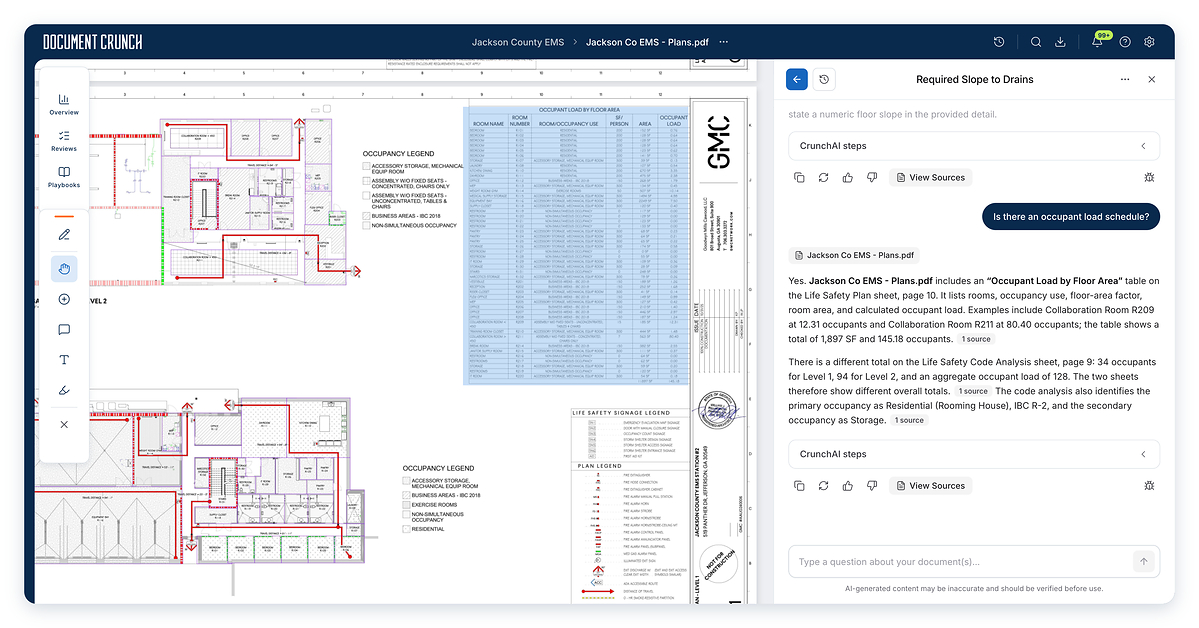
Trimble has expanded Document Crunch, its AI-powered construction risk platform, so contractors can review drawing sets alongside contracts, specifications and other project documents. The company said on Wednesday, October 21, that the new capability is designed to surface scope gaps, conflicting requirements and unclear responsibilities before work begins, and that it is available now to all Document Crunch users within their existing workflows (Trimble release).
What Happened
Document Crunch, which Trimble now owns, announced project-level risk intelligence for construction drawings, powered by its CrunchAI engine (Trimble release). Until now, the platform's reviews centered on contracts, specifications and other written project documents. Adding drawings matters because, as the release notes, scope-defining language such as notes and allowances is often spread across hundreds of sheets (Trimble release).
According to the release, CrunchAI extracts and indexes text from drawing sets, including notes, allowances and scope language spread across hundreds of sheets. Users can then ask questions through a chat interface that searches drawings, contracts and specifications together, and each answer comes with source-linked citations so the user can verify it (Trimble release). Trimble said the system combines proprietary pre- and post-processing with agentic optimization (Trimble release).
What It Is Meant to Catch
Trimble listed four main uses for the drawing review (Trimble release):
- Bid set quality: Checking sheet indexes, finding missing sheets or specification sections, and flagging discrepancies between disciplines early in preconstruction.
- Cross-document conflicts: Surfacing conflicting requirements, scope gaps and unclear responsibilities between drawings, specs and contract terms.
- Standardized review: Applying the same company checks to every drawing set and related document set.
- Stronger project start: Resolving scope questions before award to reduce preventable problems during execution.
Teams can collaborate on identified issues in a shared project environment, track resolution, and turn findings into repeatable reviews with assigned follow-up workflows (Trimble release).
An Early Field Example
Trimble included an example from Hill & Wilkinson. Kristen Ortiz, the contractor's vice president of project controls, said the tool caught additional requirements on a renovation project that the drawings alone did not show (Trimble release). Josh Levy, Document Crunch co-founder and Trimble's vice president of risk and compliance solutions, said significant risks emerge when information across documents does not line up (Trimble release).
That type of miss is familiar on renovation work, where requirements written into a specification or contract can carry demolition, cutting or patching that never appears on the sheets a trade prices from. When that happens, the cost tends to surface after award as a change order or a dispute.
Background: Trimble's Acquisition
Trimble agreed in April 2026 to acquire Document Crunch, an Atlanta-based startup founded in 2019 that uses AI to analyze construction contracts (Construction Dive). Financial terms were not disclosed, and the deal was expected to close in the second quarter (Construction Dive). At the time, Document Crunch said its software had been deployed on more than 10,000 projects, with customers including Balfour Beatty, Barton Malow and DPR Construction (Construction Dive). The tool already integrated with Trimble's ProjectSight software, and Trimble said Document Crunch would provide a "contractual rule set" for its Trimble Construction One suite (Construction Dive).
The deal was part of a broader run of construction software acquisitions in 2026. Construction Dive noted that Procore acquired Datagrid in January and Autodesk finalized its purchase of Rhumbix on March 31 (Construction Dive). Venture money is also flowing into the sector, as seen in ICON's $200 million raise earlier this month.
Where This Fits in Construction AI
Most of the AI tools now reaching contractors are aimed at narrow, document-heavy tasks where errors are costly but the work is tedious: contract review, specification checks, takeoff and safety. WCG has covered other examples, including Turner's decision to open its AI safety tool to the entire industry. The Trimble release keeps humans in the loop by attaching citations to every answer, which reflects how firms are adopting these tools: as a faster first pass that still requires a project manager or estimator to confirm the result.
Trimble did not disclose pricing for the new feature or say whether it carries an additional charge (Trimble release).
Implications for Owners, Developers, Contractors and Subs
- General contractors: Cross-checking drawings against contract terms before buyout is where scope gaps are cheapest to fix. Tools that make that review faster could tighten subcontract scopes and reduce change order exposure.
- Subcontractors: Trade partners are often the ones who absorb unclear scope. If GCs adopt automated cross-checks, subs should expect more detailed scope sheets and more pre-award questions, and can use the same type of review to qualify their own bids.
- Owners and developers: Fewer missed requirements at bid time can mean fewer change orders later. Owners may also see design teams receive more structured comments on bid set quality, such as missing sheets or conflicting notes.
- Estimators and project managers: Source-linked answers still need verification. Firms will need to decide who owns AI-flagged issues and how they are documented in bid clarifications.
What to Watch
- How Trimble integrates drawing review into Trimble Construction One and ProjectSight, as it indicated at the time of the acquisition (Construction Dive).
- Whether competing platforms add similar drawing-to-contract cross-checks.
- Field results from contractors beyond the Hill & Wilkinson example, particularly on large bid sets.
Bottom Line
Document Crunch's move from contracts into drawings targets one of the most persistent sources of disputes in construction: scope that is written in one document and missing from another. It is available now to existing users, and its value will depend on how well it holds up across real bid sets.
Related Coverage
- Turner Opens Its AI Safety Tool to the Entire Construction Industry, Free of Charge
- Icon Raises $200M to Start Producing Its Titan 3D Construction Printer
- AI in Construction: How Technology Supports Workers Instead of Replacing Them
Image credit: Trimble, via PR Newswire. Image from the source article.
Sources
- Trimble, via PR Newswire, "Trimble Expands Risk Intelligence Capabilities to Include Construction Drawings": https://www.prnewswire.com/news-releases/trimble-expands-risk-intelligence-capabilities-to-include-construction-drawings-302914759.html
- Construction Dive, "Trimble to acquire Document Crunch in latest contech M&A": https://www.constructiondive.com/news/trimble-acquire-document-crunch-contech/816630/


Let's connect
For organizations planning commercial, industrial, or infrastructure work, we will review the project and recommend the appropriate delivery approach.

Join our team
If you hold yourself to careful, accountable work, you already work the way we do.