
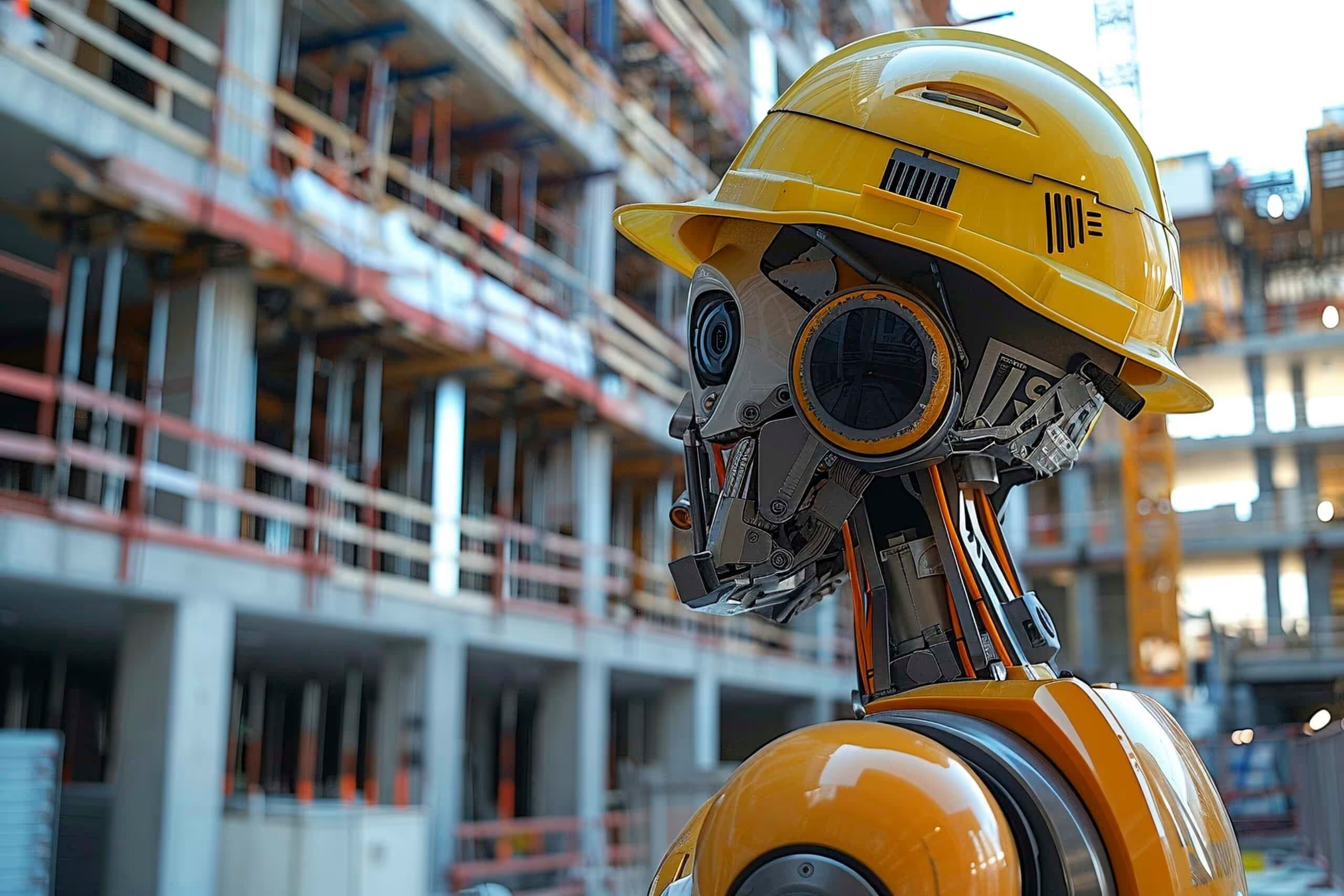
Construction Emerges as Rare Bright Spot in AI Adoption Discussion
While anxiety spreads across numerous industries about artificial intelligence replacing workers, the construction sector tells a strikingly different story. According to a December 2025 analysis by Forbes contributor Angelica Krystle Donati, construction is using AI as a tool to support human workers and address the industry's most pressing challenge: chronic labor shortages.
Only 6% of construction tasks can realistically be automated by AI, compared to nearly 50% of administrative and legal work, according to Goldman Sachs analysis cited in Forbes. This fundamental difference stems from the nature of construction work: it is physical, situational, and deeply reliant on human coordination, adaptability, and contextual awareness that current AI cannot replicate.
The Construction Workforce Crisis Driving AI Innovation
The construction industry faces an urgent labor challenge that AI is beginning to help address. Across the European Union, construction provides approximately 18 million direct jobs and contributes roughly 9% of the EU's GDP, according to the European Commission. Despite this economic significance, the EU projects a shortfall of more than 4 million workers by 2035.
The United Kingdom faces similar pressures. Industry data suggests the UK will need 250,000 additional construction workers by 2027, according to the Construction Industry Training Board (CITB). These shortages stem from demographic shifts, an aging workforce, and limited uptake of vocational training programs.
Here's where AI and automation are proving valuable: rather than replacing workers, these technologies are helping close the labor gap by reducing administrative burden and enabling skilled professionals to focus on higher-value work.
Real-World AI Applications Improving Construction Productivity
Smart scheduling tools and predictive analytics powered by AI are reducing administrative tasks and streamlining resource management on job sites. AI-powered safety systems flag risks in real time, allowing site managers and workers to address hazards before accidents occur.
In prefabrication and modular construction, robotics and computer vision enhance precision and speed—all while maintaining the critical role of skilled human oversight. This hybrid approach combines technological efficiency with human expertise to improve quality and reduce errors.
Strong Financial Results Drive AI Investment
Construction firms are seeing measurable benefits from AI adoption. In a 2025 global survey of construction and engineering executives, the data is compelling:
- 89% of respondents said AI adoption improved profitability
- Operational efficiency improved by 44%
- Supply cost reduction of 42%
- Lower project expenditure by 36%
- 91% of respondents planned to increase AI investment in 2025
These results indicate that construction companies are experiencing tangible ROI from AI implementation across their operations.
Europe and the UK Launch Major AI and Skills Initiatives
Policymakers are taking note of AI's potential in construction and investing accordingly. Earlier in 2025, the European Commission launched its Apply AI Strategy and AI in Science Strategy, mobilizing around €1 billion to accelerate responsible AI adoption across strategic industries, including construction.
These initiatives build on the AI Continent Action Plan (launched April 2025) and align with the Competitiveness Compass, which emphasizes that "digitalisation and diffusion of advanced technologies across the European economy are the second necessary ingredient to lift Europe's productivity growth."
Within these frameworks, construction is identified as a priority sector for AI deployment alongside manufacturing, energy, and mobility. Targeted support is directed at small and medium-sized firms to help them integrate AI-enabled tools for design optimization, procurement, energy efficiency, and safety monitoring.
Specific initiatives include:
- Transition Pathway for Construction - EU-backed framework for industry transformation
- Horizon Europe projects (InCUBE and DigiBUILD) - embedding digitalization into renovation, lifecycle-management, and sustainability workflows
Massive Upskilling and Workforce Development Programs
The EU and UK are launching substantial training initiatives to prepare the workforce for AI-enabled construction environments. The EU's Pact for Skills in Construction—a large-scale partnership between industry federations, trade unions, and training providers—aims to upskill and reskill three million workers by 2030.
The Pact's ambitious targets include:
- Retraining 30% of the workforce each year
- Building mobility pathways across borders for skilled workers
- Attracting more young people and women into construction careers
The United Kingdom is pursuing a parallel approach under the government's "Plan for Change." The UK will invest £600 million to train 60,000 new construction workers by 2029. This comprehensive initiative includes:
- 10 new Technical Excellence Colleges
- Expanded Skills Bootcamps and foundation apprenticeships
- 40,000+ industry placements per year
- Doubled New Entrant Support Team at the CITB to help SMEs recruit and retain apprentices
What This Means for Construction Contractors
For contractors and construction firms, the message is clear: AI adoption is not a threat to employment but rather a tool to enhance productivity and address labor shortages. Contractors who invest in AI-enabled systems for scheduling, safety, and resource management are positioning themselves for improved profitability and operational efficiency.
The emphasis on workforce training and development creates opportunities for contractors to develop skilled teams capable of working effectively with AI-enhanced systems. Building in-house expertise with new technology tools will become a competitive advantage.
The Construction Difference
Construction stands apart from other industries in its approach to AI adoption. Rather than viewing technology as a replacement strategy, the industry is leveraging AI to support human workers, address critical labor shortages, and improve safety and efficiency on job sites.
As Forbes reports: "While many industries are bracing for disruption, construction is using AI to support, not replace, its workforce, making the sector a rare source of optimism at a time of increased automation anxiety."
The measure of progress in construction, then, isn't what AI can do alone—it's what people can accomplish with AI as a tool. That human-centered approach to technology adoption is why construction is leading the way.
Sources
Forbes - "In An Age Of AI Anxiety, Construction Stands Apart From The Rest," by Angelica Krystle Donati, Contributor. Published December 1, 2025, 04:26 AM EST, forbes.com
This article draws on analysis from Goldman Sachs regarding construction automation potential, European Commission data on construction workforce, Construction Industry Training Board statistics, and 2025 global construction industry survey data cited in Forbes reporting.


Discuss an Upcoming Project


