

news +insights
How to Pass a Lead Clearance Test: 2026 Limits, Checklist and Cheat Sheet

A lead clearance test is passed or failed on microscopic amounts of dust. Since January 12, 2026, a wipe sample fails at 5 micrograms of lead per square foot (µg/ft²) on floors, 40 µg/ft² on interior window sills and 100 µg/ft² in window troughs (EPA). Passing comes down to a predictable sequence: find and stabilize every deteriorated painted surface, contain the dust, clean with a HEPA vacuum and a wet wash, keep air and feet from stirring anything back up, and let the area sit closed before the wipes are taken.
This guide is written to work anywhere in the United States. The federal rules from EPA and HUD set the baseline everywhere; states and cities can add to them, so the last section explains how to check for local rules, with Rochester and New York State as examples.
Lead Clearance Cheat Sheet
The limits (fail at or above):
- Floors, including carpet: 5 µg/ft² (was 10)
- Interior window sills: 40 µg/ft² (was 100)
- Window troughs: 100 µg/ft² (was 400)
How small that is: a penny weighs 2.5 grams. Cut a penny's weight of lead dust into 500,000 equal pieces, put one piece on one square foot of floor, and that floor fails.
The 10-step sequence:
- Walk every room and list all deteriorated paint: peeling, chipping, cracking, chalking and worn friction or impact surfaces.
- Contain the work area: close windows and doors, plastic over doorways, tape plastic over ducts, cover floors.
- Shut down anything that moves air: window fans, box fans, ceiling fans and forced-air heating or cooling.
- Mist and wet scrape every deteriorated surface. Never dry scrape, dry sand, burn or use a high-heat gun.
- Prime and repaint, or apply a lead encapsulating coating where the surface is sound and not a friction surface.
- Fix friction and impact points (window sashes, troughs, door edges, stair treads) so paint is not ground into dust.
- HEPA vacuum everything, top down, including window troughs and sills.
- Wet wash with D-Lead or a comparable lead-specific detergent, using fresh cloths and separate rinse water.
- Walk it yourself: no visible dust, chips or residue anywhere, especially troughs.
- Keep it closed and empty for at least one hour, then call the examiner.
Never: dry sweep, use a shop vac or household vacuum, open windows, run an uncleaned fan, or let anyone walk in with street shoes after cleaning.
Windows: if every window is vinyl or has tested free of lead paint, ask your examiner whether window wipes are still required. Floor wipes are always taken.
The Limits, Charted
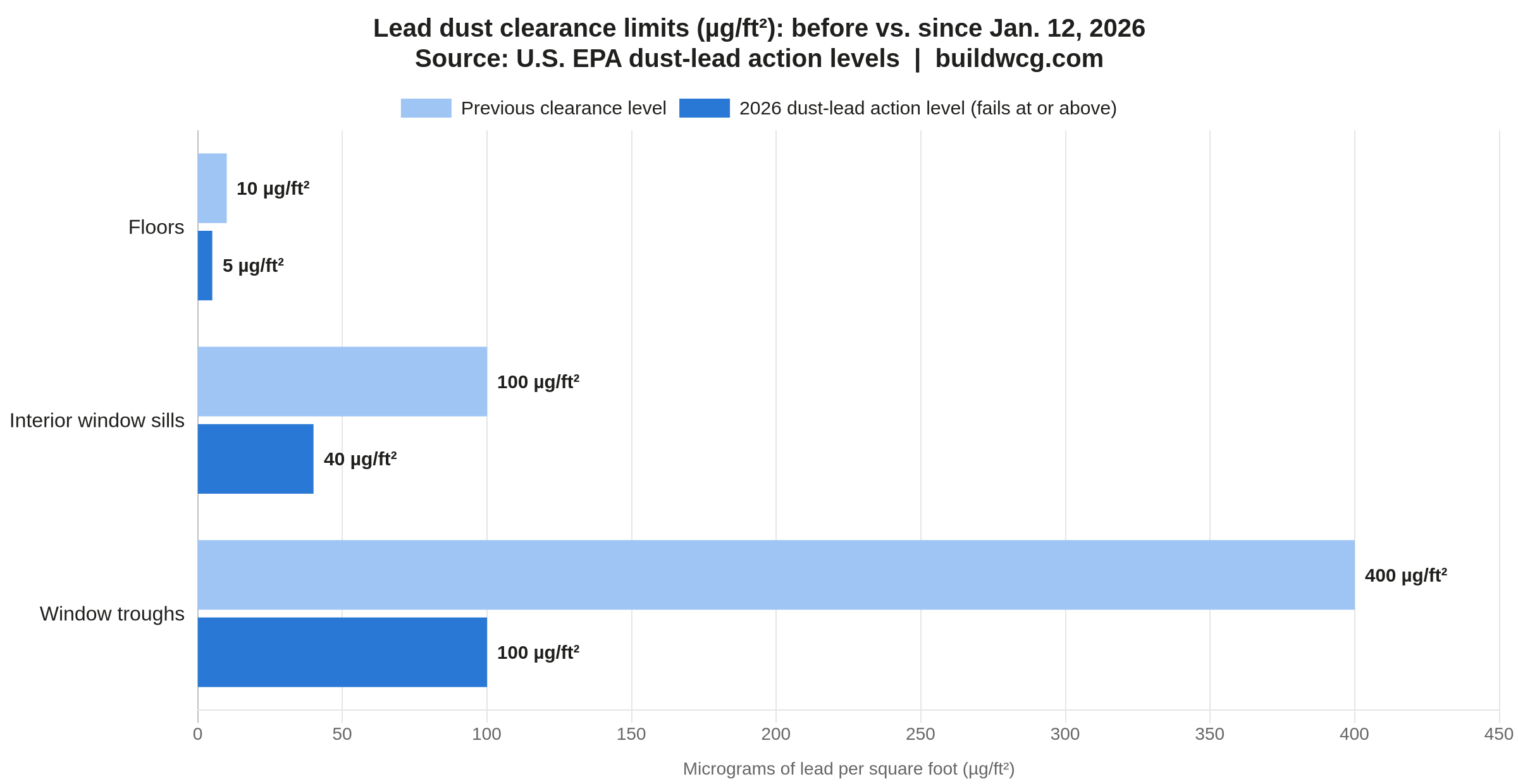
EPA's final rule, published November 12, 2024, replaced the old post-abatement clearance levels with "dust-lead action levels" of 5, 40 and 100 µg/ft² for floors, sills and troughs, cuts of 50 percent or more from the previous 10, 100 and 400 (Federal Register). The rule took effect January 13, 2025, and the new levels became enforceable January 12, 2026 (InspectionRE; EPA). A result at or above the level fails (24 CFR 35.1340). HUD requires dust standards at least as protective as EPA's, and EPA noted that HUD's Lead Safe Housing Rule cross-references the new levels, so they apply to federally assisted housing as well (24 CFR Part 35, Subpart R; Federal Register).
EPA also set a separate "dust-lead reportable level" of any amount a recognized lab can report, so a sample can show some lead and still pass clearance (Federal Register; InspectionRE). Passing does not mean a home has no lead exposure at all (Federal Register).
How Much Lead Is That? The Penny Test
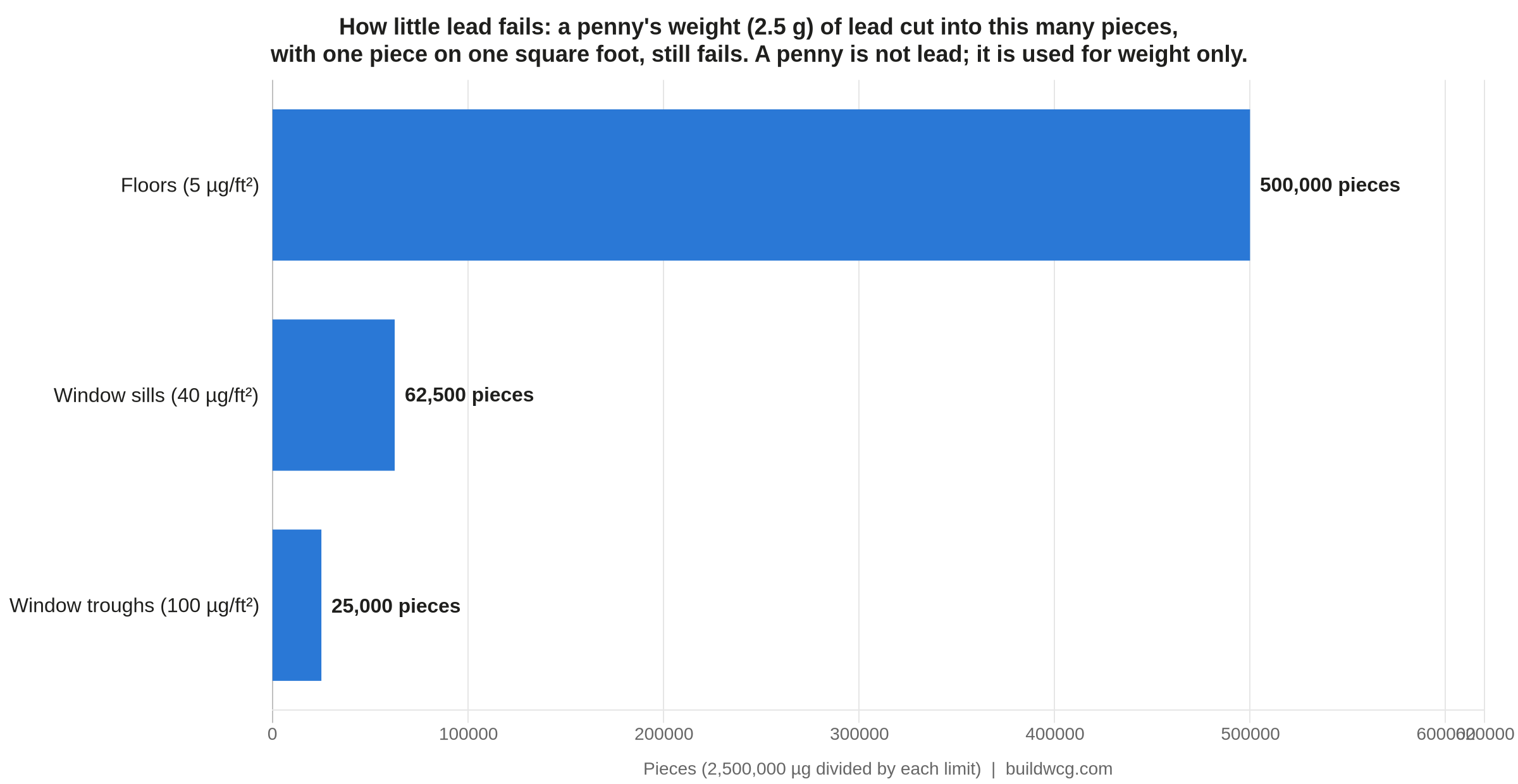
A microgram is one millionth of a gram, which makes the limits hard to picture. A current U.S. penny weighs 2.5 grams (U.S. cent specifications), or 2,500,000 micrograms. The penny itself is copper-plated zinc and contains no lead (U.S. cent specifications); it is used here only as a familiar weight. Divide that weight by each limit:
- Floors (5 µg/ft²): cut a penny's weight of lead into 500,000 pieces. One piece on one square foot of floor fails. Put another way, one penny's weight of lead spread evenly over about 11.5 acres of floor would still fail.
- Window sills (40 µg/ft²): 62,500 pieces, one per square foot, fails.
- Window troughs (100 µg/ft²): 25,000 pieces, one per square foot, fails.
For a 2,000 square foot home, the floor limit works out to 10,000 micrograms across every square foot of floor combined, or one 250th of a penny's weight. Results are reported per square foot, so a smaller wipe area such as a sill is scaled up, and a little dust on a small surface counts for a lot. That is why a quick sweep does not pass and why troughs, which collect dust from the sash rubbing above them, fail so often.
What a Clearance Test Includes
Under HUD's Lead Safe Housing Rule, clearance has four parts: a visual assessment, dust wipe sampling, analysis by an EPA-recognized lab and a written report (24 CFR 35.1340). The examiner first looks for deteriorated paint and for visible dust, debris, residue or paint chips, and those conditions must be fixed before sampling continues (24 CFR 35.1340). Wipes are then taken from floors and, where practicable, interior window sills and troughs (24 CFR 35.1340).
Clearance is performed by a certified risk assessor or lead inspector, or a trained sampling technician working under one, and after abatement only a certified risk assessor or inspector may do it (24 CFR 35.1340). The examiner must be independent of the crew that did the work (24 CFR 35.1340). This is different from the contractor self-check under EPA's Renovation, Repair and Painting (RRP) Rule, called cleaning verification, where a disposable cloth is compared with an EPA card (JLC; 40 CFR 745.83). Lab-analyzed clearance applies to abatement, HUD-assisted housing and local programs that require it (24 CFR 35.1340; Rochester City Code).
Step by Step: How to Pass the First Time
1. Do a full visual check before any work
Walk every room, hallway, stairwell and porch in the area that will be cleared. List every painted surface that is peeling, chipping, cracking or chalking; HUD counts chalking as deteriorated paint, while nail holes and hairline cracks do not count (HUD Guidelines, Ch. 15). Pay close attention to friction and impact surfaces such as window sashes and troughs, door edges, stair treads and cabinet hinge sides, where paint is ground into dust (InspectionRE). Any deteriorated paint left in place fails the examiner's visual assessment before a single wipe is taken (24 CFR 35.1340).
2. Contain the dust and stop the air from moving
EPA's RRP work practices call for closing windows and doors in the work area, covering doorways with plastic, taping plastic over duct openings and covering the floor at least six feet beyond the work (EPA RRP work practices, via CICA). In practice, also shut off forced-air heating and cooling and every window, box and ceiling fan while you work and clean. A fan that ran during demolition is coated with dust and will blow it back onto the sills and floor you just cleaned. Clean or remove fans, and keep windows shut through the clearance visit.
3. Wet scrape and repaint every deteriorated surface
Mist the surface and remove loose paint by wet scraping (HUD Guidelines, Ch. 13). Open flame burning, heat guns above 1,100°F and high-speed sanding or grinding without a shroud and HEPA attachment are prohibited under the RRP Rule (EPA RRP work practices, via CICA), and local codes such as Rochester's also bar most dry sanding and dry scraping (Rochester City Code). Wet sanding is acceptable for deglossing; dry sanding is not (HUD Guidelines, Ch. 13). Then prime and repaint. Rochester's code describes this as paint stabilization: repairing the cause of the deterioration, removing loose paint and applying a new protective coating (Rochester City Code).
Using a lead encapsulating paint. An encapsulant is a coating built to seal lead paint in place, and HUD accepts it as an abatement method when the product is warranted for at least 20 years, is applied according to the manufacturer, passes a patch test and is monitored afterward (HUD Guidelines, Ch. 13). It only works on the right surfaces. HUD says encapsulants should not be used on friction surfaces such as window and door jambs, on rotted or otherwise unsound components, on severely deteriorated paint or on surfaces with uncorrected moisture problems (HUD Guidelines, Ch. 13). Clean the surface first, since encapsulants should not go over dirt, chalk, grease or mildew (HUD Guidelines, Ch. 13). For friction surfaces, fix the rubbing itself by adjusting, replacing or enclosing the component.
4. Fix the surfaces so they can be cleaned
Rough, worn or porous floors, sills and troughs hold dust that wiping will not remove, and HUD lists surfaces that are not smooth and cleanable as a common cause of failure (HUD Guidelines, Ch. 15). Paint or seal bare wood sills and troughs, and if a sealant is applied to bare horizontal surfaces, take wipe samples after it is applied (HUD Guidelines, Ch. 15).
5. HEPA vacuum, then wet wash
- Use a true HEPA vacuum. Federal rules define it as a vacuum with a HEPA filter as the last stage, capturing 0.3-micron particles at 99.97 percent efficiency, with no air leaking past the filter (40 CFR 745.83). Shop vacuums and household vacuums without that design blow fine lead dust back into the room.
- Work top down. Clean walls from ceiling to floor, then HEPA vacuum all remaining surfaces and objects (EPA RRP work practices, via CICA). Use a crevice tool in window troughs and along baseboards.
- Wet wash. Wipe surfaces with a damp cloth and mop hard floors so wash and rinse water stay separate (EPA RRP work practices, via CICA). Rochester's code calls for lead-specific detergents or an equivalent (Rochester City Code); products such as D-Lead are made for this, and EPA guidance also allows an all-purpose cleaner with a damp cloth or sponge (EPA). Change cloths and mop water often so you are not spreading dust around.
- Many crews finish with a second HEPA pass once surfaces are dry, which picks up anything the wet wash loosened.
- Clean what comes back in. HEPA vacuum furniture and other items before returning them, since lead dust can be reintroduced (EPA).
6. Keep it clean until the wipes are taken
- No dry sweeping, no brooms, no leaf blowers and no compressed air.
- No open windows and no fans running.
- Keep people out. HUD recommends disposable booties for examiners and visitors, since dust tracked in from work areas, soil or porches means the area has to be cleaned again (HUD Guidelines, Ch. 15).
7. Do your own check, then wait an hour
HUD suggests a supervisor walk-through before calling the examiner, and visible dust on a sill, trough or floor is enough to fail (HUD Guidelines, Ch. 15). Under RRP practice, a disposable wet cloth wiped over floors and sills, a new one for each 40 square feet, gives a quick self-check (EPA RRP work practices, via CICA). Then leave the area closed for at least one hour after final cleaning before samples are taken (HUD Guidelines, Ch. 15; Federal Register).
Do Window Troughs Need to Be Tested?
Federal clearance rules call for floor wipes plus interior sill and trough wipes "where practicable" (24 CFR 35.1340). Local programs can be narrower. Rochester's code, for example, requires window wipes from sills or troughs "with a paint history," with at least one window wipe from a sill or trough with a paint history where one exists (Rochester City Code). The logic follows: if every window in the area is vinyl or another unpainted material, or has been tested and shown to have no lead-based paint, there may be no painted trough to sample under a rule like Rochester's. Floors are always sampled. Because requirements differ by program, confirm with the examiner before the test rather than assuming a window can be skipped, and clean every trough anyway, since replacement windows still collect dust from the work around them.
If a Sample Fails
A failed sample fails the area it represents, and every surface represented by that sample must be recleaned or treated and retested until it passes (24 CFR 35.1340). HUD notes that additional hazard control, not just more cleaning, is sometimes needed (HUD Guidelines, Ch. 15). Check which surface failed: a failing trough usually points to a sash that is still rubbing paint into dust, and a failing floor often points to tracked-in dust or a surface that is not smooth enough to clean.
Check Your Local Rules
The federal levels above apply nationwide, but states and cities can set additional requirements, licensing and inspection schedules. Two examples from New York:
- Rochester: Pre-1980 homes are presumed to contain lead paint. In the city's Lead Paint High-Risk Area, owners must arrange dust wipe sampling when no interior deteriorated paint violation is found, with wipes from floors and window sills or troughs in up to four rooms, including a bedroom and the living room (Rochester City Code). Results must be below the federal clearance levels in 40 CFR 745.227(e)(8), which EPA's 2024 rule updated, open porch floors must test below 40 µg/ft², and passing results are good for three years (Rochester City Code; Federal Register).
- New York State: The Lead Rental Registry requires owners of pre-1980 rentals with two or more units in 25 high-risk communities, including Buffalo, Jamestown, Niagara Falls, Cheektowaga, Utica and Rome, to register, pass a lead inspection and recertify every three years (Oneida County; Colligan Law). Sources list the start date as November 3 or December 3, 2025 (Oneida County; Colligan Law).
Elsewhere, start with your state's lead program and your city's housing or code enforcement office. If your project uses HUD funding, including CDBG or disaster recovery dollars, HUD's Lead Safe Housing Rule applies (24 CFR Part 35, Subpart R).
Bottom Line
At 5, 40 and 100 µg/ft², a fraction of a penny's weight of lead spread across a home is enough to fail. Units pass when every deteriorated surface is wet scraped and repainted or properly encapsulated, friction points are fixed, dust is contained, air movement is shut down, cleaning is done with a true HEPA vacuum and a lead-specific or all-purpose wet wash, and the area stays closed until the wipes are taken. Lead work in older buildings is part of the region's broader construction picture, from Western New York's lead service line replacement program to rehab-heavy affordable housing such as True North Apartments in Rochester.
Related Coverage
- Erie County Water Authority's $320 Million Lead Pipe Replacement Is One of Western New York's Largest Active Infrastructure Programs
- True North Apartments Opens: $39M Affordable Housing and Wellness Clinic in Northeast Rochester
- St. Petersburg Approves $40.85M in Disaster Recovery Funds for Six Housing Projects
- East Buffalo's $126 Million Towne Gardens Rehabilitation Signals a Turning Point for the East Side
Image credit: Cover photo by Max Dery on Unsplash (free license). Charts by Westside Construction Group from EPA dust-lead action levels.
Sources
- U.S. EPA, "Supplement for Protect Your Family From Lead in Your Home pamphlet (2026)": https://www.epa.gov/system/files/documents/2026-02/protectyourfamily_pamphletsupplement_2026_0.pdf
- Federal Register, "Reconsideration of the Dust-Lead Hazard Standards and Dust-Lead Post-Abatement Clearance Levels": https://www.federalregister.gov/documents/2024/11/12/2024-25070/reconsideration-of-the-dust-lead-hazard-standards-and-dust-lead-post-abatement-clearance-levels
- eCFR, "24 CFR 35.1340, Clearance": https://www.ecfr.gov/current/title-24/subtitle-A/part-35/subpart-R/section-35.1340
- eCFR, "24 CFR Part 35, Subpart R, Methods and Standards for Lead-Paint Hazard Evaluation and Hazard Reduction Activities": https://www.ecfr.gov/current/title-24/subtitle-A/part-35/subpart-R
- eCFR, "40 CFR 745.83, Definitions (HEPA vacuum, cleaning verification card)": https://www.ecfr.gov/current/title-40/chapter-I/subchapter-R/part-745/subpart-E/section-745.83
- U.S. HUD, "Guidelines for the Evaluation and Control of Lead-Based Paint Hazards in Housing, Chapter 15: Clearance": https://www.hud.gov/sites/documents/ch15_clearance_121212.pdf
- U.S. HUD, "Guidelines for the Evaluation and Control of Lead-Based Paint Hazards in Housing, Chapter 13: Encapsulation and Enclosure": https://www.hud.gov/sites/dfiles/HH/documents/Ch13.pdf
- CICA (Construction Industry Compliance Assistance), "RRP Work Practices": https://cicacenter.org/rrp_work_practices.php
- City of Rochester (eCode360), "Article III: Lead-Based Paint Poisoning Prevention": https://ecode360.com/8677786
- InspectionRE, "EPA Dust-Lead Standards 2026: What Changed": https://inspectionre.com/blog/epa-dust-lead-standards-2026-clearance-levels/
- JLC, "Builders Breathe a Sigh of Relief as EPA Abandons Lead Clearance Requirement": https://www.jlconline.com/how-to/jlc-report-builders-breathe-a-sigh-of-relief-as-epa-abandons-lead-clearance-requirement_o/
- Wikipedia, "Penny (United States coin)": https://en.wikipedia.org/wiki/Penny_(United_States_coin)
- Oneida County, "New York State Lead Rental Registry Law Now in Effect": https://oneidacountyny.gov/news/new-york-state-lead-rental-registry-law-now-in-effect/
- Colligan Law, "New Lead Rental Registry Requirements for Some NYS Landlords": https://insights.colliganlaw.com/post/102lx1c/new-lead-rental-registry-requirements-for-some-nys-landlords



Let's connect
For organizations planning commercial, industrial, or infrastructure work, we will review the project and recommend the appropriate delivery approach.

Join our team
If you hold yourself to careful, accountable work, you already work the way we do.