
news +insights
Tampa Bay Apartment Owners Face Refinancing Gap as Boom-Era Loans Mature
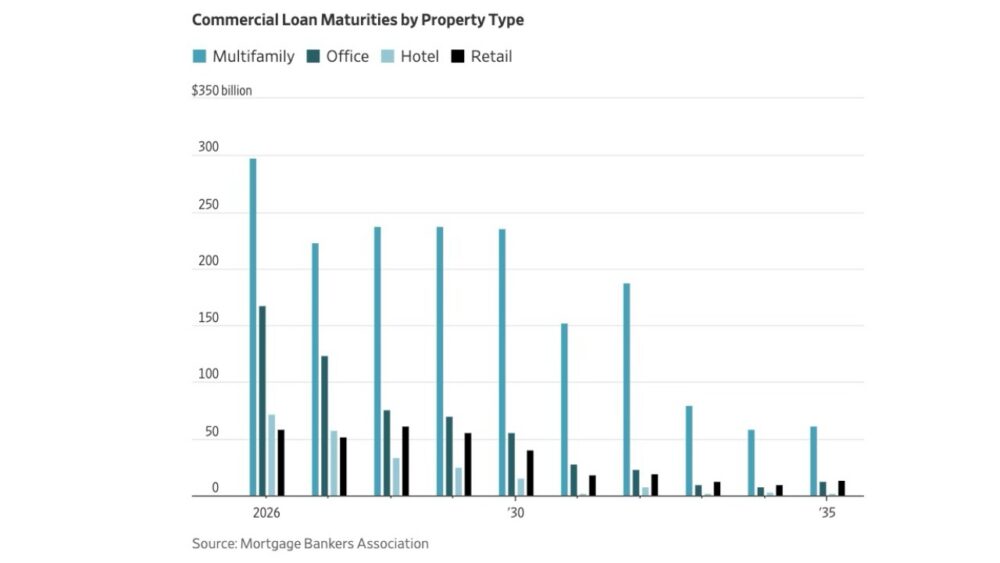
Tampa Bay apartment owners who bought during the 2021 and 2022 boom are running into a refinancing gap as their loans mature at much higher interest rates, according to Tampa Bay Business and Wealth. Local investors describe owners adding new equity, bringing in partners or selling at a loss, as nearly $300 billion in U.S. multifamily loans come due in 2026.
What Happened
In an October 12 report, Tampa Bay Business and Wealth laid out the math facing owners. A property that could support about $15 million of debt when rates were near 3.5% might qualify for only about $10 million when refinanced near 7% today, leaving roughly $5 million to be covered through new equity, new capital or a sale Tampa Bay Business and Wealth.
Matt Chadwick, head of acquisitions at Tampa-based Ally Capital Group, said owners are increasingly facing that gap as loans from the region's apartment boom mature. Tony DeSisto, president of Tampa-based Franklin Street, said some owners cannot refinance because their properties no longer produce enough income or value to replace the existing debt, and some must add money to refinance Tampa Bay Business and Wealth.
How the Market Got Here
In 2021 and 2022, rents and values were rising and debt was cheap, which made purchases work even with thin cash flow. Tampa Bay then added thousands of apartments, rent growth slowed, and five-year loans from that period began to mature Tampa Bay Business and Wealth.
- Local fundamentals: Citing Cushman and Wakefield data, TBBW reports that first-quarter 2026 multifamily occupancy in the region fell to 91%, its lowest in a decade, and effective rents fell 4.9% year over year to $1,806. About 8,908 apartments were still under construction Tampa Bay Business and Wealth.
- National maturities: The Mortgage Bankers Association reports that 17%, or $875 billion, of the $5.0 trillion in outstanding commercial mortgages is scheduled to mature in 2026, down 9% from the $957 billion scheduled for 2025 MBA NewsLink. TBBW, citing MBA, puts the multifamily share at nearly $300 billion in 2026, within about $757 billion maturing through 2028 Tampa Bay Business and Wealth.
- Values and distress: TBBW cites Wall Street Journal reporting that national apartment values are down more than 20% from their 2022 peak, and MSCI data showing distressed sales at 4.7% of U.S. multifamily transactions in the second quarter of 2026, up from 1.5% a year earlier Tampa Bay Business and Wealth.
A Local Example
Edge at 1702, a 259-unit complex at 1702 W. Cleveland Street in South Tampa built in 2015 and 2016, sold for $70 million in September. It had sold for $83 million in 2024 and $115 million in 2022, a $45 million drop from the peak. The buyer, an entity the report ties to New York Life Insurance Co., assumed about $45.5 million of existing debt from a loan that originated at roughly $47.6 million in 2024 Tampa Bay Business and Wealth.
Owner Options
Owners who run out of extensions have a short list of choices: inject more equity, bring in another investor, take on more expensive private capital or sell. DeSisto said owners typically hold unless forced to sell, since selling at today's values means accepting a loss. Chadwick said extensions bought time but also left owners uncertain about whether to keep investing, and that some are selling at losses while others recapitalize. He described the repricing as painful but healthy and expects the gap between buyers and sellers to narrow Tampa Bay Business and Wealth. DeSisto added that the market needs certainty more than lower rates, and that activity can recover once participants adjust to a stable, if higher, rate environment.
Implications for Owners, Developers, Contractors and Subs
- New multifamily starts: When existing assets trade well below their 2022 values, it is harder to justify new construction at today's costs. Developers will need lower land basis, cheaper capital or stronger rent assumptions to pencil new projects.
- Capital improvement budgets: Owners putting new equity into a refinance often defer discretionary renovation and amenity work. Contractors focused on multifamily repositioning may see more scrutiny of scope and longer decision cycles.
- New owners, new work: Properties that change hands at a reset basis often come with a renovation plan. Buyers acquiring at lower prices may have room in their budgets for unit upgrades, envelope work and systems replacement.
- Credit risk in the supply chain: Contractors and subcontractors working for owners under refinancing pressure should pay close attention to payment terms, lien rights and project funding.
- Other property types: TBBW notes Ally largely avoided multifamily during the boom and instead bought office properties at steep discounts to replacement cost, including a recapitalization of Rivergate Tower in downtown Tampa with about $8 million committed to improvements Tampa Bay Business and Wealth.
What to Watch
- Further Tampa Bay apartment sales below prior trade prices.
- Occupancy and rent trends as the remaining units under construction deliver.
- Movement in long-term interest rates, which sets refinancing proceeds.
Bottom Line
The Tampa Bay apartment market is working through loans written at boom-era prices and low rates. Owners are covering the refinancing gap with new equity or selling at a loss, and until values and rates settle, that reset will weigh on new multifamily construction while creating renovation opportunities for buyers who acquire at lower prices.
Image credit: Tampa Bay Business and Wealth (data: Mortgage Bankers Association). Image from the source article.
Sources
- Tampa Bay Business and Wealth, "Higher Rates Squeeze Tampa Bay Apartment Owners": https://tbbwmag.com/2026/10/12/tampa-bay-apartment-refinancing/
- Tampa Bay Business and Wealth, "South Tampa Apartment Complex Sells for $70 Million": https://tbbwmag.com/2026/09/02/edge-at-1702-sale/
- MBA NewsLink, "MBA: 17% of Commercial and Multifamily Mortgage Balances to Mature in 2026": https://newslink.mba.org/mba-tag/commercial-and-multifamily-balances/

Let's connect
For organizations planning commercial, industrial, or infrastructure work, we will review the project and recommend the appropriate delivery approach.

Join our team
If you hold yourself to careful, accountable work, you already work the way we do.