
America's Semiconductor Construction Boom: The Biggest Fab Projects Reshaping U.S. Manufacturing
The United States has not seen a domestic manufacturing construction surge like this in decades. Driven by the CHIPS and Science Act of 2022, intensifying geopolitical pressure, and soaring demand from artificial intelligence hardware, the country is in the middle of a historic buildout of semiconductor fabrication plants—commonly called fabs. The projects are massive, technically complex, and creating substantial demand for construction labor, specialized contractors, and industrial supply chains nationwide.
The Scale of the Pipeline
According to SEMI's World Fab Forecast, 18 new semiconductor fabrication plants were slated to begin construction in 2025 alone, contributing to a projected total of 97 new high-volume fabs launched between 2023 and 2025. Most of these facilities are 300mm wafer fabs—the industry's most advanced and expensive facility type—and the majority are expected to enter production between 2026 and 2027. The semiconductor plant construction market is projected to reach $58.82 billion by 2030, according to research published on Yahoo Finance.
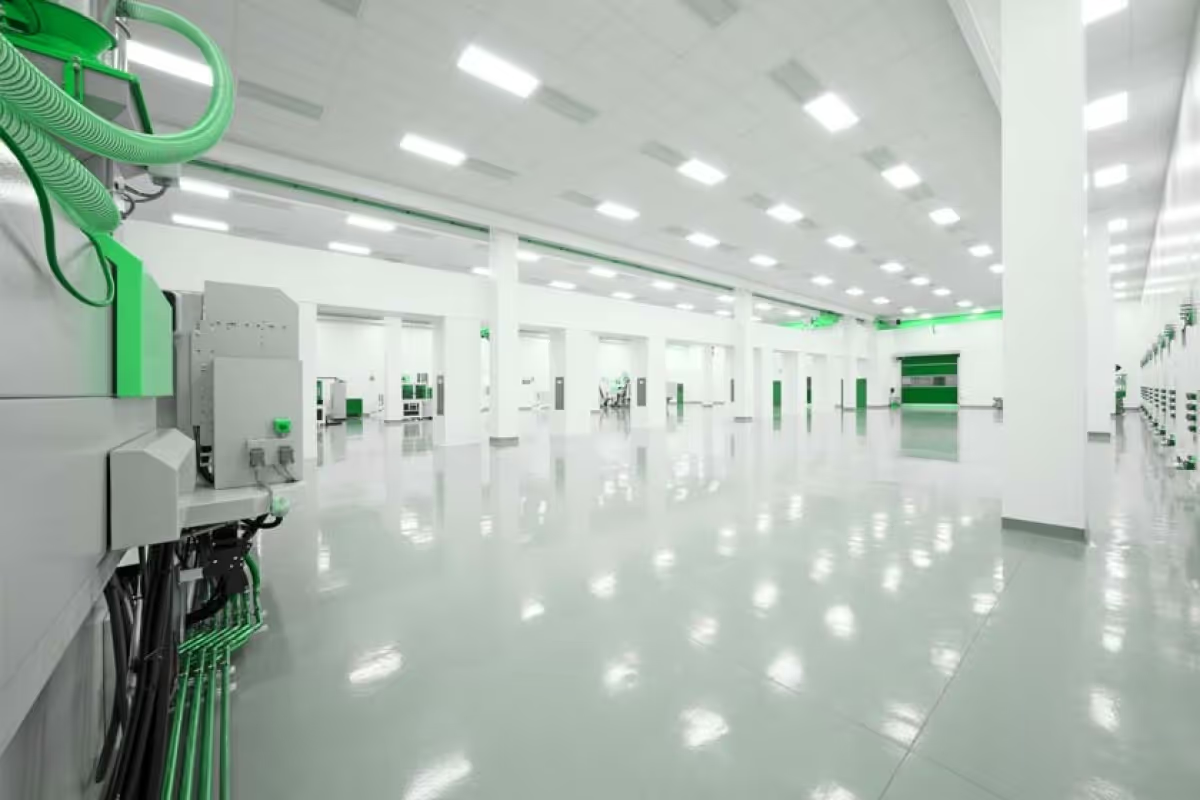
These are not ordinary construction projects. A single semiconductor fab can encompass more than a million square feet of cleanroom space, require extraordinarily precise mechanical and electrical systems, and take anywhere from 18 months to several years from groundbreaking to first production wafer. That complexity makes the current buildout one of the most technically demanding chapters in American industrial history.
TSMC: Four Fabs in Arizona
Taiwan Semiconductor Manufacturing Company (TSMC) is the most prominent name in the buildout. The company is investing $65 billion—now expanding toward $165 billion in its Arizona campus near Phoenix. TSMC's first Arizona fab (Fab 21 Phase 1) entered high-volume production using 4-nanometer process technology in late 2024, with yields described as comparable to its Taiwan facilities, according to CNBC. The second fab (Phase 2), built to 3-nanometer specifications, has already entered pilot production roughly six months ahead of schedule, with volume production now guided for the first quarter of 2027, per reporting from The Platinum Capital. Apple, AMD, and NVIDIA are confirmed customers for Fab 21 Phase 2.
Construction is already underway on a third fab, with equipment installation expected in 2026. TSMC has also applied for permits for a fourth Arizona fab and has acquired an additional 900-acre site beyond its original 1,100 acres to accommodate its expanding footprint, according to Focus Taiwan.
Micron: A New York Megafab and Idaho Expansion
Micron Technology broke ground on its flagship $100 billion megafab in Clay, New York in January 2026—what New York Governor Kathy Hochul called the largest private investment in New York history. The Clay facility will produce DRAM memory chips across multiple phases, with the first phase expected to achieve production around 2030. Micron's total U.S. expansion plan includes $150 billion in fabrication plants and $50 billion in research and development across Idaho, New York, and Virginia, as detailed by Construction Owners. Once complete, the program is projected to supply 40 percent of Micron's global DRAM output from U.S. facilities and generate an estimated 90,000 direct and indirect jobs.
Separately, Micron is expanding its Fab 4 campus in Boise, Idaho with a $30 billion expansion, aided by a CHIPS Act grant from the U.S. Department of Commerce, according to Industrial Info Resources. The first wafer output from Boise is targeted for the second half of 2027.
Samsung: Taylor, Texas Campus
Samsung Electronics resumed full-scale construction at its Taylor, Texas fab after a mid-2024 pause due to softer demand. The facility—the largest foreign investment in Texas history—is now targeting operational status in 2026 and is expected to create 1,800 permanent jobs within a decade, per Samsung Semiconductor's official site. Samsung's long-term Texas plan involves up to $37 billion in total investment at a 1,268-acre campus, with a second fab (Fab 2) now entering regulatory review for construction. Fab 2 is projected to cover approximately 2.7 million square feet. Samsung has secured preliminary orders from 121 customers and is in discussions for major agreements with global technology leaders.
Texas Instruments: Utah and Texas
Texas Instruments is executing a $60 billion multi-site investment that includes fabs in Sherman, Texas and Lehi, Utah. The Sherman fab—projected to be the largest economic project in Texas history—began early production phases in 2025. The Lehi, Utah fab, an $11 billion project built adjacent to an existing TI facility, is targeting production in 2026 and is expected to produce tens of millions of analog and embedded processing chips per day once fully operational, according to Z2 Data research.
Construction and Workforce Implications
Semiconductor fabs are among the most construction-intensive projects an owner can commission. Each facility requires advanced cleanrooms, ultra-high-purity water systems, specialized HVAC and gas distribution, seismic isolation, and vast electrical infrastructure. During construction, a single major fab can sustain thousands of direct construction jobs. Samsung's Taylor campus alone supported 8,868 direct and 9,768 indirect construction jobs in 2024, according to Samsung's own reporting.
The buildout has also pushed demand for specialized construction expertise—including cleanroom installation, EUV equipment placement, and precision mechanical work—creating both opportunity and labor competition for firms operating in Arizona, Texas, New York, Utah, and Idaho. The investment tax credit for U.S. fab construction was also raised from 25 to 35 percent under the Trump administration's proposed legislation, incentivizing projects that break ground before the end of 2026, per Manufacturing Dive.
Looking Ahead
The semiconductor construction pipeline represents a multi-decade commitment to domestic manufacturing capacity. For owners, developers, and general contractors, it signals sustained demand for industrial construction expertise, specialty trades, and large-scale project management in a handful of key states. Whether evaluating workforce strategy, equipment procurement, or subcontractor relationships, the chip fab buildout is a defining force in U.S. nonresidential construction through at least the early 2030s.
Sources:
- AnySilicon / SEMI World Fab Forecast: Chipmakers Rush to Build New Fabs in 2025
- Construction Owners: Major U.S. Factory Projects Set to Launch in 2026
- The Platinum Capital: TSMC Arizona Second Fab Moves Into Pilot Production Ahead of Schedule
- Focus Taiwan: TSMC's Fab 2 in Arizona to Begin Mass Production in 2nd Half of 2027
- CNBC: TSMC Is Set to Expand Its $165 Billion U.S. Investment
- NY Governor's Office: Micron Megafab Groundbreaking, Clay NY
- Samsung Semiconductor: Taylor Texas Fab
- Industrial Info Resources: U.S. Semiconductor Plant Construction Advances
- Z2 Data: Where Are All the North American Semiconductor Fabs Being Built
- Manufacturing Dive: Navigating Growth in Semiconductor Manufacturing

Discuss an Upcoming Project


