
Pharma's $480 Billion U.S. Construction Wave: What Onshoring Means for Builders and Owners
The pharmaceutical industry is in the middle of the largest onshoring buildout in its history, and the construction implications are substantial. Since early 2025, more than a dozen major drug companies have announced U.S. manufacturing investments totaling over $480 billion, with commitments spanning at least 22 new manufacturing sites and thousands of construction and permanent jobs, according to Think Global Health's tracking. The driving forces are a combination of trade policy pressure, supply chain vulnerabilities exposed during the pandemic, and growing government pressure to reduce dependence on foreign active pharmaceutical ingredient (API) manufacturing.
For owners, developers, and general contractors, the wave creates a multi-year pipeline of technically demanding, highly regulated construction work—including greenfield manufacturing campuses, advanced cleanroom facilities, and specialized chemical processing plants that bear little resemblance to ordinary industrial builds.
The Triggering Forces
The buildout accelerated sharply in early 2025. In February, Eli Lilly announced a $27 billion domestic expansion plan encompassing four new U.S. manufacturing facilities. Other major companies followed quickly. The Trump administration's May 2025 executive order directing the FDA to streamline approval of U.S. drug plants, and the FDA's August 2025 launch of its PreCheck initiative—providing early-stage feedback during facility planning and construction—helped reduce regulatory risk for new projects, per Insight Global's industry analysis.
Section 232 tariff pressure on pharmaceuticals, announced in April 2026, further intensified the incentive to establish domestic production rather than import finished drugs or precursor ingredients. By late 2025, industry trade groups and analysts were tallying $370 to $480 billion of U.S.-targeted pharmaceutical investment planned for 2025–2030, according to analysis by Intuition Labs.
Eli Lilly's Four-Site Program
Eli Lilly is the most active builder in this cycle. The company announced four new U.S. manufacturing facilities across 2025, all focused on active pharmaceutical ingredient (API) production:
- Goochland County, Virginia: A $5 billion facility announced in September 2025 for bioconjugate and monoclonal antibody manufacturing, including antibody-drug conjugates (ADCs). Expected to create 650 manufacturing jobs and 1,800 construction jobs. Per Lilly's investor relations announcement.
- Houston, Texas (Generation Park): A $6.5 billion facility for small molecule synthetic medicines including orforglipron, Lilly's oral GLP-1 drug for obesity. Announced September 2025, expected to generate 4,000 construction jobs and 615 permanent positions, per Lilly's investor release.
- Huntsville, Alabama: A $6 billion facility for small molecule synthetic and peptide medicines. Construction expected to begin in 2026, anticipated to be operational by 2032, generating 3,000 construction jobs and 450 permanent positions, per Lilly's December 2025 announcement.
- Lehigh Valley, Pennsylvania: A $3.5 billion facility described as the largest life science project in Pennsylvania history, expected to produce GLP-1 medicines including Lilly's blockbuster diabetes and weight-loss treatments by 2029. Construction began in 2026, with 2,000 construction jobs and 850 permanent positions, per the Lehigh Valley Economic Development Corporation.
Lilly's four announced sites represent $21 billion in new construction investment, part of a broader $50 billion U.S. expansion commitment since 2020. A fourth site in North Carolina is also in early stages.
The Broader Industry Commitment
Lilly is not alone. By late 2025, the following major commitments had been publicly announced:
- Johnson & Johnson: $55 billion, including 4 new U.S. plants
- Novartis: $23 billion for 6 new U.S. plants
- Roche: $50 billion including new North Carolina facilities
- Merck: More than $70 billion in U.S. manufacturing and R&D expansion
- Sanofi: $20 billion by 2030
- Merck (biologics): A $1 billion biologics plant in Delaware
Collectively, these commitments are expected to establish 22 or more new manufacturing sites and create an estimated 44,000 new direct jobs, according to Think Global Health's analysis. DPR Construction, tracking company press releases, identified over $370 billion in announced U.S. pharma development as of late 2025, per Intuition Labs.
Construction Complexity in Pharmaceutical Facilities
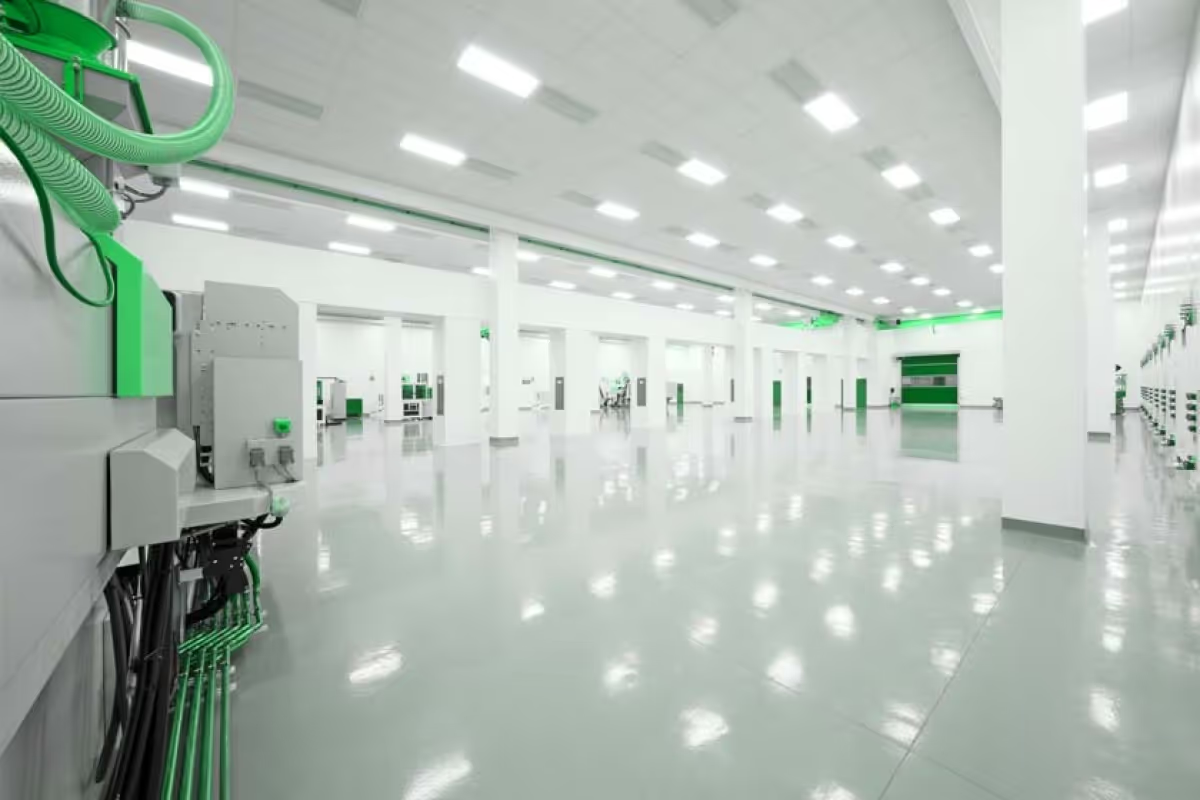
Pharmaceutical manufacturing plants are among the most technically demanding buildings constructed in the nonresidential sector. API facilities require cleanroom environments, highly specialized HVAC and containment systems, solvent and chemical handling infrastructure, and compliance with FDA's Current Good Manufacturing Practice (cGMP) regulations throughout construction. The quality management requirements extend into the construction process itself—materials traceability, equipment qualification, and construction documentation all face elevated scrutiny.
General contractors and owners entering this sector for the first time face meaningful learning curves. Projects often use construction manager at-risk or integrated project delivery models to manage risk, and early engagement of specialty subcontractors for mechanical, electrical, and cleanroom work is essential. Timeline risk is particularly acute: pharmaceutical clients face regulatory deadlines linked to drug approval timelines, and schedule certainty often commands premium pricing.
Cautionary Notes on Commitment vs. Construction
It is worth noting that a portion of the announced investments remain in planning stages, and some are brownfield repurposing or equipment upgrades rather than new construction. Analysts note uncertainty around how many of the commitments are truly greenfield projects versus acquisitions of existing facilities, per Think Global Health. The evolving regulatory environment around tariffs has also led some companies to defer final construction decisions pending greater policy clarity. That said, the projects that have already broken ground—including all four Lilly facilities—represent confirmed, committed work entering the construction pipeline over the next two to six years.
For general contractors and specialty builders with pharmaceutical sector experience, the pipeline is genuine and substantial. For those without it, the sector represents a compelling area for capability development—if entered thoughtfully and with the right team.
Sources:
- Think Global Health: Tracking Pharma's Progress on U.S. Onshoring
- Eli Lilly Investor Relations: Virginia $5B Facility Announcement
- Eli Lilly Investor Relations: Texas $6.5B Facility Announcement
- Eli Lilly Investor Relations: Alabama $6B Facility Announcement
- Lehigh Valley Economic Development: Lilly $3.5B Pennsylvania Facility
- Insight Global: Pharmaceutical Manufacturing Expansion Analysis
- Intuition Labs: Pharma Tariffs 2026 — Supply Chain and Onshoring

Discuss an Upcoming Project


