
news +insights
HUD Taps NIBS for 12-Month Push on Factory-Built Multifamily Housing
The U.S. Department of Housing and Urban Development has selected the National Institute of Building Sciences to support a 12-month initiative aimed at expanding factory-built construction for multifamily housing. The work targets the obstacles that keep offsite methods out of larger projects: building codes, financing, insurance and regulatory approval National Institute of Building Sciences.
What Happened
NIBS announced the selection on October 7. Working with strategic partner MOD X, the institute will bring together experts from government, industry, building science, engineering, finance and code development to help HUD work through those barriers National Institute of Building Sciences.
The effort has two stated goals. It is meant to create a pathway for manufactured housing to be used in developments of five or more homes, and to support HUD's planning for future factory-built multifamily demonstration projects National Institute of Building Sciences.
The main deliverable is a draft framework. According to the announcement, NIBS will:
- Draft a framework for safety, quality and performance expectations for manufactured housing in developments of five or more units National Institute of Building Sciences.
- Outline how builders can document their designs, demonstrate outcomes and obtain an independent technical review National Institute of Building Sciences.
- Provide technical review and expert opinion to HUD as the department leads the demonstration effort National Institute of Building Sciences.
What It Does Not Do
The announcement is careful about limits. It states that the work does not change existing federal requirements. HUD leads the demonstrations, and NIBS will not construct, operate or implement the demonstration projects National Institute of Building Sciences. No dollar value for the award and no demonstration sites were disclosed in the announcement.
That matters for anyone reading this as a rule change. It is a technical and advisory effort that could inform later policy, with a one-year clock Construction Dive.
Background: Two Regulatory Tracks
Factory-built housing in the United States runs on two separate systems. Manufactured housing is regulated under the federal HUD Code. Modular housing is generally reviewed under state and local building codes National Institute of Building Sciences. A project team that wants to stack factory-built units into a multifamily building has to work out which rules apply, who reviews the design, and how a lender and an insurer will treat the finished product.
HUD has been studying the question for several years. The new award builds on research funded by the department's Office of Policy Development and Research, including a research roadmap for offsite construction, a report on HUD's role in accelerating it, and a handbook for regional pilot projects National Institute of Building Sciences. The roadmap, posted in January 2023, defined offsite construction to include manufactured housing, modular homes and prefabricated structural components. It set out six research priorities: regulatory framework, standards and system performance, capital, finance and insurance, project delivery and contracts, labor and workforce, and business models HUD User.
NIBS president and chief executive George Guszcza framed the problem as one of alignment. He said the country has a growing shortfall in resilient and affordable housing, and that innovation cannot succeed without standards, financing, insurance and approval processes that line up National Institute of Building Sciences. NIBS was created by an act of Congress in 1974 and operates as an independent, non-partisan nonprofit National Institute of Building Sciences.
Where Things Stand
The initiative is at the start of its 12 months. The framework is still to be drafted, and HUD has not announced the demonstration projects it is planning for. In practical terms, 2027 is the earliest that a usable pathway could be in front of developers and code officials.
The federal effort arrives alongside state programs already putting factory-built homes in the ground. New York's MOVE-IN NY program, for example, has directed more than $20 million to 68 factory-built starter homes in Buffalo and Niagara Falls, which we covered in an earlier post.
Implications for Owners, Developers, Contractors and Subs
- Approval risk is the real barrier. Factories can build units today. What slows multifamily adoption is uncertainty over which code applies, how inspections work and whether lenders and insurers will accept the product. A recognized framework with independent technical review addresses that directly.
- Developers should track the five-unit threshold. The pathway is aimed at developments of five or more homes, which covers small multifamily and infill sites where conventional construction costs are hardest to make work.
- General contractors keep a central role. Factory-built projects still need sitework, foundations, utilities, setting and stitching of units, and common areas. Contractors who understand the coordination between factory and site will be in a stronger position.
- Trades should expect a shift, not a disappearance. More work moves into plants, while on-site scope concentrates on connections, envelopes at the joints and building systems.
- Documentation will carry weight. The framework centers on documenting designs and demonstrating outcomes. Teams with strong quality records and traceable submittals will adapt fastest.
What to Watch
- Release of the draft framework and whether it is opened for industry comment.
- HUD's selection of demonstration projects and locations.
- Responses from lenders, insurers and state code officials, whose acceptance will decide how far the pathway goes.
Bottom Line
HUD is not changing the rules yet. It has asked a congressionally chartered building science body to spend a year defining how factory-built multifamily housing can be shown to be safe, financeable and insurable. For developers and contractors, the practical step now is to follow the framework as it takes shape.
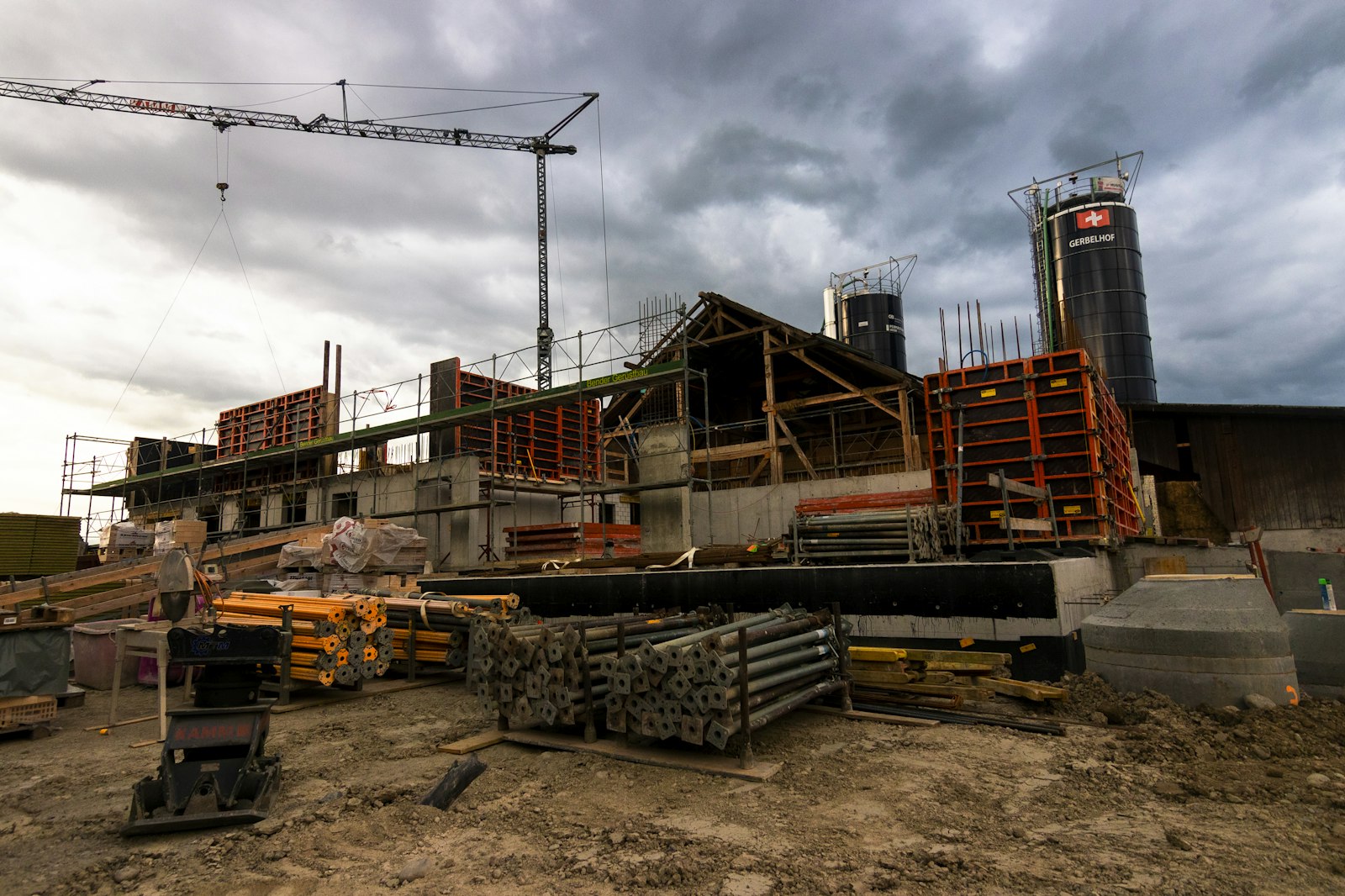
Image credit: Jan Huber on Unsplash. Free-license photo, used because the source announcement includes only a logo. Unsplash.
Sources
- National Institute of Building Sciences via PR Newswire, HUD Selects National Institute of Building Sciences to Support Acceleration of Innovative Multifamily Housing Construction: https://www.prnewswire.com/news-releases/hud-selects-national-institute-of-building-sciences-to-support-acceleration-of-innovative-multifamily-housing-construction-302901257.html
- Construction Dive, Punch List: Bechtel teams with Ted Danson, Hensel Phelps breaks ground on new HQ: https://www.constructiondive.com/news/punch-list-bechtel-ted-danson-hensel-phelps-hq/832590/
- HUD User, Offsite Construction for Housing: Research Roadmap: https://www.huduser.gov/portal/publications/Offsite-Construction-for-Housing-Research-Roadmap.html


Let's connect
For organizations planning commercial, industrial, or infrastructure work, we will review the project and recommend the appropriate delivery approach.

Join our team
If you hold yourself to careful, accountable work, you already work the way we do.