

news +insights
GlobalFoundries to Add Malta Fab Capacity Under $2 Billion TSMC Interposer Deal

GlobalFoundries has signed a multiyear manufacturing agreement with Taiwan Semiconductor Manufacturing Co. to produce silicon interposers at its Malta, New York, facility, a deal the company values at $2 billion. GlobalFoundries says it will add fabrication capacity there, with volume production expected to ramp in the first half of 2028.
What Happened
GlobalFoundries announced on October 8, 2026, from Malta, New York, that it has reached a manufacturing agreement with TSMC to establish a U.S.-based supply of silicon interposers for TSMC's chip-on-wafer-on-substrate advanced packaging ecosystem, known as CoWoS, according to GlobalFoundries. Under the agreement, GlobalFoundries will provide manufacturing services to TSMC.
The company's headline puts the value of the multiyear agreement at $2 billion, and Manufacturing Dive reported the deal at that figure. The body of the company's release does not break that number down or say how much of it represents capital spending at the Malta site.
What Is Confirmed
- Location: GlobalFoundries will add fabrication capacity at its Malta, New York, facility and expand it over time as customer demand grows, per GlobalFoundries.
- Schedule: Volume production is expected to ramp at Malta in the first half of 2028, per GlobalFoundries.
- Term: The initial term is five years, with a framework for future expansion, per GlobalFoundries.
- Product: Silicon interposers for advanced packaging, including embedded deep trench capacitor components. The company says it expects to become the first U.S.-based source of these parts, per GlobalFoundries.
- Demand driver: High-performance computing and artificial intelligence systems. The added capacity is meant to support several product generations, according to Manufacturing Dive.
Ed Kaste, senior vice president of the company's CMOS business, said in the announcement that advanced packaging is becoming increasingly critical to AI performance and that the company's U.S. footprint gives customers "a secure, scalable source of essential advanced-packaging elements," as quoted by Manufacturing Dive.
Background
An interposer is a layer that sits between chips and the substrate beneath them and carries the connections among them. TSMC describes CoWoS as an advanced 2.5D packaging technology that integrates multiple systems on a chip with high-bandwidth memory stacks, forming a foundation for high-performance computing and AI products, per Manufacturing Dive. GlobalFoundries says it expects to be the first U.S.-based source of the interposer component, which is the gap this agreement is meant to fill.
The Malta agreement is the latest in a series of GlobalFoundries deals this year tied to semiconductor manufacturing and data center growth. Earlier agreements involved the U.S. Department of Commerce, the Department of Energy and Renesas Electronics, among others, according to Manufacturing Dive. In August the company reported second-quarter revenue of $1.79 billion, up 9% from the prior quarter, with its communications infrastructure and data center segment up 60% year over year.
TSMC is expanding its own U.S. footprint at the same time. In July, the White House and the Commerce Department said TSMC plans to spend an additional $100 billion on four more Arizona facilities, bringing its total U.S. investment to $265 billion across 12 sites, per Manufacturing Dive. TSMC reported second-quarter revenue of $40.2 billion, up more than 33% from a year earlier.
What Is Not Yet Known
Several details that matter to the Capital Region construction market have not been released.
- Neither the company nor the trade press coverage says whether the added capacity will come from new construction, from fit-out of existing cleanroom space, or from tool installation inside the current fab.
- No square footage, capital budget for the Malta work or construction start date has been given. The only dated milestone is the production ramp in the first half of 2028.
- No architect, engineer, construction manager or contractor has been named.
- No job numbers or state or local incentives are mentioned in the announcement.
Implications for Owners, Developers, Contractors and Subs
A production ramp in the first half of 2028 leaves roughly 18 months for whatever facility work, tool installation and qualification the new line requires. Semiconductor capacity additions of any kind tend to be dominated by mechanical, electrical, process piping and controls scopes, along with cleanroom construction and tool hook-up. Those are specialized trades, and in upstate New York they are already drawing demand from other chip projects.
That overlap is the practical point for the wider market. Owners planning industrial, laboratory or advanced manufacturing projects across upstate should expect continued competition for process mechanical and electrical labor through 2027 and 2028. Early engagement with trade partners and realistic lead times for electrical gear and specialty mechanical equipment remain the best tools for protecting a schedule.
For contractors and subcontractors with cleanroom and high-purity experience, the agreement signals a multi-year customer commitment behind the Malta site. A five-year initial term with a framework for expansion suggests the work may come in phases tied to demand, not as a single large package. Firms that want to position for it should follow permitting and site plan activity in the Town of Malta.
For owners in other sectors, the deal is another example of a manufacturer adding capacity at an existing, permitted campus instead of starting on a new site. Expansion inside an operating facility shortens the path to production, but it brings phasing, shutdown coordination and contamination control requirements that affect both cost and sequencing.
What to Watch
- Any filing or announcement that defines the physical scope at Malta, including square footage and whether new building area is involved.
- Selection of a design and construction team, and bid opportunities for trade contractors.
- Whether the state or local agencies announce support tied to the expansion.
- Progress toward the first-half 2028 production ramp, and any expansion beyond the initial five-year term.
Bottom Line
GlobalFoundries has a named customer and a five-year commitment behind new capacity at its Malta fab, with production due to ramp in the first half of 2028. The construction scope has not been defined, but the schedule implies facility and tool installation work over the next year and a half, in a region where process trades are already in demand.
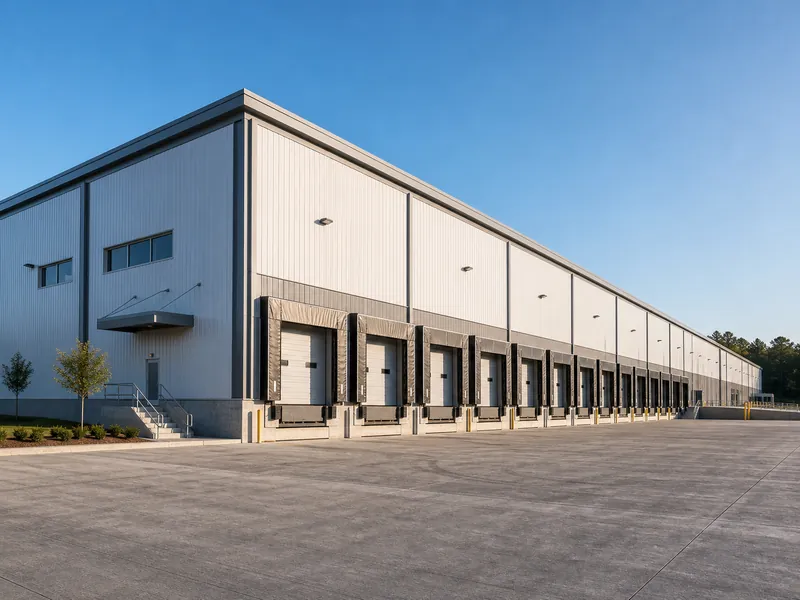
Image credit: GlobalFoundries. Image from the source article at Manufacturing Dive.
Sources
- GlobalFoundries (GlobeNewswire), "GlobalFoundries Reaches Agreement to Establish U.S.-Based Supply of Silicon Interposers for Advanced AI Packaging": http://www.globenewswire.com/news-release/2026/10/08/3377242/0/en/globalfoundries-reaches-agreement-to-establish-u-s-based-supply-of-silicon-interposers-for-advanced-ai-packaging.html
- Manufacturing Dive, "GlobalFoundries and TSMC reach $2B deal for US-based silicon interposers": https://www.manufacturingdive.com/news/globalfoundries-tsmc-silicon-interposes-semiconductors/832537/



Let's connect
For organizations planning commercial, industrial, or infrastructure work, we will review the project and recommend the appropriate delivery approach.

Join our team
If you hold yourself to careful, accountable work, you already work the way we do.