
news +insights
Demolition Begins at Former Tampa Bay Times Building in Downtown St. Petersburg
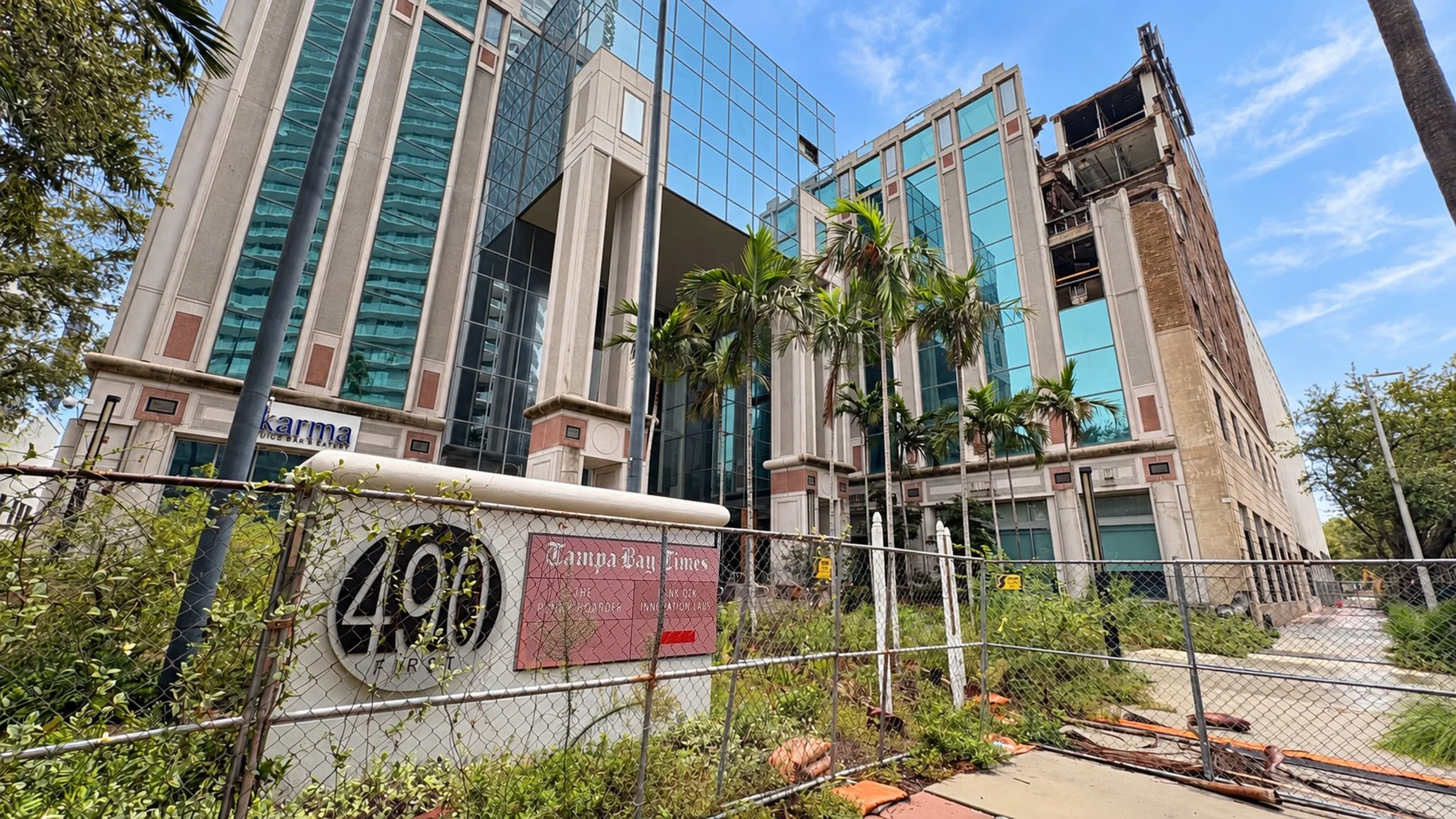
Demolition has started at the former Tampa Bay Times building at 490 1st Avenue South in downtown St. Petersburg, about two years after a tower crane fell onto it during Hurricane Milton. Crews are carrying out interior, non-structural demolition and asbestos abatement under a city permit, and owner Stock Development plans a high-rise condominium tower on the site St. Pete Rising.
What Happened
City of St. Petersburg permit records show the first phase of work is underway inside the eight-story, 240,000-square-foot complex St. Pete Rising. The property is made up of three connected buildings. The original structure dates to 1924, and additions followed in 1968 and 1988 St. Pete Rising.
The city approved a partial demolition permit on September 18, and it was issued in two phases St. Pete Rising:
- Phase one: interior demolition, asbestos removal and utility disconnections. Before any structural work begins, the developer must cap the water, sewer and gas connections and lock out electrical service.
- Phase two: full structural demolition, work in the right-of-way and site restoration.
The city says no additional demolition permit is needed for the second phase. City spokesperson Samantha Bequer told the outlet that the existing permit authorizes work to proceed on both phases, subject to any revisions that come out of what crews find during phase one St. Pete Rising.
How the Building Got Here
The building was damaged in October 2024, when a construction crane at the neighboring Residences at 400 Central site collapsed during Hurricane Milton and struck the upper three floors St. Pete Rising. The city declared the building unfit and unsafe, and it was later stabilized under separate permitted work St. Pete Rising.
By May 2025, the landlord had deemed the building uninhabitable, with no power and a large hole in the roof, and the owner at the time was in informal talks with the city about tearing it down WUSF. The newspaper had been in the building since 1924, sold it in 2016 and stayed on as a tenant until the storm. Its chief executive told staff they would not be returning WUSF.
Naples-based Stock Development bought the building in June for $18 million and paid another $14.5 million for the neighboring Tramor Cafeteria property at 123 4th Street South, a combined $32.5 million for about 1.8 acres St. Pete Rising. The site sits across the street from the 46-story Residences at 400 Central and is zoned DC-1, which allows substantial height and density St. Pete Rising.
Where Things Stand
Stock Development has said it plans a high-rise condominium tower with ground-floor commercial space, and offices may be part of the program St. Pete Rising. As of October 9, the company had not submitted redevelopment plans to the city St. Pete Rising.
That sequence is unusual for downtown St. Petersburg. Demolition of a principal building in the DC zoning districts normally requires an approved site plan and a complete building permit application. The city allowed this teardown to move ahead of a site plan because of the building's unsafe condition St. Pete Rising.
The Tramor building is a different matter. Built in 1929, it is a designated historic structure and cannot be demolished. The developer has said it will work with preservation officials on how to fold it into the project St. Pete Rising. The interior is known for Spanish-Mediterranean detailing and ceiling trusses reused from a 1920s airport hangar St. Pete Rising.
Implications for Owners, Developers, Contractors and Subs
- Abatement sets the pace. A building with sections from 1924, 1968 and 1988 will have more than one generation of materials to survey and remove. The permit ties structural demolition to completing interior work and utility cut-offs first, so the schedule for the visible teardown depends on what phase one uncovers.
- Utility isolation is a hold point. Capping water, sewer and gas and locking out power are written into the permit as conditions before structural work. On a tight downtown block, that coordination with utilities and the city is a critical-path item.
- Selective demolition next to a protected building. Taking down an eight-story complex beside a designated 1929 structure calls for protection, monitoring and careful sequencing at the property line.
- Unsafe-structure findings change the entitlement order. Owners of storm-damaged downtown buildings should note that the city was willing to release demolition before a site plan when the building was formally declared unsafe.
- A large condo tower is in the pipeline. No plans are filed yet, but 1.8 acres of DC-1 land across from the city's tallest building points to a significant future bid opportunity.
What to Watch
- When phase two structural demolition begins, and whether the permit is revised after phase one findings.
- A site plan filing from Stock Development that shows height, unit count and how the Tramor building is incorporated.
- Right-of-way closures on 1st Avenue South and 4th Street South during the structural teardown.
Bottom Line
One of downtown St. Petersburg's most visible storm-damaged buildings is finally coming down, starting from the inside. The demolition is permitted through to site restoration, the redevelopment plan is not yet public, and the historic Tramor building next door will shape whatever gets designed.
Image credit: St. Pete Rising. Image from the source article. St. Pete Rising.
Sources
- St. Pete Rising, Demolition begins at former Tampa Bay Times building in downtown St. Pete: https://stpeterising.com/home/demolition-begins-at-former-tampa-bay-times-building-in-downtown-st-pete
- St. Pete Rising, Former Times building, historic Tramor property in downtown St. Pete sold for $32.5 million: https://stpeterising.com/home/former-times-building-and-historic-tramor-property-sold-high-rise-tower-planned
- WUSF, After Milton dropped a crane on it, the Tampa Bay Times' former home might be torn down: https://www.wusf.org/economy-business/2025-05-12/tampa-bay-times-building-hit-by-crane-hurricane-milton-may-be-torn-down
Let's connect
For organizations planning commercial, industrial, or infrastructure work, we will review the project and recommend the appropriate delivery approach.

Join our team
If you hold yourself to careful, accountable work, you already work the way we do.