

news +insights
ABC Backlog Rebounds to 8.5 Months as Data Center Work Reshapes Contractor Capacity
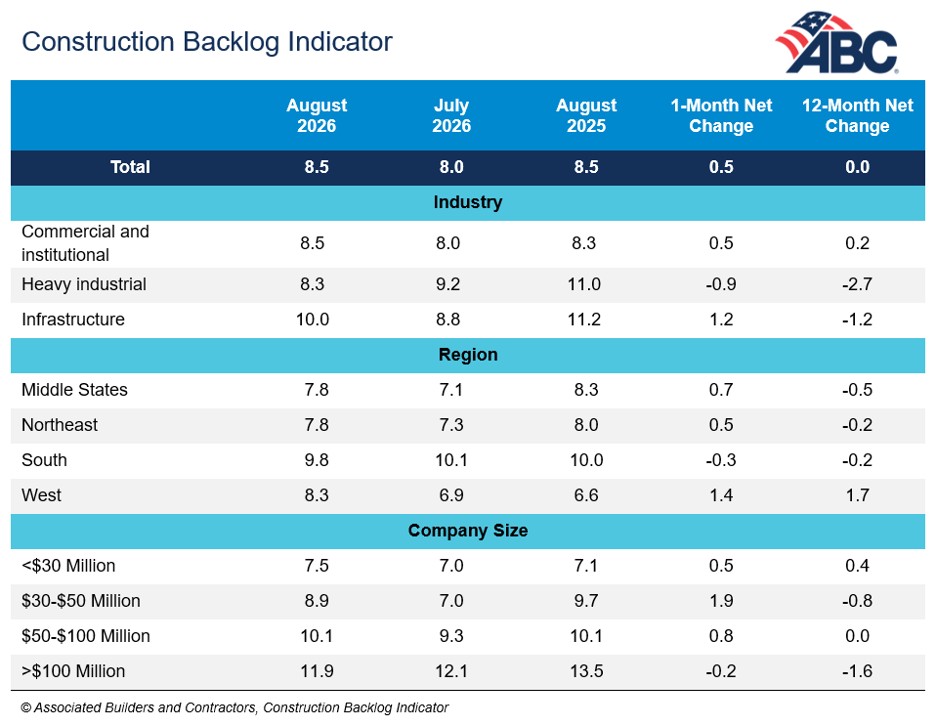
Associated Builders and Contractors reported that its Construction Backlog Indicator rebounded to 8.5 months in August, while a record share of members reported data center work under contract. ABC said the August survey was conducted from August 20 to September 4, 2026, and that backlog increased 0.5 months from July while remaining unchanged year over year Associated Builders and Contractors.
The headline is not simply that backlog improved. The more useful takeaway for owners and contractors is that data centers continue to support parts of the nonresidential market while labor pressure and staffing uncertainty are reappearing. ENR reported the same 8.5-month August backlog figure and described data centers as an increasingly important source of contractor backlog Engineering News-Record.
What happened
ABC reported that contractors with data center work had 9.9 months of backlog in August, compared with 8.3 months for contractors without data center work Associated Builders and Contractors. ABC also said roughly one in six members was under contract to work on a data center, the highest proportion on record Associated Builders and Contractors.
TileLetter's repost of the ABC release echoed that backlog was up 0.5 months from July and unchanged year over year TileLetter. The page also repeated ABC's observation that only the largest contractors saw backlog decline in August, while year-over-year gains were concentrated among the smallest contractors, defined as firms with less than $30 million in annual revenue TileLetter.
Key data points
- Overall backlog: 8.5 months in August, up 0.5 months from July and unchanged from the prior year Associated Builders and Contractors.
- Data center split: contractors with data center work had 9.9 months of backlog, compared with 8.3 months for contractors without data center work Associated Builders and Contractors.
- Staffing risk: the share of contractors intending to cut staffing over the next six months rose to 12.3% in August Associated Builders and Contractors.
- Confidence: ABC said sales, profit-margin and staffing expectations remained above 50, meaning contractors still expected growth over the next six months Associated Builders and Contractors.
Why it matters to construction professionals
Backlog is not revenue, but it is a useful signal of work under contract. When backlog rises because data centers are absorbing contractor capacity, owners in other sectors may face tighter access to certain trades, longer lead times and more selective contractor interest. Specialty trades tied to power, mechanical systems, controls, concrete, steel and site infrastructure may feel the pressure most directly.
The staffing signal is mixed. Contractors remain broadly optimistic about sales and margins, but ABC said the staffing index fell and the share of contractors expecting to cut staffing rose to the highest level since December Associated Builders and Contractors. That tension matters because contractors can have backlog and still face labor allocation problems.
Implications for owners, developers and subcontractors
Owners planning 2027 work should treat subcontractor capacity as a market risk rather than a bid-day detail. If data center, power and industrial work remain active, early trade partner engagement becomes more valuable. Preconstruction teams may need to identify long-lead electrical gear, utility coordination, workforce availability and supplier constraints earlier than usual.
Subcontractors should read the numbers as both opportunity and warning. Data center work can create high-volume demand, but it can also expose firms to concentration risk if too much backlog sits in one sector. The better strategy is to understand which clients have funded, permitted and executable projects rather than assuming every announced project will move at the same pace.
The wider data picture
Other ABC releases from the same weeks help explain the backlog reading. ABC's analysis of Census data found that national nonresidential construction spending rose 0.1% in July to a seasonally adjusted annualized $1.286 trillion, and that the increase was entirely due to data centers Associated Builders and Contractors. Excluding data centers, ABC said nonresidential spending fell for the second straight month to its lowest level since September 2023 Associated Builders and Contractors.
Costs are also moving. ABC reported that construction input prices rose 1.2% in August and were 8.9% higher than a year earlier, with iron and steel, softwood lumber, switchgear, copper wire and cable among the materials up more than 10% year over year Associated Builders and Contractors. ABC's chief economist warned that ongoing input-price escalation was expected to weigh on profitability over the next several months Associated Builders and Contractors.
Labor demand remains firm. ABC said construction job openings rose by 28,000 to 326,000 at the end of July, a near two-year high, and that construction added 22,000 jobs in August with an unemployment rate of 3.1% Associated Builders and Contractors. That combination of rising prices, firm hiring and concentrated demand explains why contractors can report healthy backlog while also warning about margins and staffing.
What to watch next
The next useful indicators are September backlog, job openings, nonresidential spending and whether more local governments pursue data center moratoriums. AGC separately warned that construction employment gains could be affected by opposition to data centers, delayed federal highway funding and tariff uncertainty Associated General Contractors of America.
Bottom line
August's backlog rebound is positive, but it is not broad comfort. The market is increasingly shaped by data centers, power demand and labor availability. Contractors with the right skills may see strong opportunities, while owners outside the hottest sectors need to plan earlier and communicate clearer scopes to attract qualified teams.
Image credit: Construction Backlog Indicator chart image from Associated Builders and Contractors Associated Builders and Contractors.
Related Coverage
- Contractor Backlog Rises to 8.7 Months in September as Data Centers Lead
- Contractor Backlog Drops to 8.0 Months, and the Average Hides a 3.9-Month Split
- Construction backlog slips to 8.4 months
Sources
- Associated Builders and Contractors: https://www.abc.org/News-Media/News-Releases/abc-construction-industry-needs-to-attract-an-estimated-499000-new-workers-in-2026
- Engineering News-Record: https://www.enr.com/articles/63658-data-centers-lift-contractor-backlog-as-labor-pressures-reemerge
- TileLetter: https://www.tileletter.com/abc-survey-shows-backlog-rebounds-in-august-1-in-6-members-performing-data-center-work/
- Associated General Contractors of America: https://www.agc.org/news/2026/09/18/construction-employment-increases-august-year-ago-35-states-and-dc-31-states-add-jobs-july-august

Let's connect
For organizations planning commercial, industrial, or infrastructure work, we will review the project and recommend the appropriate delivery approach.

Join our team
If you hold yourself to careful, accountable work, you already work the way we do.