

news +insights
U.S. Industrial Construction Pipeline Ticks Back Up as Market Stabilizes in 2026
The U.S. industrial and logistics construction market spent most of 2024 and 2025 working off a historic supply overhang — the product of a development boom that delivered more than 1.8 billion square feet of new warehouse and distribution space between 2020 and 2024. That correction has run its course. As of the first quarter of 2026, the national construction pipeline has risen for three consecutive quarters and now stands at 284.1 million square feet under construction — up 6.2 percent year-over-year and the highest level since the third quarter of 2024, according to Cushman & Wakefield's Q1 2026 U.S. Industrial Market report.
The signal matters because it arrives alongside stabilizing vacancy and accelerating demand. Cushman & Wakefield researchers describe it as evidence that "peak industrial vacancy is likely in the rearview mirror," with the market transitioning from a correction phase into healthier, more balanced growth.
Vacancy Has Stabilized — and Is Beginning to Compress
National industrial vacancy stood at 7.0 percent in Q1 2026, unchanged from year-end 2025 and 10 basis points below the Q3 2025 peak, per the Cushman report. Vacancy declined in three of four U.S. regions quarter-over-quarter, with only the West posting a modest increase (up 20 basis points to 7.9 percent). That regional divergence reflects ongoing delivery backlogs in high-construction West Coast markets, even as inland markets tighten.
Annual rent growth returned to positive territory across the board: asking rents grew 2.1 percent year-over-year nationally in Q1 2026, up from 1.1 percent at year-end 2025. Among 83 tracked markets, 60 posted positive annual rent growth, with 19 exceeding 5 percent. Markets with long-term rent growth above 50 percent — Philadelphia, Baltimore, Nashville, and Fort Lauderdale among them — have each seen rent gains of more than 80 percent since 2020, reflecting durable demand fundamentals rather than speculative supply.
New Supply Is Near a Multi-Year Low
The most important structural dynamic supporting the market's rebalancing is the sharp slowdown in new deliveries. Q1 2026 completions totaled just 54 million square feet — down 27 percent year-over-year and the lowest quarterly delivery total since mid-2017, per Cushman. Full-year 2025 deliveries came in at 281 million square feet, a 35 percent decline from 2024 and the lowest annual total since 2017.
That supply discipline is the mirror image of the development frenzy that preceded it. In 2022 and 2023, developers delivered a combined 1.1 billion square feet in just two years, peaking at 610 million square feet in 2023 alone. The correction that followed — driven by rising interest rates, decelerating e-commerce growth, and excess speculative inventory — forced a dramatic pullback in new starts beginning in late 2023. The industry is now living with the consequences: a leaner pipeline, tighter vacancy, and a gradual re-opening of the development window in proven markets.
Demand Is Accelerating, Led by Larger Users
Net absorption in Q1 2026 totaled 40 million square feet — the strongest first quarter since 2023 and up 52 percent year-over-year, according to Cushman's Q1 report. Over the trailing 12 months, total absorption reached 198 million square feet, exceeding both 2024 and 2025 full-year totals — by 31 percent and 8 percent, respectively.
The composition of that demand is shifting in ways that affect how construction projects are structured. Large-format users — tenants occupying 500,000 square feet or more — are driving a disproportionate share of activity. In Q1 2026, nearly half of the 68 million square feet absorbed in modern facilities (built since 2020) occurred in buildings larger than 500,000 square feet. Three-party logistics (3PL) providers and manufacturers accounted for 60 percent of large-format leasing activity, while inland markets captured 70 percent of total large-format volume.
The geographic concentration is worth noting: Dallas-Fort Worth, Indianapolis, Phoenix, Atlanta, and Charlotte led Q1 inland absorption. Port-proximate markets were more selective but remained active — Houston captured 4.9 million square feet, New Jersey 3.4 million, and Savannah 1.7 million in Q1 alone.
Build-to-Suit Is Leading the New Construction Wave
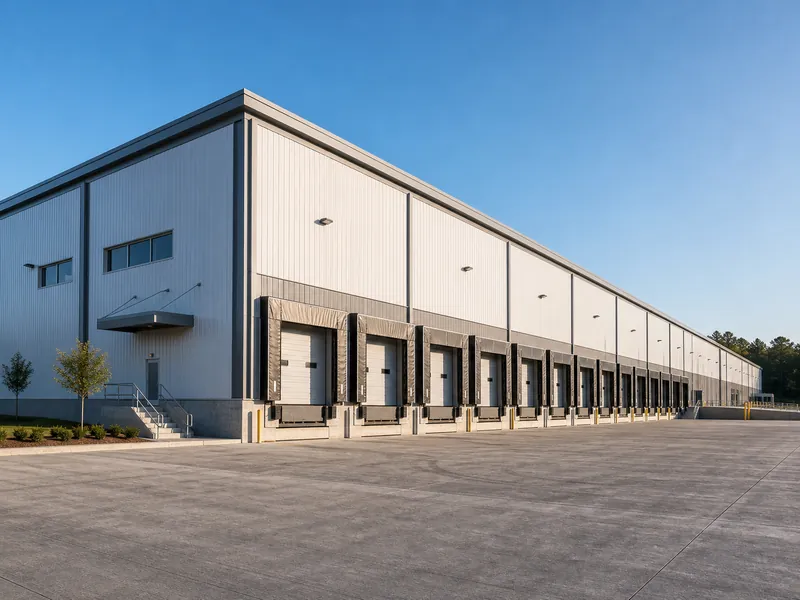
The rising construction pipeline is not a return to speculative overbuilding. Of the 284.1 million square feet now under construction nationally, 40 percent is build-to-suit (BTS), per Cushman — a share significantly higher than during the 2021–2023 boom. Two-thirds of the BTS pipeline consists of facilities 500,000 square feet or larger, including at least six manufacturing facilities exceeding one million square feet each.
That shift toward BTS reflects a more disciplined development environment. Occupiers coming off multi-year supply chain recalibrations are specifying exactly what they need — automation-ready layouts, higher clear heights (40-foot clearance is now standard for large-format deals), and access to reliable power infrastructure. Power availability is emerging as one of the most critical site-selection constraints, as fulfillment and manufacturing operations increasingly require substantial electrical capacity for automation, robotics, and AI-integrated logistics systems.
Markets posting notable new construction pipeline increases in Q1 2026 include Memphis, St. Louis, Columbus, Minneapolis, and Charlotte — markets with strong transportation infrastructure, lower land costs, and proximity to major population centers. These markets are attracting a mix of BTS and speculative development, with speculative projects concentrated in the sub-500,000-square-foot range where lease-up risk is more manageable.
Data Centers Are Now a Competing Priority for Industrial Construction Dollars
One underappreciated shift in the industrial construction market is the growing competition between logistics warehouses and data centers for the same pools of contractor capacity, construction materials, and power-infrastructure resources. Data center construction spending reached $50 billion at a seasonally adjusted annual rate in March 2026 — up 34 percent year-over-year — surpassing office construction and closing in on warehouse construction as the dominant industrial use of construction dollars, per REI Prime citing U.S. Census Bureau data. Bloomberg reported in March 2026 that data centers have already overtaken offices in total U.S. construction spending.
This creates a practical constraint for logistics and warehouse developers: the same electrical contractors, structural steel fabricators, and concrete crews that build large distribution facilities are increasingly being drawn toward data center projects, which offer larger contract values and faster lease-up certainty. In markets with both active warehouse and data center pipelines, construction cost inflation and scheduling delays are more pronounced.
Outlook Through 2026
Cushman's research team expects demand to reaccelerate in the second half of 2026, driven by supply chain recalibration focused on cost efficiency and network resilience. Vacancy compression is expected to be led by the 500,000-square-foot segment, in both leasing and user-purchase transactions, as disciplined development keeps new supply in check. Markets with modern, power-capable assets are expected to outperform older inventory as the flight to quality continues.
For developers, contractors, and GCs tracking the industrial pipeline, the current moment is a transition point: the correction is behind us, the rebound is underway, and the next phase of ground-up development is concentrating in inland markets with infrastructure advantages, power access, and proximity to domestic consumption. The question is not whether industrial construction will grow — the pipeline data says it already is — but how quickly BTS contracts convert to construction starts as lease negotiations close.
Sources
- Cushman & Wakefield — Q1 2026 U.S. Industrial Market Report (April 9, 2026)
- Cushman & Wakefield — U.S. Industrial Market Q4 2025 Wrap-Up (January 2026)
- Cushman & Wakefield — Q1 2026 U.S. Industrial MarketBeat (PDF)
- REI Prime — Data Center Construction Crosses Office Spending (May 7, 2026)
- Bloomberg — Data Centers Overtake Offices in U.S. Construction Spending Shift (March 2026)
- CoStar — 2026 Industrial Outlook (January 2026)



Let's connect
For organizations planning commercial, industrial, or infrastructure work, we will review the project and recommend the appropriate delivery approach.

Join our team
If you hold yourself to careful, accountable work, you already work the way we do.