

news +insights
U.S. Construction Spending Holds Near $2.19T as Public Work Supports the Market

U.S. construction spending held near a $2.19 trillion annual pace in January 2026, while public construction and highway work remained important bright spots for contractors watching the year ahead. This test post is formatted with Webflow-compatible Rich Text HTML, including paragraphs, headings, a short list, bold text, and citation links.
What the Census numbers show
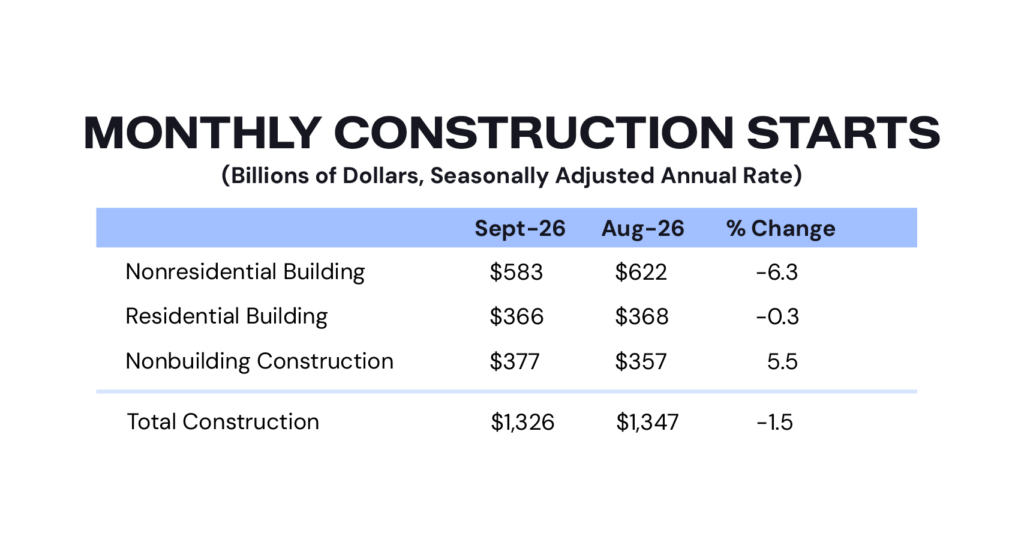
The U.S. Census Bureau estimated January 2026 construction spending at a seasonally adjusted annual rate of $2,190.4 billion. That was 0.3 percent below the revised December estimate of $2,197.6 billion, but 1.0 percent above the January 2025 estimate. U.S. Census Bureau
Private construction spending was estimated at $1,661.2 billion, down 0.6 percent from December. Within private construction, residential work was estimated at $933.0 billion and private nonresidential work was estimated at $728.2 billion. U.S. Census Bureau
Public work remains a key signal
Public construction moved in the other direction. Census estimated public construction spending at $529.2 billion in January, up 0.6 percent from the revised December estimate. Highway construction was estimated at $148.5 billion, up 3.3 percent from December, while educational construction was estimated at $114.1 billion. U.S. Census Bureau
Labor still shapes project delivery
Spending is only one side of the market. Associated Builders and Contractors estimated that the industry needs to attract 349,000 net new workers in 2026 to meet demand, with the need rising to 456,000 workers in 2027 if spending growth resumes. Associated Builders and Contractors
ABC Chief Economist Anirban Basu said the industry needs those workers “just to keep the supply and demand for labor in equilibrium.” For owners and contractors, that means preconstruction planning, realistic schedules, and early trade partner coordination remain just as important as headline market growth. Associated Builders and Contractors
Bottom line
The January data points to a market that is steady but selective. Public infrastructure continues to support activity, private work is more mixed, and workforce capacity remains a practical constraint. For construction teams, the advantage goes to firms that plan early, communicate clearly, and manage risk before work reaches the field.
Sources: U.S. Census Bureau, Monthly Construction Spending, January 2026; Associated Builders and Contractors workforce analysis.


Let's connect
For organizations planning commercial, industrial, or infrastructure work, we will review the project and recommend the appropriate delivery approach.

Join our team
If you hold yourself to careful, accountable work, you already work the way we do.