
U.S. Pharma and Semiconductor Manufacturing Construction: The $100 Billion+ Industrial Buildout Reshaping the Map
Two of the most capital-intensive sectors in the American economy are executing simultaneous, large-scale domestic manufacturing buildouts in 2026 — and the construction industry is absorbing the consequences. The pharmaceutical and semiconductor sectors together represent well over $100 billion in active U.S. construction commitments, spanning fabrication plants in Idaho, biomanufacturing campuses in Indiana and North Carolina, API production facilities in Virginia, and cleanroom complexes in Ohio and Arizona. The pace of project announcements, groundbreakings, and active construction activity in the first half of 2026 signals a reshoring wave that is no longer speculative — it is in the ground.
Micron's $50 Billion Boise Campus: A Generational Semiconductor Construction Project
One of the largest manufacturing construction projects currently underway in the United States is advancing in Boise, Idaho, where Micron Technology is building a semiconductor production campus representing a planned total investment of approximately $50 billion. According to Construction Owners reporting from June 1, 2026, the company's first fabrication plant — a structure extending more than one-third of a mile in length with approximately 600,000 square feet of cleanroom space — is preparing to receive manufacturing equipment later this year, with the first wafer production targeted for mid-2027.
A second fabrication plant is already in the earthwork phase, with rock blasting and grading operations underway to prepare the building platform adjacent to the first facility. The campus includes extensive utility networks, cooling systems, water treatment infrastructure, fire protection systems, and specialized support equipment. The full Boise expansion is projected to create more than 4,000 Micron jobs and has already driven significant construction employment, supplier investment, and workforce development activity across Idaho. The project illustrates the construction complexity of semiconductor manufacturing: in addition to the primary production buildings, each fab requires years of supporting infrastructure development before a single chip can be produced.
The CHIPS Act Ecosystem: $169 Billion in Active Fab Projects
Micron's Boise campus is one node in a national buildout. Analysis by Specialty Chemicals Online shows that over $169 billion in semiconductor fabrication projects are currently underway in the United States, with another $200 billion proposed or in early development. Arizona, Texas, and New York are emerging as the primary hubs, with TSMC's advanced chip production in Arizona, Samsung's next-generation facility in Texas, and Intel's Ohio "Silicon Heartland" campus representing the flagship investments of the cycle. The Semiconductor Industry Association reports that over $630 billion in announced private investment has been committed to domestic semiconductor manufacturing since 2020.
Construction costs for these facilities are extraordinary. TSMC has stated that its Arizona facility construction costs run four to five times higher than an equivalent facility in Taiwan, driven by labor costs, regulatory requirements, and training demands for a workforce that has not built semiconductor fabs at this scale in the United States for decades. Intel's Ohio campus has generated over 10 million construction labor hours to date; initial chip production timelines have extended to approximately 2030 to 2031 as the company manages capital deployment and demand alignment. The labor and permitting bottlenecks are now the critical path items for the CHIPS Act buildout, as every major recipient simultaneously manages a megaproject construction program while standing up a domestic supplier base.
Pharmaceutical Manufacturing: Lilly, AbbVie, and a Reshoring Wave Driven by Drug Demand
The pharmaceutical sector's U.S. construction activity in 2026 is driven by a combination of demand for GLP-1 weight loss drugs, oncology biologics, and gene therapies — plus a policy environment that is accelerating domestic manufacturing commitments. MP Consulting Group's May 2026 project watch documents the two headline investments of the quarter:
- Eli Lilly — Lebanon, Indiana: A further $4.5 billion committed across Lilly's Lebanon campus brings total Indiana capital spending to over $21 billion since 2020. The investment supports a new dedicated genetic medicines facility — already open — and the future Lebanon API site, which is projected to become the largest active pharmaceutical ingredient production facility in U.S. history when it opens in 2027.
- AbbVie — Durham, North Carolina: A $1.4 billion commitment representing AbbVie's largest single capital investment to date. The 185-acre AI-integrated campus will produce immunology, neuroscience, and oncology medicines, with the first phase covering small volume parenteral drug product, next-generation laboratories, and warehouse facilities. The project is projected to create 734 permanent roles and over 2,000 construction jobs.
GEN's 2026 biopharma cluster analysis adds additional context: AstraZeneca has expanded the scope of its new manufacturing facility in Charlottesville, Virginia to a $4.5 billion project covering manufacturing for weight management, metabolic, and cancer technologies. Merck broke ground on a $3 billion Center of Excellence for Pharmaceutical Manufacturing in Elkton, Virginia. Eli Lilly announced a $5 billion manufacturing facility in Goochland County, Virginia — the company's first integrated API and drug product facility for its bioconjugate and monoclonal antibody platform. Roche's Genentech subsidiary expanded its first East Coast manufacturing facility in Holly Springs, North Carolina to a $2 billion project. North Carolina alone has seen $24.5 billion in announced pharmaceutical and life science investments since 2021.
Construction Complexity and Cost Escalation
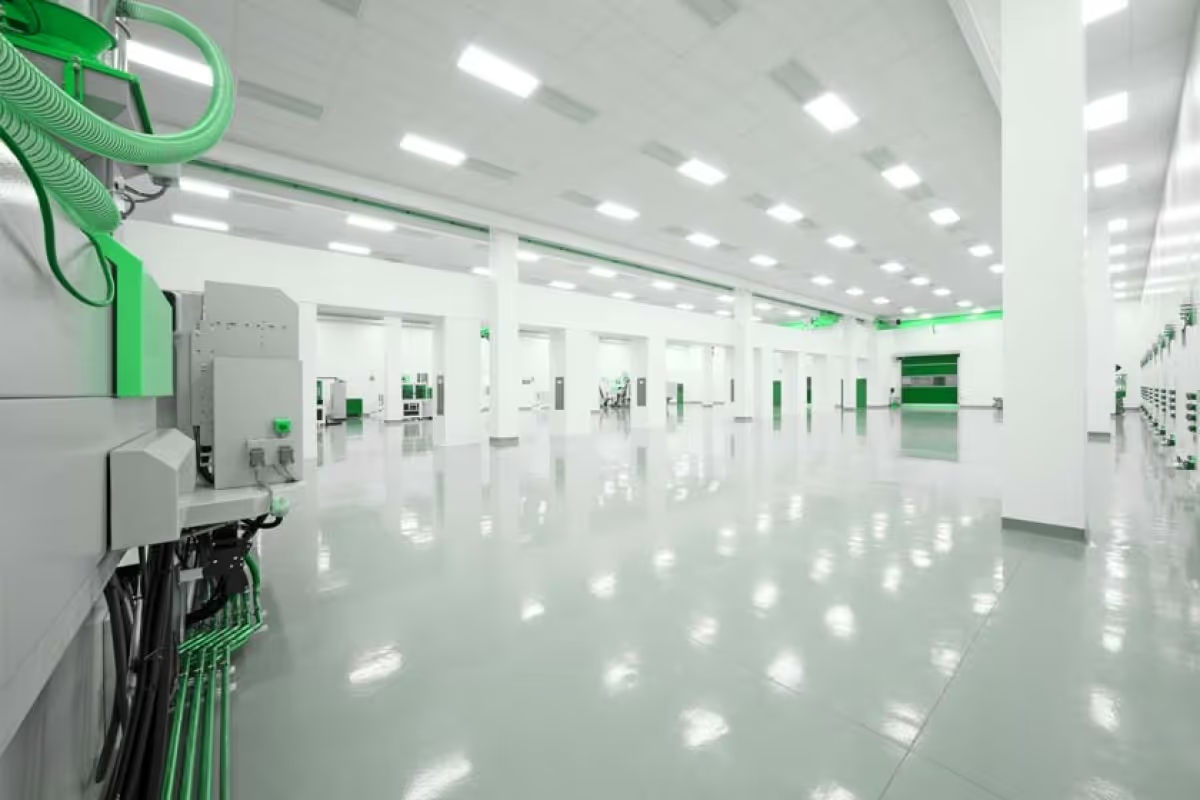
Advanced manufacturing construction presents different challenges than conventional nonresidential building. Pharmaceutical facilities require pharmaceutical-grade HVAC and cleanroom environments, specialized process piping, complex utility systems, and regulatory compliance documentation that runs in parallel with physical construction. Semiconductor fabs require cleanrooms with contamination controls measured in parts per trillion, ultra-pure water systems, process gas delivery infrastructure, and vibration isolation that exceeds nearly any other building type in precision requirement.
Mortenson's Q1 2026 Construction Cost Index identified advanced manufacturing as one of the primary drivers of labor demand and pricing pressure in select markets, alongside data center and healthcare construction. Nationally, nonresidential construction costs rose 1.69 percent quarter-over-quarter and 6.77 percent year-over-year in Q1 2026, with advanced manufacturing projects among the largest contributors to labor absorption and material demand. The tariff environment — with steel at a 50 percent Section 232 tariff and aluminum at 50 percent — is adding direct cost pressure to steel-intensive fab construction, particularly for structural systems, utility distribution, and equipment mounting.
The Manufacturing Pipeline: Pharmaceutical Capital Projects in May 2026
Beyond the headline investments, the broader advanced manufacturing pipeline remains active. Industrial SalesLeads' May 2026 capital project tracking identified Eli Lilly's ongoing $4.5 billion Lebanon, Indiana expansion, AbbVie's $1 billion Durham, North Carolina campus (noted separately from the April commitment as construction approval advances), and Bristol Myers Squibb's reported evaluation of a $1 billion manufacturing facility in Houston, Texas. Chemical manufacturers INEOS Acetyls and Sandpiper Chemicals are planning a $1.7 billion methanol processing facility in Texas City, Texas. Building materials manufacturer USG Corp. is planning a $1.2 billion manufacturing and warehouse facility in Orange, Texas.
The pattern across all of these investments is consistent: domestic production capacity for strategically important products, from GLP-1 biologics to semiconductor memory chips to chemical feedstocks, is being built at a pace and scale that was not visible in the U.S. construction market five years ago. The construction industry is absorbing the project volume — but the combination of specialized labor requirements, long-lead equipment, regulatory complexity, and tariff-driven cost pressure means that execution capability, not capital availability, has become the binding constraint on the advanced manufacturing buildout.
Sources
- Construction Owners, Micron's Boise Megaproject Accelerates (June 1, 2026)
- Genetic Engineering & Biotechnology News, Top 10 U.S. Biopharma Clusters 2026 (June 1, 2026)
- Specialty Chemicals Online, America's Semiconductor Facilities Are Being Built (June 1, 2026)
- MP Consulting Group, Project Watch May 2026 (May 19, 2026)
- Mortenson Construction Cost Index Q1 2026 (June 2, 2026)
- Powder Bulk Solids / Industrial SalesLeads, Manufacturing Capital Projects in May 2026 (June 5, 2026)

Discuss an Upcoming Project


