
Moog Opens $150M, 150,000-SF Advanced Manufacturing Plant in East Aurora
Moog Inc. formally opened a $150 million Advanced Integrated Manufacturing (AIM) facility at its East Aurora headquarters campus on Friday, Aug. 14, 2026, timing the ribbon cutting to the company's 75th anniversary. The building spans 150,000 square feet and gives Moog roughly 50 percent more space than the operation it replaces (Moog Inc.). Empire State Development confirmed the investment figure and the anniversary event in a state release the same week (Empire State Development).
For a region that has spent the last several years chasing semiconductor, battery and data center announcements, the Moog project is a reminder that some of the most durable industrial construction in Western New York comes from companies already here, reinvesting in plants they intend to run for decades.
What Happened
The AIM facility is a machining consolidation project. Moog said it is transitioning approximately 1,500 parts into the new building over the next several years, with full production expected by October 2027 (Moog Inc.). The building itself was completed last year, which means the schedule now running is a process ramp rather than a construction schedule — equipment installation, qualification and part-by-part transfer.
Local coverage of the Aug. 14 event described the same $150 million investment and tied it to the company's anniversary programming (Spectrum News Buffalo). Moog President and Chief Executive Officer Pat Roche framed the project around consolidating machining cells into a single, modern operation rather than adding standalone capacity (Moog Inc.).
Gov. Kathy Hochul, in the state's release, called the company a "crown jewel of New York manufacturing" (Empire State Development).
The Broader Capital Program
AIM is the largest piece of a multi-site program. Moog reported more than $300 million invested in Western New York over the last five years, including a 120,000-square-foot expansion of its Space Actuation and Avionics center in East Aurora, a propulsion clean room expansion in Niagara Falls that increases capacity by roughly 80 percent, and a 13,000-square-foot Operations Training Center (Moog Inc.).
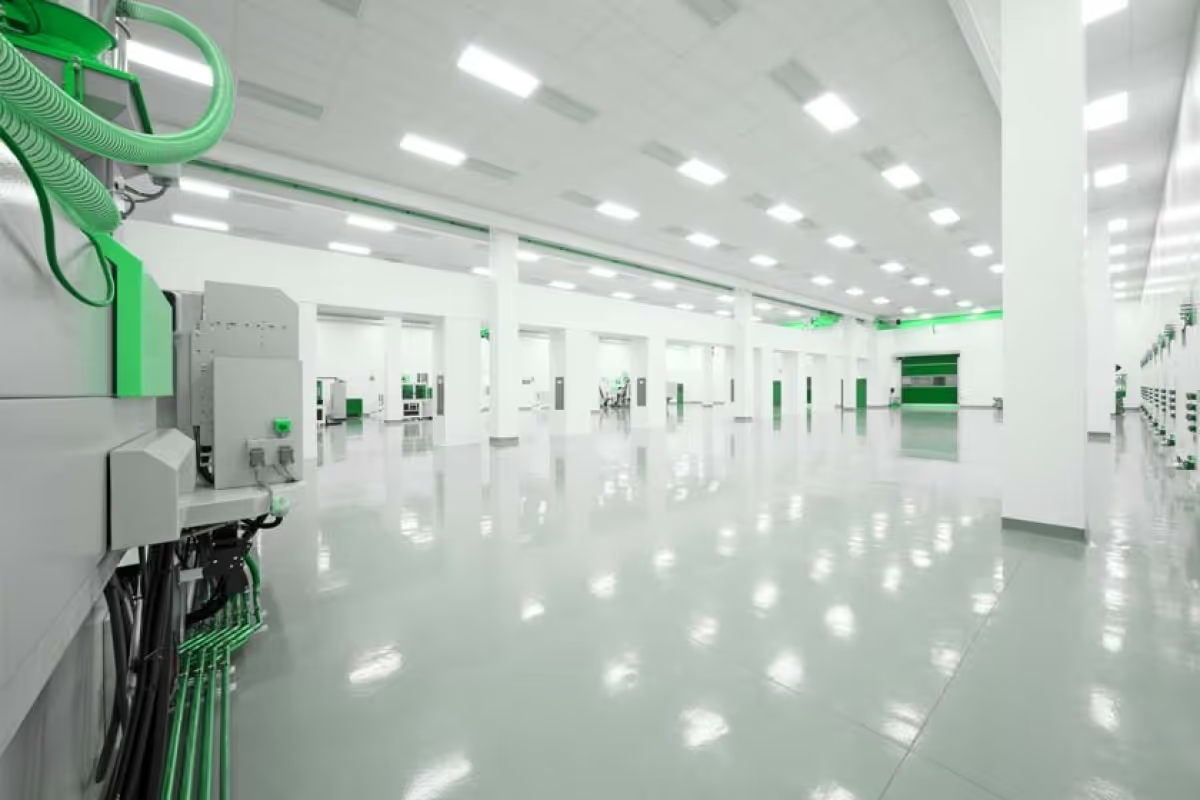
That is a meaningful pipeline of industrial, cleanroom and training-facility work spread across Erie and Niagara counties. The mix matters: cleanroom and precision-machining environments carry tighter tolerances on slab flatness, vibration isolation, HVAC filtration and electrical quality than a conventional warehouse or light-industrial shell, and they usually involve a longer commissioning tail.
Local Economic Footprint
Moog reported more than 4,300 employees in Western New York, roughly 30 percent of a global workforce exceeding 14,000, and approximately $40 million in annual spending with more than 200 Western New York suppliers (Moog Inc.). The company also announced 75 STEM scholarships of $1,951 each — a nod to its 1951 founding — distributed through Buffalo Prep, Dream It Do It WNY, the Northland Workforce Training Center and Say Yes Buffalo (Moog Inc.).
The Northland connection is worth noting for contractors. Northland trains for advanced manufacturing and skilled trades in Buffalo, and a large anchor employer funding that pipeline tends to raise, not lower, competition for the same electricians, millwrights, pipefitters and controls technicians that construction firms need.
Why It Matters to Construction Professionals
Three practical takeaways stand out.
- Owner-driven reinvestment is a different sales cycle than incentive-driven megaprojects. Moog's program is spread across several buildings and several years on land it already controls. Work like this rarely gets a groundbreaking press conference, and it often gets awarded to firms already prequalified on the campus.
- The construction is finished before the announcement. The AIM building was completed last year and is only now being celebrated as production transitions (Moog Inc.). For business development teams, the lesson is that public announcements are a lagging indicator; the buying decisions happened 24 to 36 months earlier.
- Precision manufacturing pulls specialty trades, not just general trades. A 150,000-square-foot machining consolidation implies heavy foundations, coolant and chip-handling systems, compressed air, high-capacity power distribution and crane or material-handling infrastructure — scopes that favor subcontractors with industrial process experience.
Implications for Owners, Developers and Subcontractors
For owners and developers, the Moog program is a template for phasing capital work without shutting down revenue-generating operations. Building new capacity first, then migrating roughly 1,500 parts over several years, protects delivery commitments to aerospace and defense customers who cannot tolerate interruption. The construction consequence is a longer, quieter, more relationship-driven scope of work: tie-ins, temporary utilities, phased occupancy and repeated small packages instead of one large bid.
For general contractors, the competitive question is whether you are on the campus standards list. Large manufacturers with multi-year programs typically standardize on a short list of design and construction partners, safety requirements and even preferred equipment vendors. Getting onto that list generally happens through smaller maintenance, tenant-fit and equipment-installation work, not through a single hard-bid pursuit.
For subcontractors, the East Aurora and Niagara Falls scopes described by Moog — cleanroom, avionics assembly, training space — suggest continued demand for mechanical, electrical and controls capacity in Erie and Niagara counties through at least 2027 (Moog Inc.). Firms with cleanroom certification and process-piping capability should expect to be pursued rather than merely invited.
What to Watch Next
The near-term milestone is the October 2027 full-production target for AIM (Moog Inc.). Ramps of this type frequently generate follow-on construction: added machine foundations, utility upsizing, expanded receiving and inspection areas, and sometimes additional office or lab space once the layout is proven in practice.
Also worth tracking is whether the Space Actuation and Avionics expansion and the Niagara Falls propulsion capacity increase lead to further phases. Space and defense propulsion demand has been the driver behind several Western New York industrial expansions, and Moog's own description of capacity gains suggests the company is positioning for volume growth rather than replacement (Moog Inc.).
Finally, watch the workforce side. Moog's scholarship commitments through Northland Workforce Training Center and Say Yes Buffalo are small in dollar terms but signal where the company expects its labor constraint to be (Moog Inc.). Contractors competing for the same technical labor pool should plan accordingly.
Bottom Line
Moog's $150 million, 150,000-square-foot AIM facility is now open, with about 1,500 parts moving in and full production targeted for October 2027 (Moog Inc.). Combined with more than $300 million in regional investment over five years, it confirms that East Aurora remains one of the most active private industrial construction campuses in Western New York — and that the most reliable work in this market often comes from established manufacturers quietly modernizing what they already own.
Sources
- Moog Inc. — "Moog Celebrates 75 Years": https://www.moog.com/news/operating-group-news/2026/moog-celebrates-75-years.html
- Empire State Development — Governor Hochul Celebrates Moog Inc.'s 75th Anniversary and $150M Investment: https://esd.ny.gov/esd-media-center/press-releases/governor-hochul-celebrates-moog-incs-75th-anniversary-and-150m
- Spectrum News Buffalo — "Moog celebrates opening of massive new facility," Aug. 14, 2026: https://spectrumlocalnews.com/nys/buffalo/news/2026/08/14/moog-celebrates-75th-anniversary---150m-investment-in-new-facility

Discuss an Upcoming Project


