
Offsite and Modular Construction Gets a White House Endorsement: What the 2026 Push Means for the Industry
For years, modular and offsite construction has been described as a promising but underutilized technology in the United States—capable of reducing construction timelines by 30 to 50 percent and cutting costs by 20 percent or more, yet consistently accounting for less than 5 percent of new construction activity. In 2026, that narrative is beginning to change in a meaningful way. The White House Economic Report of the President explicitly endorsed modular construction as a solution to the national housing shortage. Three new ICC/MBI standards are moving toward broader adoption. Government agencies at the city, state, and federal level are launching programs specifically designed to build modular manufacturing capacity. And the U.S. modular construction market has grown to approximately $20 billion—a figure that puts it on a trajectory that market analysts project will sustain growth through the early 2030s.
The White House Endorsement
In April 2026, the Modular Building Institute highlighted that the White House's 2026 Economic Report of the President explicitly called for "unleashing manufacturing innovation" and "streamlining the stages of homebuilding" as key solutions to the housing shortage, according to an MBI LinkedIn post citing Chapter 6 (p. 150) of the report. The report specifically cited three national offsite construction standards developed by MBI as goals for industry alignment:
ICC/MBI 1200 — Standard for Off-site Construction: Planning, Design, Fabrication and Assembly
ICC/MBI 1205 — Standard for Off-site Construction: Inspection and Regulatory Compliance
ICC/MBI 1210 — Standard for Mechanical, Electrical, Plumbing Systems, Energy Efficiency and Water Conservation in Off-site Construction
"Washington is clearly signaling that housing must be built with a more manufacturing-centric mindset," said Tom Hardiman, CAE, Executive Director of the Modular Building Institute. "That's exactly what modular construction delivers—speed, scale, and efficiency. This report is a strong validation of the approach our industry has been advancing."
The White House endorsement follows a March 2026 executive order on removing regulatory barriers to affordable home construction that specifically directed states and localities to stop restricting manufactured and modular housing based solely on construction method rather than objective building and safety standards—a long-standing barrier to modular adoption in many markets.
Market Size and Growth
The U.S. modular construction market is valued at approximately $19.9 billion in 2026, growing at a compound annual growth rate of 6.5% over the past five years, according to IBISWorld. The broader North American market for all modular construction reached approximately $26.2 billion in 2026, while the global market hit $100.8 billion, projected to grow to $175.6 billion by 2034 at a 7.2% CAGR, according to Fortune Business Insights.
Within the U.S. market, permanent modular construction (PMC)—structures built to remain in place rather than be relocated—accounts for the majority of activity and is growing fastest. Commercial applications lead market share, but residential modular is growing rapidly in response to housing supply pressure, including both affordable housing projects and market-rate development.
At the MBI's 2026 World of Modular conference, MBI partnered with FMI Consulting to present the latest permanent modular construction industry data, including more specific regional data across the four U.S. Census regions. The data showed that Canada's modular sector is experiencing "unprecedented momentum" from federal commitments to factory-built housing—and that the U.S. market is watching closely as a potential policy model.
Cities and States Are Building Modular Manufacturing Capacity
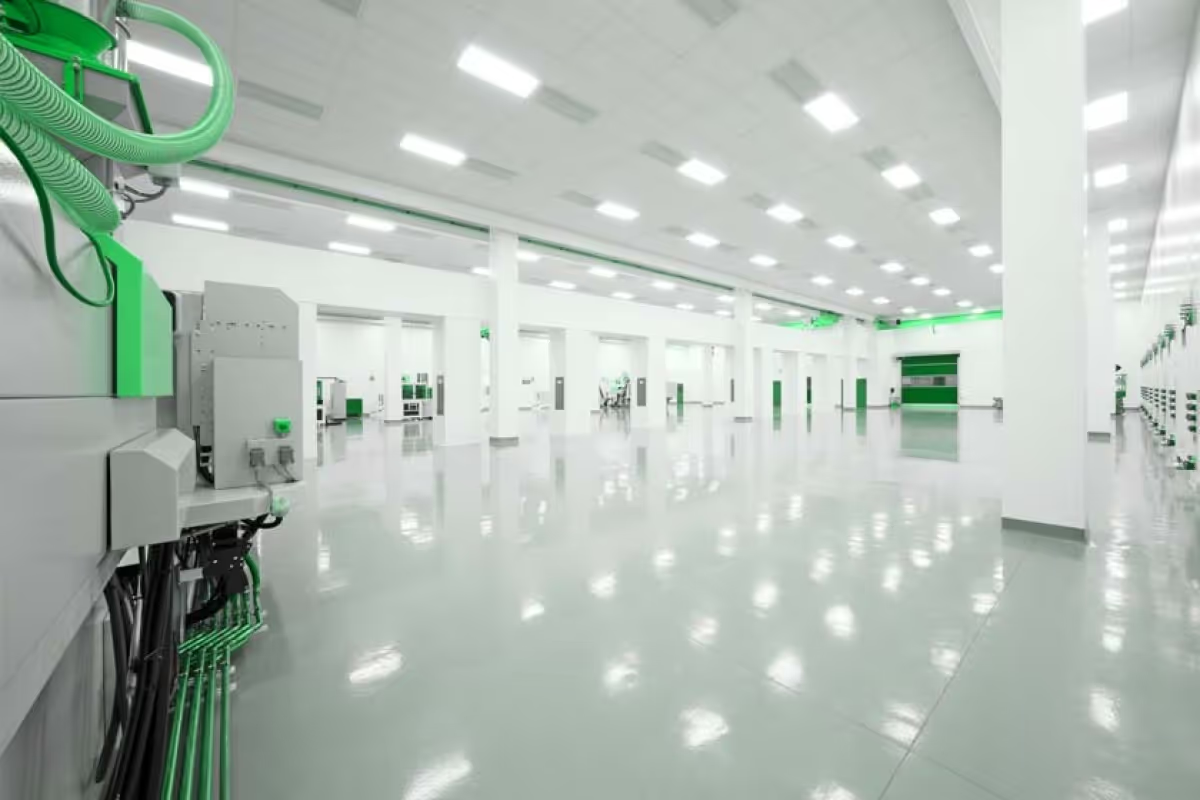
Perhaps the most significant development in the U.S. modular market is the emergence of government-led demand-creation strategies designed to address one of the fundamental economic barriers to modular adoption: the cost of factory construction. Building a new modular manufacturing facility requires capital investment of $40 million to $50 million, according to the National Housing Crisis Task Force. Without a reliable pipeline of orders, that investment is difficult to justify.
Cleveland has addressed this through the Site Readiness Fund, which issued an RFP in late 2025 to attract an offsite construction manufacturer to a 20-plus-acre parcel of land in the city. The city secured base demand commitments of 100 to 200 homes annually over ten years beginning in 2026. A new Cleveland modular factory is expected to serve not just the city but the broader metro area and nearby cities including Columbus, Toledo, Pittsburgh, Detroit, and Buffalo, New York—all within three hours via interstate.
The Boston region's Metropolitan Area Planning Council received a $3 million HUD PRO Housing grant to develop a strategy for cooperative pre-purchasing of modular housing across Boston, Cambridge, Everett, and Newton—with a goal of producing 500 units annually by 2030. The strategy explicitly targets establishing a modular manufacturing facility within 50 miles of Boston, which the MAPC identified as the most significant barrier to modular adoption in the region.
The Minneapolis Public Housing Authority successfully demonstrated the model with its Family Housing Expansion Project, delivering 84 public housing units across 16 developments using modular construction, achieving a 30% faster delivery timeline compared to conventional construction methods, according to the National Housing Crisis Task Force.
The Regulatory Barrier That Remained—and Is Now Being Addressed
The largest structural barrier to modular construction in the United States has been the absence of a uniform national building code. While manufactured housing (mobile homes on permanent chassis) is regulated by a HUD federal code, all other modular buildings are regulated at the state and local level. This creates a patchwork of requirements that can require manufacturers to customize units for different jurisdictions—increasing costs and reducing the efficiency gains that make modular attractive.
The ICC/MBI standards cited in the White House Economic Report are designed to create greater harmony in the industry. Broader adoption of these standards, combined with the March 2026 executive order directing states to remove arbitrary restrictions on modular housing, represents the most sustained federal push toward modular code standardization the industry has seen.
What It Means for the Construction Industry
For construction professionals, the modular and offsite shift represents both a competitive challenge and an opportunity. Projects that shift to offsite manufacturing reduce on-site labor demand and weather-related delays. Modular structures can be manufactured in parallel with site preparation, shortening overall schedules. Material waste is significantly lower in factory settings than in traditional construction.
At the same time, the growth of modular creates demand for a different kind of construction work: factory floor operations, transportation logistics, crane and installation work, and site preparation for modular delivery. General contractors who develop expertise in hybrid delivery—combining modular components with conventional site work—are positioned to capture projects in residential, healthcare, education, and hospitality sectors that are driving modular adoption.
Sources
Modular Building Institute — White House Economic Report Recognition (LinkedIn, April 28, 2026)
IBISWorld — Prefabricated Home Manufacturing in the US Industry Data (February 2026)
Fortune Business Insights — Modular Construction Market Size (May 2026)
Modular Building Institute — 2026 World of Modular Agenda (April 28, 2026)
National Housing Crisis Task Force — Pre-Purchasing to Increase Modular Capacity
White House — Executive Order: Removing Regulatory Barriers to Affordable Home Construction (March 13, 2026)

Discuss an Upcoming Project


