
EPA Launches Water Reuse Action Plan 2.0 — What It Means for Water Infrastructure Construction
Water infrastructure construction is entering a new phase, driven in part by a federal initiative that reframes recycled water not as an environmental nicety but as critical industrial infrastructure. On April 16, 2026, EPA Administrator Lee Zeldin launched the Water Reuse Action Plan 2.0 (WRAP 2.0), a non-regulatory, public-private initiative designed to accelerate the adoption of water reuse across American industry, the technology sector, and energy development. The plan builds on the original WRAP launched during the first Trump administration in 2020 and now involves more than 200 federal, state, tribal, industry, and water sector partners working on 76 active actions.
What WRAP 2.0 Is and Is Not
WRAP 2.0 is explicitly not a federal regulatory mandate. It operates through voluntary commitments, cooperative agreements, and collaborative partnerships between government and private sector participants. Administrator Zeldin described the initiative: "Water reuse has never been more important. WRAP 2.0 builds on the strong foundation established during President Trump's first term and unleashes the power of American ingenuity to advance prosperity and make America the global AI leader, while supporting public health and strengthening water resources."
The plan is organized around three high-impact initiatives:
- Supporting Reuse for Resurgent Domestic Industry — component fabrication (bottles, batteries), finished products (food and beverage, automobiles), and agricultural production.
- Water for the U.S. Technology Revolution — microchip and memory fabrication and data center cooling.
- Unleashing American Energy Dominance — electricity generation and energy development, including produced water reuse from oil and gas operations.
The Data Center Cooling Connection
The technology sector's water demand is the most immediate driver of new water reuse infrastructure investment. Large-scale AI data centers require vast quantities of water for cooling — and the gap between available water supply and cooling demand is already generating construction activity. In Loudoun County, Virginia, outside Washington, D.C., over 745 million gallons of recycled, non-potable, reclaimed water was used to cool data centers in 2025 alone — a figure that illustrates both the scale of demand and the feasibility of meeting it with recycled water infrastructure.
Under WRAP 2.0, partners will develop a tool to map available recycled water capacity for connection with industrial users — a project that could enable municipalities with excess reclaimed water supply to market that capacity to nearby data centers, manufacturers, and processors, potentially offsetting capital costs for advanced treatment infrastructure through industrial water sales.
Construction Categories This Plan Accelerates
WRAP 2.0 is not a grant program and does not directly fund construction. However, its emphasis on removing permitting barriers, streamlining regulations, and building public-private partnerships has direct implications for the pace and scale of water reuse infrastructure investment. The National Association of Home Builders noted that for builders and developers facing water scarcity challenges, the plan could help ensure continued, reliable mitigation options for communities in arid and water-stressed regions.
Near-term project categories the plan points toward include:
- Advanced water purification (AWP) facilities — The most capital-intensive form of water reuse, AWP plants treat wastewater to drinking water standards through membrane bioreactor, reverse osmosis, and UV/AOP systems. These facilities cost $50 million to several hundred million dollars each and are the fastest-growing category in water capital investment in Western states.
- Non-potable recycled water distribution systems — Purple-pipe infrastructure networks that distribute reclaimed water to industrial, commercial, and irrigation customers are a growing construction category, particularly in drought-prone Sun Belt and Western states.
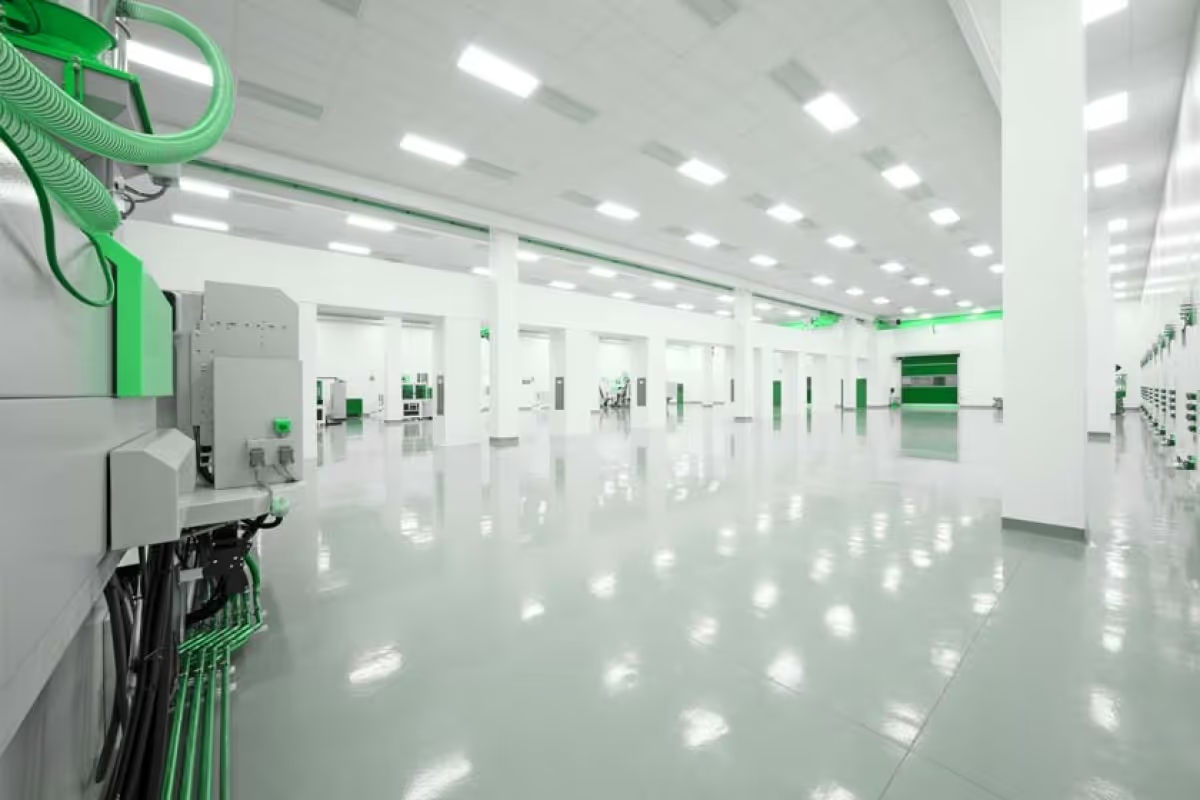
- Industrial on-site water reuse systems — Treatment systems integrated into semiconductor fabs, food and beverage plants, and data center cooling systems that recycle process water on-site, reducing both intake demand and discharge volume.
- Produced water treatment infrastructure — WRAP 2.0 specifically targets produced water reuse in energy development, aiming to expand regulatory flexibility for treating oil and gas wastewater for beneficial uses including industrial cooling, critical mineral extraction, and agriculture — which could generate significant new construction for treatment systems in Permian Basin, Appalachian, and other producing regions.
Where Experts See Friction
Not all observers are optimistic about the plan's near-term construction impact. Street Lee, president and CEO of civil engineering firm McKim & Creed, cautioned that encouraging coordination between agencies and utilities does not fully address the core bottlenecks that slow reuse projects. He identified three persistent friction points: inconsistent state regulations (while states like Florida have mature reuse frameworks, many others have limited or no structure for advanced reuse); competing capital priorities at utilities already managing PFAS treatment, lead service line replacement, and system rehabilitation; and public perception challenges in communities where stigma associated with treated wastewater can lead ratepayers to prefer other options.
Those headwinds are real — but they are the same ones that characterized potable reuse 15 years ago, before California, Texas, and Florida built large direct and indirect potable reuse programs now serving millions of customers.
Who Is Participating
WRAP 2.0's 200-plus partners span an unusually wide range of sectors. Industry participants include Micron Technology — which has committed to 75% water conservation through onsite reuse and recycling by 2030 — along with Grundfos, Veolia, Xylem, the American Petroleum Institute, the U.S. Chamber of Commerce, and the National Association of Home Builders. Water sector participants include the WateReuse Association, the Water Environment Federation, and the Metropolitan Water District of Southern California. Federal partners include NOAA, the Council on Environmental Quality, and the U.S. Department of Agriculture.
What to Watch Next
The near-term indicator to watch is whether WRAP 2.0's streamlined permitting commitments translate into measurable reductions in project development timelines. The EPA has signaled it will work to streamline permitting for water reuse projects within existing Clean Water Act and Safe Drinking Water Act authorities — if that translates into faster state-level permit approvals, it could meaningfully shorten the preconstruction timeline for advanced treatment plants that currently face multi-year regulatory processes. The industrial reuse mapping tool being developed by the WateReuse Coalition will also be worth monitoring: connecting municipalities with available reclaimed water capacity to industrial buyers could unlock infrastructure investment not previously economically viable without a committed off-taker.
Bottom Line
WRAP 2.0 is a policy framework, not a construction program — and its direct effect on near-term project starts will be modest compared to a dedicated federal funding vehicle. But it matters for the construction industry because it signals that the federal government views water reuse infrastructure as a strategic priority for AI, manufacturing, and energy competitiveness. That framing can accelerate state-level regulatory action, attract private capital, and give utilities and industrial users the political cover to pursue advanced treatment investments they might otherwise defer. For water infrastructure contractors, engineers, and equipment manufacturers, the message is clear: the market is growing and federal policy wants it to grow faster.
Sources: EPA — WRAP 2.0 Press Release (April 16, 2026); EPA — Water Reuse Action Plan 2.0; Smart Cities Dive — WRAP 2.0 Expert Analysis; WateReuse Association — New Actions Commitment; NAHB — WRAP 2.0 Commentary; Holland & Hart LLP — WRAP 2.0 Legal Analysis; Oklahoma Farm Report — Industry Partner Statements

Discuss an Upcoming Project


