
America's First Domestic Semiconductor Pump Factory Opens in Genesee County This Fall
A manufacturing milestone decades in the making is now weeks away from becoming reality in Genesee County. Edwards Vacuum, part of the global Atlas Copco Group, is putting the finishing touches on a $319 million, 240,000-square-foot dry pump manufacturing facility at the Western New York Science and Technology Advanced Manufacturing Park — better known as WNY STAMP — in the town of Alabama. The plant's grand opening is set for November 2026, and when it opens, it will be the first facility in the United States dedicated to producing semiconductor-grade dry vacuum pumps.
For the construction and manufacturing industries in Western New York and the Finger Lakes, this project represents something more than a single factory coming online. It is the leading edge of a coordinated push to build a semiconductor supply chain corridor stretching across Upstate New York — one that links Genesee County directly to Micron Technology's massive chip fabrication campus under construction in Clay, outside Syracuse.
What Edwards Vacuum Makes — and Why It Matters
Dry vacuum pumps are a critical but often invisible component of semiconductor fabrication. Inside a chip fab, these pumps create and maintain the ultra-low pressure environments that allow circuit patterns to be etched into silicon wafers at nanometer scales. Without them, no chip gets made. According to the U.S. Department of Commerce's CHIPS Act program office, prior to the Edwards Genesee facility, there was no domestic production of semiconductor-grade dry vacuum pumps anywhere in the country. Every pump used in American chip fabs was manufactured in Asia.
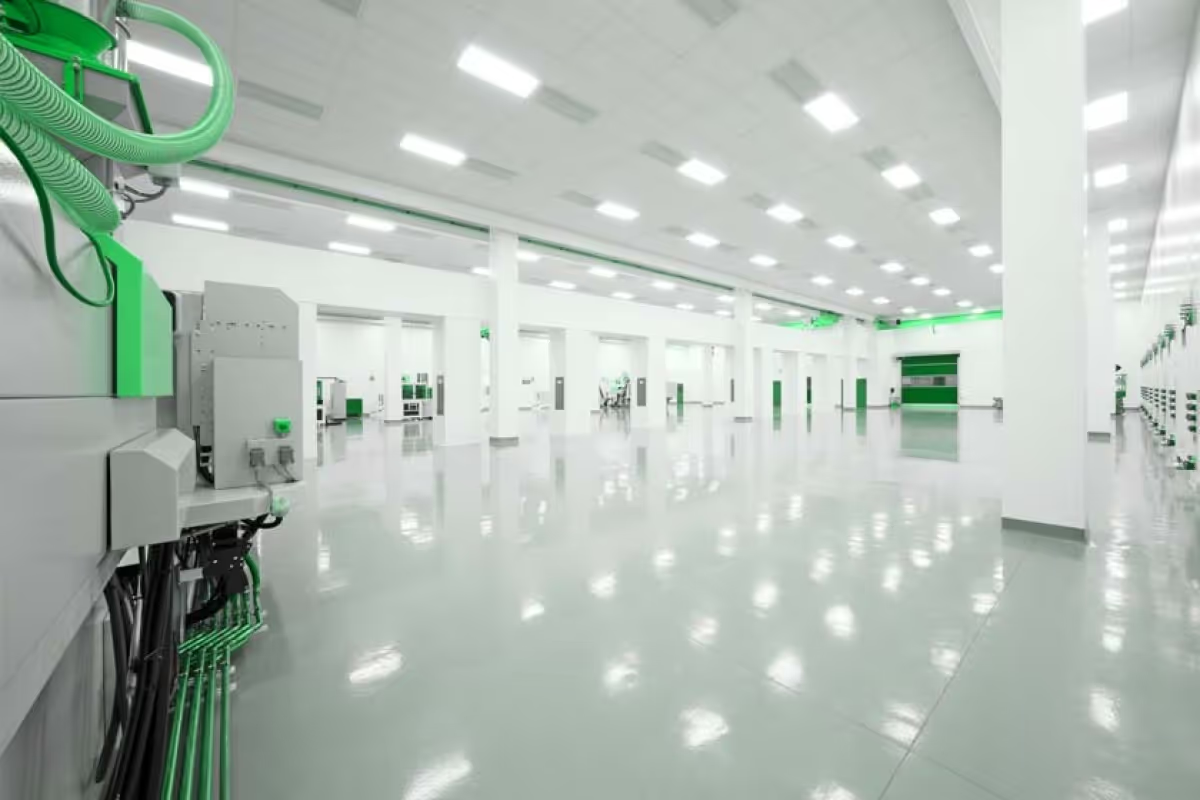
Edwards' new Genesee plant changes that. According to the company's own facility status page, the 240,000-square-foot campus is now past the construction phase and in commissioning, with teams actively working on-site. Phase one will produce up to 10,000 dry pumps per year, with the physical capacity to scale to 20,000 annually as demand from domestic chip fabs accelerates.
Construction Milestones and Public Investment
Edwards broke ground in April 2024, following an announcement made by Governor Kathy Hochul and Senate Majority Leader Chuck Schumer in November 2022. The Genesee County Economic Development Center confirmed at groundbreaking that Phase 1 carries a price tag of $127 million, encompassing manufacturing floor space, warehouse facilities, and administrative buildings. The full multi-phase project — which will expand the campus and workforce over seven years — is budgeted at $319 million.
Public investment has been substantial. The Department of Commerce's CHIPS Act program awarded Edwards up to $18 million in direct federal funding for construction, citing national security rationale: the absence of domestic dry pump production represents a vulnerability in the entire U.S. semiconductor manufacturing supply chain. Empire State Development separately committed up to $21 million in Excelsior Jobs Tax Credits and Investment Tax Credits tied to job creation. The New York Power Authority allocated a 4.9-megawatt low-cost Niagara hydropower block — a significant competitive advantage given the facility's all-electric design.
The STAMP site itself has received more than $74 million in state infrastructure investment to prepare utilities, roads, and transmission connections on the 1,250-acre campus, according to CPL Engineering, which handled civil and site engineering work.
Jobs, Training, and Local Economic Impact
When Phase 1 reaches full staffing, Edwards projects approximately 280 new jobs at the Genesee facility — all described as skilled, well-paid manufacturing positions. Over the full seven-year buildout, employment could reach 600 workers. Governor Hochul's office noted at the August 2024 construction milestone ceremony that the facility will also draw workers from both the Buffalo and Rochester labor markets, given its location between the two metros at the STAMP site in Alabama.
The construction phase itself generated roughly 100 direct construction jobs, according to the CHIPS Act award summary. Edwards has been coordinating with SUNY Genesee Community College and other regional institutions on workforce development programming to build the pipeline of technicians the plant will need at scale.
A LEED-Certified, All-Electric Manufacturing Facility
The Edwards Genesee facility was designed from the start for environmental performance. The company's November 2024 announcement confirmed the building is pursuing LEED certification, is fully electric, and draws the majority of its power from Niagara hydroelectric sources. Only 21 percent of the 50-acre site is dedicated to buildings and pavement; the remaining 79 percent is permeable surface and green space. Edwards estimates the facility will eliminate approximately 13,000 tonnes of CO2 equivalent per year in freight emissions alone, compared to the current model of importing pumps from Asia.
The Broader STAMP Picture
Edwards is STAMP's first fully operational tenant to reach the commissioning phase. The 1,250-acre campus still has more than 470 buildable acres available, according to GCEDC's current site data. A separate, highly contested proposal from Stream U.S. Data Centers for a 900,000-square-foot data center at STAMP was approved in early 2025 but faces ongoing environmental and permitting challenges. Edwards, by contrast, moved steadily from announcement to construction to commissioning in just under two years — a timeline that reflects the combination of site readiness, public-sector coordination, and the urgency of domestic semiconductor supply chain investment created by the CHIPS Act.
For the broader Western New York and Finger Lakes construction market, the Edwards facility signals that STAMP is beginning to deliver on its decade-long promise. Construction professionals, suppliers, and workforce development organizations across the region will be watching November's grand opening as a proof-of-concept for what shovel-ready, utility-served mega-site development can attract when the policy and infrastructure conditions align.
Sources
- Edwards Vacuum — Genesee Dry Pump Facility (facility status page, 2026)
- U.S. Department of Commerce CHIPS Act — Edwards Vacuum (New York) project summary
- GCEDC — Edwards Starts Construction at STAMP (April 2024)
- NY Governor's Office — Hochul and Schumer Announce Edwards Vacuum Progress (August 2024)
- Edwards Vacuum — Introducing Edwards Genesee (November 2024)
- Genesee County Economic Development Center — STAMP site overview
- WHAM-TV — $300M Semiconductor Factory in Genesee County Nears Completion (February 2026)

Discuss an Upcoming Project


