
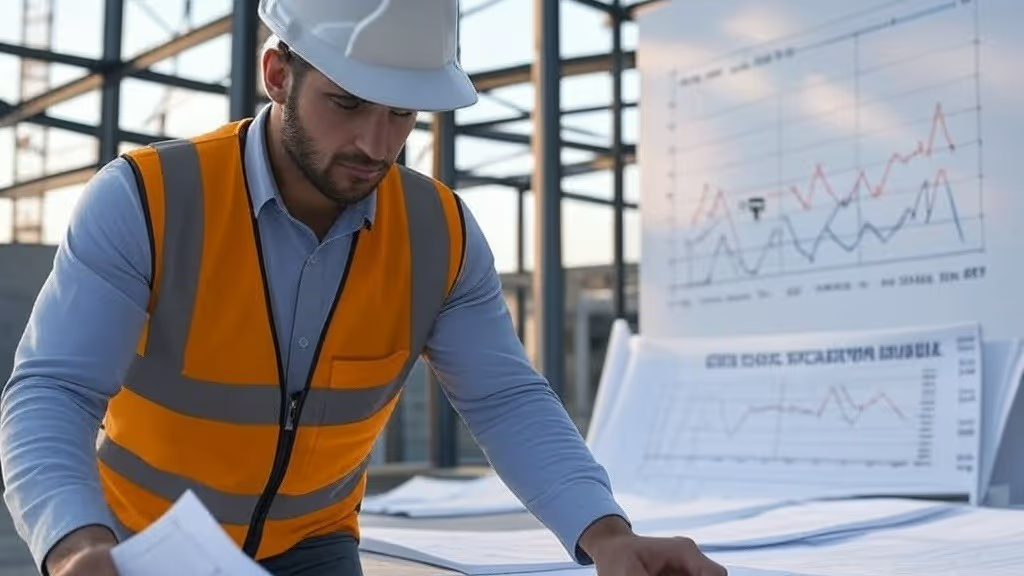
Construction Sector Contraction Signals Economic Headwinds; AI Infrastructure to Lead Future Growth
The U.S. construction industry faces a 2.7% annual decline in real terms in 2025, according to new analysis from ResearchAndMarkets.com's comprehensive industry forecast. The downturn reflects a challenging economic environment driven by trade policy uncertainty, rising input costs, and weakened builder sentiment—headwinds that are disrupting supply chains and delaying major project delivery across commercial, industrial, and residential sectors.
Root Causes of 2025 Construction Decline
The primary driver of the slowdown is the U.S. President's global trade policy, which has contributed to structural inflation in construction materials and labor costs. What initially appeared as industry absorption of tariffs—masked through inflated inventories and contractor margins—has evolved into widespread supply chain disruption.
Key impacts of trade policy on construction:
- Rising input costs — Steel, lumber, equipment, and other critical materials have become more expensive, compressing contractor profit margins
- Supply chain delays — Trade friction is causing delays in material delivery and project sequencing
- Builder sentiment decline — Uncertainty about future tariffs and input cost stability is causing builders to postpone investment decisions
- Project delays — Major construction projects are being delayed as developers reassess economics and financing
The combined effect has weakened the three largest construction sectors: commercial, industrial, and residential, which together represent the majority of U.S. construction market value.
What This Means for Contractors and Builders
For contractors and builders, 2025 represents a challenging operating environment. Margin compression, project delays, and increased risk are defining the year. Many contractors that expanded capacity during the 2020-2024 boom are now managing underutilized operations and higher fixed costs.
Strategic priorities for contractors in this environment include:
- Cost management and efficiency — Optimizing labor scheduling, material procurement, and supply chain logistics
- Risk hedging — Locking in material prices where possible and negotiating fixed-price contracts with escalation caps
- Client communication — Managing project timelines and costs proactively with owners and developers
- Workforce adaptation — Right-sizing labor forces and investing in worker retention for expected recovery
The decline is not uniform across all sectors. Infrastructure projects funded by federal legislation remain relatively strong, and energy/utilities construction continues to show resilience.
Recovery Trajectory: 1.9% Annual Growth 2026-2029
While 2025 is challenging, the construction industry is expected to rebound with 1.9% average annual growth from 2026 through 2029. This recovery will be driven by a fundamentally transformative force in the global economy: artificial intelligence infrastructure development.
AI-driven construction opportunities include:
- Data center construction — Tech companies and cloud providers are racing to build capacity for AI training and inference. Data center construction is expected to become one of the largest construction sectors by the end of the decade
- Power generation and transmission infrastructure — Data centers demand massive amounts of reliable, clean power. Construction of power plants, microgrids, and transmission lines is accelerating
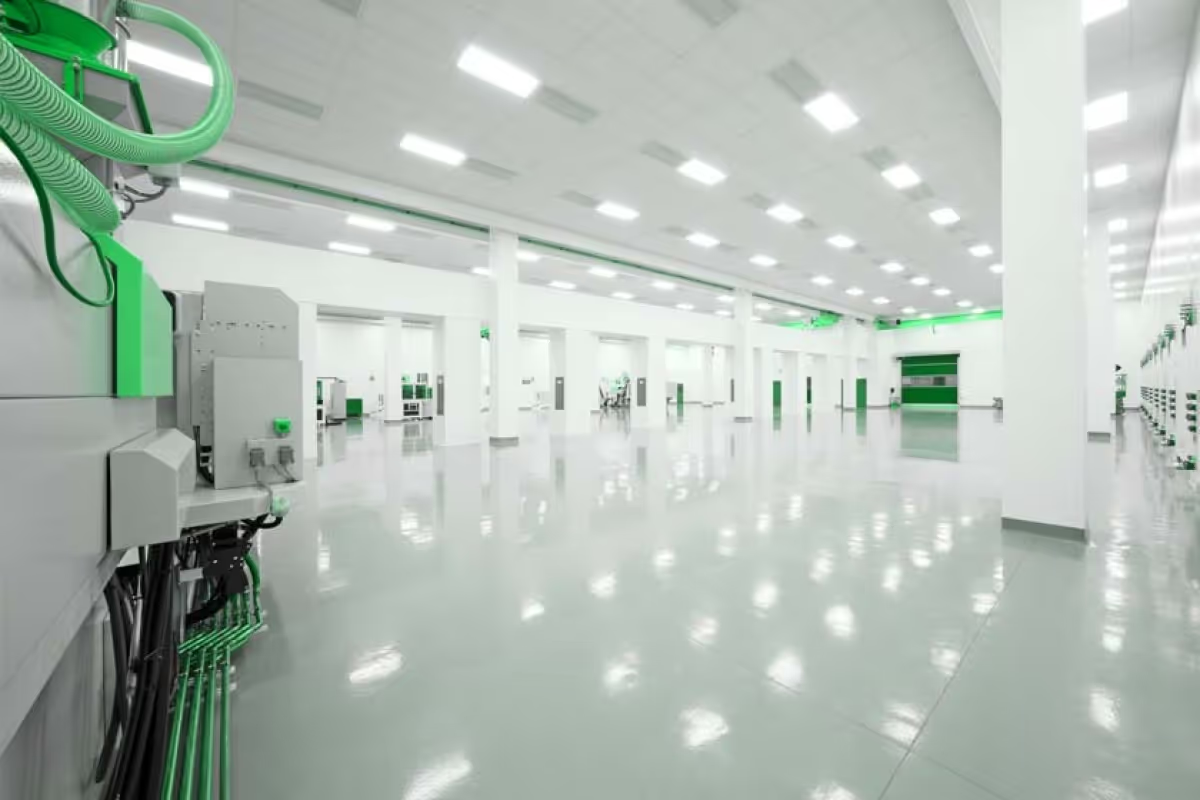
- Manufacturing infrastructure — Companies are reshoring manufacturing capacity to support AI chip production and related industries
This structural shift represents a multi-decade investment cycle that will support construction spending far beyond the traditional business cycle.
Apple's $600 Billion American Manufacturing Program Signals Reshoring Trend
Apple announced a $600 billion American Manufacturing Program investment through 2029—an increase from the initially announced $500 billion in February 2025. This represents the largest commitment any technology company has made to domestic manufacturing in decades.
The program will support:
- Manufacturing facility construction and expansion
- Supply chain infrastructure development
- Worker training and development programs
- Supply chain resilience and diversification
Apple's commitment signals broader industry confidence in the potential for U.S.-based manufacturing to support critical technologies. Other technology, semiconductor, and advanced manufacturing companies are likely to follow with similar commitments, creating a multi-year construction pipeline.
Sector-Specific Outlook
Commercial Construction: Facing headwinds in 2025 due to rising interest rates and reduced tenant demand. Recovery dependent on monetary policy normalization and improved business sentiment.
Industrial Construction: Weak in 2025 but expected to strengthen as companies pursue nearshoring and supply chain resilience initiatives. Data center and advanced manufacturing construction will drive growth.
Residential Construction: Challenged by affordability concerns and higher mortgage rates. Recovery will be gradual and dependent on interest rate environment.
Infrastructure Construction: Supported by bipartisan federal funding through infrastructure legislation. Strongest performing sector with consistent demand for transportation, water, and broadband projects.
Energy and Utilities Construction: Utilities are planning record capital expenditures of over $212 billion in 2025 for grid reliability, transmission upgrades, and renewable energy integration. This sector is expected to see sustained demand through the forecast period.
Strategic Implications for Contractors and Developers
Construction professionals should view 2025 as a transition year—a period of consolidation and preparation for the next growth cycle. Companies that maintain financial discipline, invest in technology and workforce development, and position themselves for AI infrastructure construction will be best positioned for the 2026-2029 recovery.
Priority actions:
- Strengthen balance sheets and maintain liquidity
- Invest in estimating and project management technology
- Develop expertise in data center, power infrastructure, and advanced manufacturing construction
- Build relationships with major technology, semiconductor, and energy companies
- Ensure workforce readiness for specialized construction work
Long-Term Outlook: Structural Growth Drivers
Beyond 2029, the construction industry's growth trajectory will be supported by:
- AI infrastructure deployment — Data centers, power facilities, and supporting infrastructure
- Energy transition — Renewable energy, grid modernization, and battery storage
- Supply chain resilience — Manufacturing reshoring and nearshoring investments
- Infrastructure modernization — Transportation, water, broadband, and utilities upgrades
These secular trends represent opportunities for contractors and construction companies that can develop specialized capabilities and establish long-term client relationships in high-growth sectors.
Source: ResearchAndMarkets.com / BusinessWire, December 2, 2025

Discuss an Upcoming Project


