
$800 Million in Federal Funding Awarded for Small Modular Nuclear Reactor Projects
The U.S. Department of Energy has announced major federal funding awards for advanced nuclear power development, with the Tennessee Valley Authority (TVA) and private developer Holtec International each receiving up to $400 million in federal cost-share funding to advance small modular reactor (SMR) projects. The announcement, made on December 5, 2025, represents a significant commitment to next-generation nuclear technology and reflects the Trump administration's strategic focus on reliable, baseload power for artificial intelligence and data center operations, according to reporting from Engineering News-Record.
TVA's Clinch River Project: 600 MW of New Nuclear Capacity
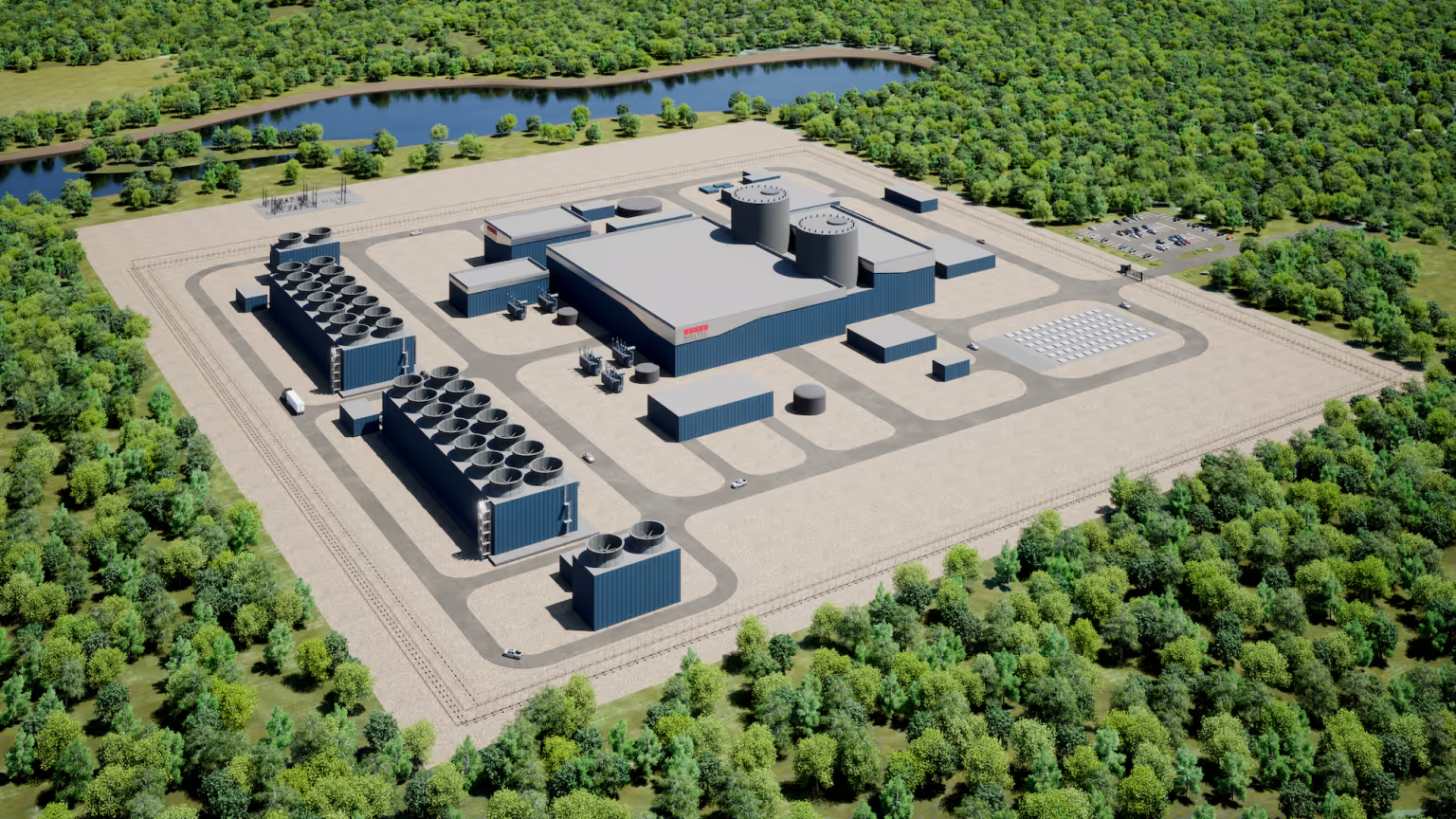
TVA's $400 million federal award will support construction of the first two-unit GE Vernova Hitachi BWRX-300 Small Modular Reactor at its Clinch River site in Tennessee. The project targets an estimated 600 megawatts (MW) of generating capacity with anticipated operation beginning in the early 2030s.
The TVA development team includes industry leaders across multiple disciplines:
- GE Vernova Hitachi Nuclear Energy - reactor design and technology
- Bechtel - engineering and construction management
- Aecon (Ontario-based) - construction planning and execution
- BWX Technologies - specialty nuclear equipment
- Duke Energy - partner utility
- Indiana Michigan Power - partner utility
- Oak Ridge Associated Universities - research and development support
- Electric Power Research Institute (EPRI) - technical analysis
TVA's construction permit application to the U.S. Nuclear Regulatory Commission for the BWRX-300 was submitted in May and remains under agency review. TVA President and CEO Don Moul stated: "This award affirms TVA's continued leadership in shaping the nation's nuclear energy future."
What This Means for Contractors
The TVA Clinch River project introduces a significant shift in nuclear construction methodology: an integrated project delivery (IPD) model that fundamentally changes how contractors and developers collaborate. Rather than traditional design-bid-build approaches, the Clinch River project brings GE Vernova Hitachi, TVA, Bechtel, Aecon, and other partners together as a highly integrated team from planning through construction and commissioning.
Bob Deacy, TVA senior vice president and Clinch River project leader, explained: "The integrated project delivery model is the preferred method that will make our project a true team effort. We will actively work together toward a target budget and schedule—creating a significant advantage to drive nuclear innovation, share risks and reduce costs."
This approach represents best practices in complex, high-risk infrastructure projects and suggests broader adoption of IPD methodology in future large-scale construction programs. For contractors, the model offers opportunities for earlier involvement in design decisions and shared responsibility for project outcomes—but also requires commitment to collaborative problem-solving and joint risk management.
The SMR projects also create demand for specialty contractors and suppliers with expertise in small modular reactor construction, quality assurance in nuclear environments, and advanced manufacturing. The relatively modest size of SMRs (compared to traditional reactors) may create opportunities for mid-sized contractors with experience in factory-built components and off-site construction methodologies.
Holtec's Palisades Project: Revolutionary Reactor Restart and Expansion
Holtec International's $400 million federal award supports a transformative project at the Palisades nuclear power plant site in Covert, Michigan. The project involves two major components:
- Restart of the 800 MW Palisades reactor in January 2026
- Construction of dual-unit SMR-300 reactors adding an additional 600 MW capacity
Holtec targets first power from the SMR units by 2030 as part of its "Mission 2030" initiative. The company projects project costs of $2.1 billion to $2.7 billion per reactor and is partnering with Hyundai Engineering & Construction to build a potential 10-GW fleet of SMR-300s throughout North America during the 2030s.
The Palisades project also benefits from a $1.52-billion conditional DOE loan for the reactor restart, approved under the Advanced Reactor Demonstration Program dating to 2020. Holtec founder, chairman, and CEO Krishna Singh has emphasized that the company self-funded SMR-300 development after the 2011 Fukushima nuclear disaster, when DOE declined to fund the design. The firm's investment paid off: after years of development, the SMR-300 design is positioned for deployment with the federal funding announcement.
However, the Palisades restart and SMR project faces legal challenges from anti-nuclear groups that have filed lawsuits against both Holtec and the U.S. Nuclear Regulatory Commission in federal court, introducing scheduling uncertainty to the project timeline.
Industry Context: Strategic Energy Infrastructure Investment
Energy Secretary Chris Wright framed the SMR investment within the Trump administration's strategic priorities: "Advanced light water SMRs will give our nation the reliable, round-the-clock power we need to support data centers and AI growth, and reinforce a stronger, more secure electric grid."
TVA alone has reported approximately 11 gigawatts (GW) of requested load for artificial intelligence and data center operations across its service territory, with demand from major technology companies including Google, Meta, and xAI. This demand underscores a fundamental shift in U.S. energy infrastructure: data centers and AI computing facilities require 24/7 reliable baseload power, which nuclear energy uniquely provides.
The SMR projects also reflect broader industry trends:
- Decentralization of power generation: SMRs can be deployed at diverse geographic locations, reducing transmission constraints
- Factory manufacturing advantage: Many SMR components are factory-built and transported to sites, supporting workforce development and quality control
- Smaller capital requirements per unit: While still expensive, SMRs require lower upfront capital than traditional reactors, enabling staged deployment
- Heat and industrial applications: Beyond electricity, SMRs can provide process heat for industrial applications and district heating
International Context and Competitive Positioning
The U.S. SMR investment occurs within a global race for advanced nuclear technology leadership. Canada's Ontario Power Generation has already started construction of four GE Vernova BWRX-300 units at its Darlington power plant, with the first targeted for 2030 operation. A partnership of Aecon and Kiewit Nuclear Canada won a construction management contract valued at approximately $930 million (Aecon's share).
Additionally, GE Vernova Hitachi Nuclear Energy and design-build firm Samsung C&T announced a strategic alliance in October 2025 to advance BWRX-300 deployment in markets outside North America, signaling rapid commercial expansion of this reactor design.
Timeline and Implementation
The $800 million in awards stems from a Biden-era Department of Energy solicitation released in October 2024, utilizing funding from the 2021 Infrastructure Investment and Jobs Act (IIJA). The Trump administration revised the solicitation in spring 2025, removing certain community benefit requirements while maintaining the core funding mechanism.
An additional $100 million in federal funding is scheduled for award later in 2025 to support additional SMR deployments and address barriers in design, licensing, supply chain, and site readiness across the sector.
What to Watch Next
Key milestones for the SMR projects include:
- TVA Clinch River: NRC construction permit decision (under review); IPD team mobilization; early construction activities in 2026-2027
- Holtec Palisades: Reactor restart (January 2026); resolution of ongoing litigation; SMR foundation preparation and early phase construction
- Canadian deployment: First GE Vernova BWRX-300 operational by 2030 at Darlington
- Supply chain development: Manufacturer expansion and specialty contractor recruitment in nuclear and advanced manufacturing sectors
For the construction industry, the TVA and Holtec awards represent substantial near-term opportunities and signal long-term demand for nuclear construction expertise. The shift toward integrated project delivery and factory-built components suggests evolution in how large-scale infrastructure projects are executed, with implications across the construction industry.
Sources
Engineering News-Record - "TVA, Holtec Gain $800M US Funding For Small Nuclear Reactor Builds" by Debra K. Rubin, December 5, 2025

Discuss an Upcoming Project


