
Rochester Area Fire Department Launches $21.8M New Firehouse Construction Project
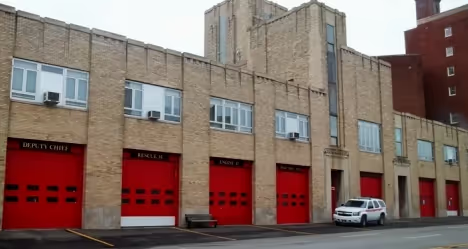
Rochester Fire Department Approves Major Infrastructure Upgrade
The St. Paul Boulevard Fire Department in Rochester, New York has announced an ambitious $21.8 million new firehouse construction project designed to address decades-old facility deficiencies and modernize operations for the department. The decision, made public on December 16, 2025, represents one of the most significant infrastructure investments in the department's recent history and reflects growing demands for emergency service facilities that meet contemporary health, safety, and operational standards.
According to department leadership, the current fire station facility falls significantly short of modern standards. The existing structure does not meet current health and safety requirements, cannot adequately accommodate the department's current staffing levels, lacks private bunkroom facilities for firefighters, and suffers from persistent mechanical failures in both plumbing and HVAC systems. These deficiencies have created operational challenges and safety concerns that have prompted the comprehensive renovation initiative.
Project Scope and Modern Amenities
The new firehouse will represent a comprehensive modernization of the department's facilities. The design includes modern apparatus bays equipped with updated technology and configurations to accommodate contemporary emergency response vehicles and equipment. A critical component of the project is the addition of private bunkrooms for firefighters, addressing a significant gap in the current facility's accommodation infrastructure.
The new facility will also incorporate gender-inclusive facilities, reflecting current best practices in emergency service infrastructure design. These amenities ensure that the department can attract and retain qualified personnel while providing appropriate facilities for its diverse workforce. The comprehensive modernization addresses not only physical infrastructure but also the operational and personnel needs of a modern fire department serving an increasingly diverse community.
Pole Barn Training Facility Enhances Operational Efficiency
A particularly innovative component of the project is the Pole Barn Training Facility, which will serve multiple operational purposes beyond the main firehouse construction. This dedicated facility will support construction operations during the building phase, provide year-round training capabilities for firefighters, and offer storage capacity for equipment and materials. Most significantly, the pole barn is projected to save $1.6 million in overall project costs, making it a cost-effective addition that enhances the project's value proposition to city officials and taxpayers.
By integrating the training facility into the project plan, the Rochester Fire Department demonstrates forward-thinking infrastructure planning that addresses immediate facility needs while investing in ongoing professional development and operational capability. The year-round training capacity will enable continuous skill development and preparedness enhancement for department personnel, ensuring that firefighters maintain peak operational readiness throughout all seasons.
Project Timeline and Implementation Phases
The ambitious $21.8 million project is structured in two distinct phases, carefully sequenced to minimize disruption to emergency service operations. Phase 1, focused on the Pole Barn Training Facility, will proceed from January through June 2026. This initial six-month phase will establish the training infrastructure and allow the pole barn to support ongoing construction activities for the main firehouse facility.
Phase 2, the main station construction, is scheduled to begin in July 2026 and will continue through Fall 2027. This 16-month construction window reflects the scope and complexity of building a modern emergency services facility that must meet extensive regulatory requirements, architectural specifications, and operational standards. The phased approach allows the department to manage construction activities while maintaining emergency response capabilities and ensuring continuity of fire protection services to Rochester residents and surrounding areas.
Financial Impact and Tax Considerations
Understanding the financial implications for taxpayers and property owners is essential context for this infrastructure project. The Rochester area will need to finance this modernization through property taxes, with projections indicating a tax impact of 33 cents per $1,000 of assessed property value. For the average home in the area, this translates to approximately $62 per year in additional property tax burden to support the new firehouse construction and equipping.
While any tax increase warrants careful consideration, the projected cost remains modest when amortized across the property tax base and understood in the context of the facility's long-term service life. Department officials have emphasized that the $21.8 million budget represents a disciplined, carefully managed investment in critical emergency services infrastructure. The inclusion of the pole barn training facility, which saves $1.6 million in project costs, demonstrates cost-consciousness and value-engineering in project planning and execution.
Why This Investment Matters for Rochester
Modern emergency services infrastructure is foundational to public safety and community well-being. A fire department facility that meets current health and safety standards, provides appropriate facilities for personnel, and incorporates contemporary emergency response capabilities directly enhances the department's ability to respond effectively to emergencies throughout the Rochester area. The new firehouse represents an investment not only in physical infrastructure but in the operational capacity and personnel well-being of those who serve the community.
The current facility's documented deficiencies—inability to meet health and safety standards, inadequate accommodation for current staffing, lack of private facilities, and persistent mechanical failures—have limited the department's operational capabilities. The new facility will eliminate these constraints and provide a modern operational platform for Rochester's emergency services for decades to come. Enhanced facilities also support recruitment and retention of qualified firefighters, essential for maintaining optimal emergency response capacity.
Looking Forward: Long-Term Infrastructure Investment
The St. Paul Boulevard Fire Department's $21.8 million firehouse project, with its phased implementation timeline beginning January 2026, represents a significant commitment to modernizing Rochester's emergency services infrastructure. The project demonstrates that even mid-sized municipalities can undertake substantial infrastructure investments when they prioritize essential services and develop realistic financial plans for implementation.
As construction progresses through 2027, the pole barn training facility will begin supporting firefighter professional development and operations, while the main station construction advances toward completion. The facility will serve as a model for other municipalities considering similar emergency services facility upgrades. By late 2027, Rochester will have invested in essential emergency services infrastructure that will serve the community for the foreseeable future, enhancing public safety capabilities while providing modern, appropriate working facilities for the department's dedicated professionals.
Source: Rochester First (WROC-TV), December 16, 2025

Discuss an Upcoming Project


