
EPA Reallocates Federal Funding Based on Verified State Inventories
The U.S. Environmental Protection Agency announced on November 25, 2025, that it will distribute $3 billion in new Drinking Water State Revolving Fund assistance and reallocate another $1.1 billion in previously awarded but unused funds to accelerate removal of lead service lines nationwide. This significant infrastructure investment reshapes project pipelines across utilities and contractors beginning in 2026.
Updated Lead Service Line Inventory Data
The funding reallocation stems from the first full round of service-line inventories required under the federal Lead and Copper Rule Revisions. Updated state data now shows approximately 4 million lead service lines nationwide—less than half the prior 9.2 million estimate that existed before mandatory reporting requirements took effect.
These inventories were due October 16, 2024, and the EPA spent the past year analyzing state submissions. The revised data—now publicly available in an EPA dashboard—enables more precise federal resource allocation. According to EPA Administrator Lee Zeldin, the new distribution reflects "the agency's effort to ensure funding is properly distributed to achieve maximum impact."
The revised inventory shows significant geographic variation. States such as Illinois, Ohio, Pennsylvania, and Florida are reporting some of the highest known concentrations of documented lead service lines. This geographic disparity is critical for contractors and utilities planning capital improvement budgets and project sequencing for 2026 and beyond.
Funding Distribution and Program Structure
The EPA is distributing the $3 billion through the Drinking Water State Revolving Fund's (DWSRF) lead service line replacement program, established under the Infrastructure Investment and Jobs Act. These funds can support locating, planning, design, and full replacement of lead service lines.
EPA Assistant Administrator for Water Jess Kramer emphasized the efficiency gains: "The $3 billion will go farther because utilities are identifying fewer lead pipes than previously believed." This represents a fundamental shift in how federal capital will be deployed across utility systems.
For states and utilities, the key requirement is straightforward: states that have not obligated or spent funds dating back to fiscal 2023 must submit updated plans explaining deployment of previous awards before qualifying for additional allocations. This mechanism ensures momentum in project execution rather than funding accumulation.
What This Means for Contractors and Utilities
Water system operators face immediate planning decisions. The combination of EPA's new $3 billion distribution and $1.1 billion reallocation creates approximately $4.1 billion in federal capital targeting lead service line replacement over the planning cycle. For construction firms serving the water infrastructure sector, this signals robust bidding opportunity.
Contractors should note that lead service line replacement projects typically involve:
- Service line identification and inventory mapping
- Customer notification and coordination
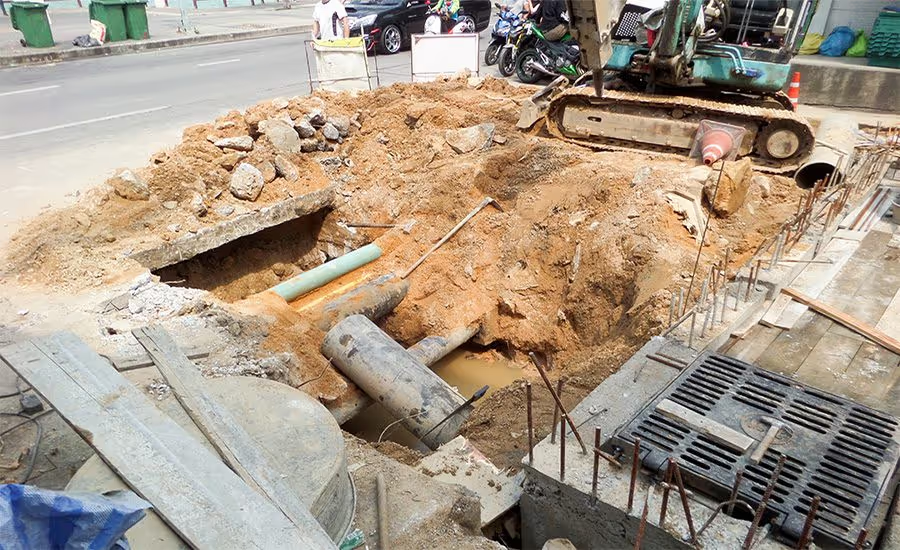
- Excavation and line replacement
- Street restoration and pavement replacement
- Water system pressure testing and commissioning
- Private property portion coordination (often customer-funded or grant-supplemented)
The funding structure typically covers public portion replacement, but utilities are increasingly seeking federal and state grants to address private property portions where property owners face barriers to funding replacement work.
EPA Flexibility and Implementation Timeline
The EPA released a memorandum outlining additional flexibilities states may use when deploying appropriations. This guidance addresses practical implementation challenges utilities and contractors have identified during lead replacement program execution.
The timing is significant: with replacement obligations and inventory reporting deadlines continuing into 2026, the refined state data and updated funding distribution are expected to influence project pipelines as utilities adjust intended-use plans and develop new bid packages.
Industry Impact and Broader Infrastructure Context
The Seventh Drinking Water Infrastructure Needs Survey estimates $625 billion in drinking-water infrastructure needs over 20 years, including extensive pipe replacement. Lead service line replacement represents a substantial but concentrated portion of this broader investment requirement.
Federal funding commitments under the Infrastructure Investment and Jobs Act, CHIPS and Science Act, and Inflation Reduction Act continue to support major infrastructure projects. However, water sector officials note that several major funding pools are now fully committed or nearing their limits, raising concern that key programs could taper over the next 12 to 18 months.
What to Watch Next
Contractors and utilities should monitor several key developments:
- State Plan Submittals: Updated plans from states addressing deployment of 2023 and earlier awards
- EPA Dashboard Updates: Ongoing inventory refinement as utilities complete detailed surveys
- Bid Package Development: Utilities developing new lead replacement bid packages based on updated inventories
- Private Property Funding: Emerging state and local programs to support private portion replacement
- Contractor Competition: Increased bidding activity as utilities accelerate project schedules
Regional Variations and State-by-State Considerations
The funding reallocation will produce material differences across states. States with lower documented lead line concentrations will see relatively smaller allocations based on revised inventory data. Conversely, states with higher identified concentrations—particularly Illinois, Ohio, Pennsylvania, and Florida—will see proportionally larger funding deployment.
This rebalancing reflects EPA's commitment to data-driven resource allocation. Environmental and public-health organizations largely welcomed the recalibration. Clean Water Action called the decision "a common-sense and welcome improvement" that helps direct federal support to communities with the clearest replacement needs.
Key Takeaways for the Construction Industry
- $4.1 billion federal commitment to lead service line replacement (new $3B + reallocated $1.1B)
- Approximately 4 million lead service lines identified nationwide (revised down from 9.2 million)
- Geographic variation in concentrations—Illinois, Ohio, Pennsylvania, Florida among highest
- 2026 project pipeline acceleration as utilities develop bid packages
- EPA flexibilities enabling varied implementation approaches across states
- State deadline requirement—prior awards must be deployed to access new allocations
Contractor Opportunities and Risk Considerations
The lead service line replacement market presents robust opportunities for contractors with experience in:
- Underground utility installation and replacement
- Street and sidewalk restoration
- Water system coordination and commissioning
- Trenchless technology applications
- Project management in densely populated utility corridors
Contractors entering or expanding in the water infrastructure sector should understand that lead replacement work often involves:
- Coordinating with multiple utility systems (water, gas, electric, telecommunications)
- Managing customer access and notifications
- Operating under strict EPA and state water quality standards
- Meeting aggressive project timelines in competitive markets
Source: Engineering News-Record (ENR), "EPA Redirects $4.1B to States for Lead Pipe Removal," November 25, 2025. Author: Bryan Gottlieb. EPA Announcement: November 25, 2025.


Discuss an Upcoming Project


