
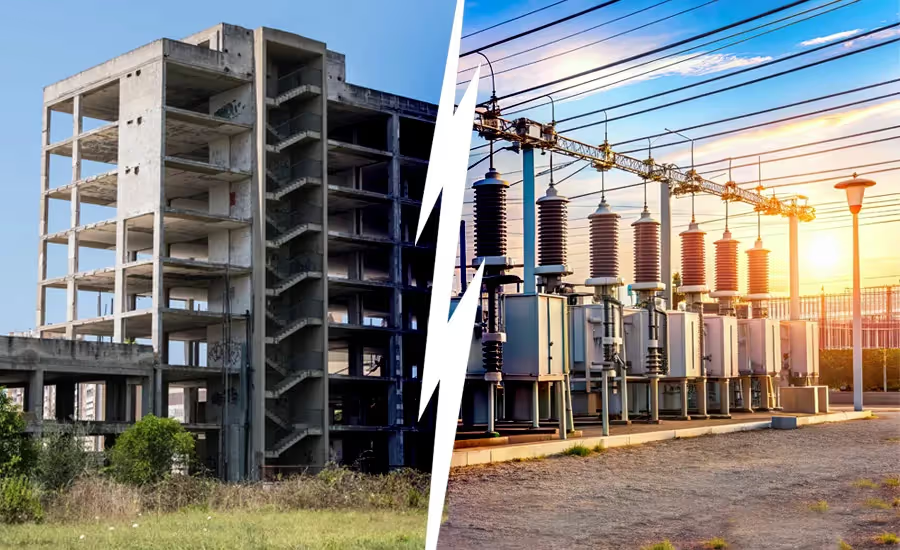
National Construction Employment Peaks While Office and Retail Markets Cool
The U.S. commercial construction sector has reached a historic employment peak, yet underlying data reveals a market increasingly concentrated in megaprojects rather than broad-based growth. According to analysis published by Engineering News-Record on November 25, 2025, commercial construction employment sits at roughly 8.3 million workers—the highest level since federal recordkeeping began. However, this apparent strength masks significant divergence between thriving segments and cooling traditional markets.
Historic Employment Peak Masks Market Divergence
The U.S. Bureau of Labor Statistics confirms that construction employment has reached unprecedented levels, with wages rising approximately 4% over the past year as firms compete for limited labor. However, this headline strength conceals a fragmented market: data centers, energy facilities, and specialized industrial megaprojects are driving national totals while office, retail, and manufacturing construction have softened significantly through 2025.
The divergence is pronounced in backlog data. According to the Associated Builders and Contractors (ABC) October Construction Backlog Indicator, the overall backlog fell to 8.4 months—the lowest level since May. More concerning, nearly 65% of contractors surveyed believe the industry is contracting, despite strength in heavy industrial, infrastructure, and data center work.
Spending Data Reveals Softening Across Sectors
Federal spending data presents a more cautious picture. Through August 2025, total construction outlays were down 1.6% from the same period in 2024, according to the U.S. Census Bureau. Nonresidential spending declined 1.5% year over year, marking the third monthly drop in four months.
The deterioration is particularly evident in manufacturing and traditional commercial construction:
- Manufacturing construction climbed from $75 billion in 2020 to roughly $225 billion in 2025, but is expected to end the year down 4.7% compared with 2024, with further 3.7% decline projected for 2026
- Commercial starts climbed nearly 27% for the 12 months ending in October, but this growth is driven almost entirely by billion-dollar-scale megaprojects rather than broad-based commercial activity
- Institutional work was flat year-over-year, and manufacturing fell more than 16% in starts
Data Center Boom Reshapes Market Dynamics
Data centers have become the dominant factor shaping national construction statistics. A 2024 Electric Power Research Institute study backed by the U.S. Department of Energy estimates that U.S. data centers now consume more than 4% of national electricity—a share projected to climb to as much as 12% by 2028.
This energy intensity is creating unprecedented infrastructure challenges. Mortenson's Executive Vice President Maja Rosenquist noted that several hyperscale facilities delayed progress even after breaking ground due to utilities' inability to meet power-delivery schedules. Additionally, increasing AI workloads are causing mid-project redesigns of cooling and electrical systems.
Contractors working in data centers report 10.9 months of backlog, compared with 8.0 months for firms not active in the segment—a dramatic 36% premium reflecting market concentration. This premium indicates that capacity and pricing power are firmly concentrated among firms with data center expertise.
Power and Infrastructure Constraints Emerging
Burns & McDonnell's data-center practice lead, Christine Wood, told ENR that hyperscale build schedules are increasingly "at odds with the pace of power and transmission infrastructure development," calling the mismatch a "critical constraint."
Utilities are struggling to keep pace. In July, Dominion Energy—host to about 13% of global data-center capacity in northern Virginia—saw its power-capacity pipeline nearly double over the past year, rising from 21.4 GW to 40.2 GW. Water use presents similarly significant demands: a large hyperscale campus can require up to 5 million gallons per day, according to the Environmental and Energy Study Institute.
These infrastructure constraints are creating new project risks:
- Interconnection timelines: Utilities cannot accelerate electrical interconnection despite contractor readiness
- Transmission capacity: Regional transmission infrastructure is inadequate for projected data center loads
- Long-lead electrical equipment: Supply chain delays for specialized transformers and switchgear
- Water availability: Regional water constraints limiting data center site selection
Heavy Industrial and Infrastructure Maintain Strength
Beyond data centers, heavy industrial and infrastructure segments remain resilient:
- Heavy industrial backlog: Rose to 8.8 months
- Infrastructure backlog: Reached 9.8 months, among the highest in ABC's measurement series
- LNG megaprojects: Venture Global LNG's CP2 export terminal in Louisiana (authorized in May) could cost up to $28 billion with early construction underway
These megaprojects—led by firms like Worley across 1,150-acre sites with 36 liquefaction trains, four storage tanks, and 90 miles of pipeline—dominate national construction totals but represent a small number of projects requiring highly specialized expertise.
Commercial Backlog Flat While Divergence Grows
Commercial and institutional backlog held at 8.5 months—a flat trend consistent with slowing demand. This stability masks underlying weakness: while megaprojects inflate national statistics, traditional office, retail, and mid-market commercial projects face softer demand.
Corporate earnings data reinforces the concentration pattern. Turner Construction—part of Spain-based ACS Group—reported that sales grew 43% in the first nine months of 2025 on a foreign-exchange–adjusted basis, driven primarily by data centers and biopharma projects. Turner's backlog rose 20% to €34.4 billion (approximately $37.8 billion).
Across the broader ACS Group, more than half of new orders now come from digital infrastructure, energy infrastructure, and defense, underscoring how a relatively small set of megaproject categories is sustaining much of today's national construction volume.
Labor Shortages Intensify Cost Pressures
The industry faces workforce shortages that are expected to persist into 2026, according to the Associated General Contractors' 2025 Construction Hiring & Business Outlook. ABC estimates that the industry will need to attract an additional 500,000 workers in the coming year due to persistent skilled labor shortage.
The workforce challenges are compounded by demographic realities: QBE notes that roughly one-quarter of the construction workforce is foreign-born—a larger share than the overall labor force—leaving the sector sensitive to changes in immigration enforcement and visa processing.
The Trump administration's immigration enforcement campaign, combined with National Association of Home Builders' assessment of a retirement-related crisis (more than one-fifth of U.S. construction workers are 55 or older), is accelerating attrition rates. These pressures are particularly acute in fast-growing states such as Texas and Florida.
Material and Equipment Costs Rise
ABC's November update shows construction input prices up 3.5% from last September, driven by increased costs for electrical equipment, steel, copper, and transportation. These cost increases are attributed to Trump's tariff policies and supply chain disruptions.
Manufacturers and contractors working under fixed-price contracts signed before 2025 are now facing tighter contingencies and more frequent renegotiations with owners. This dynamic particularly affects contractors on traditional commercial and manufacturing projects, where margins are already compressed by market softness.
Optimism Moderating Despite Growth Signals
ABC's Construction Confidence Index eased to 60.1 for staffing expectations. While this number remains above the 50-point growth threshold, the recent moderation reflects industry concern about further labor market constriction and continued cost pressure.
For firms outside the data center and megaproject segments, the sentiment is more cautious. Smaller contractors report:
- Declining project availability outside megaproject categories
- Competitive pressure from large firms with specialized capabilities
- Difficulty attracting and retaining skilled workers
- Margin compression from material and labor cost inflation
Outlook and Strategic Implications
Forecasts indicate that full-year 2025 nonresidential put-in-place construction will finish approximately 2% below 2024, followed by a further 0.5% decline in 2026, according to FMI—a consulting and investment banking firm specializing in engineering and construction.
Several major federal funding pools are now fully committed or nearing their limits under the Infrastructure Investment and Jobs Act, CHIPS and Science Act, and Inflation Reduction Act. If project notices to proceed begin to slow faster than backlogs can be replenished, contractors could face a "funding hangover" beginning in 2026.
Key Takeaways for Contractors
- Historic employment peak of 8.3 million workers masks market divergence
- Data centers driving national growth: 36% higher backlog premium vs. traditional commercial
- Manufacturing construction declining: Down 4.7% from 2024, with 3.7% decline projected for 2026
- Office and retail softening: Traditional commercial segments experiencing reduced demand
- Megaproject concentration: Large, specialized industrial and energy projects sustaining national totals
- Infrastructure constraints emerging: Power, water, and transmission capacity limiting data center acceleration
- Workforce shortages persisting: Industry needs 500,000 additional workers, with immigration and retirement pressures mounting
- Cost inflation accelerating: Material and equipment prices up 3.5%, with tariff pressures likely to continue
- Market concentration risk: 65% of contractors believe industry is contracting despite headline employment gains
Strategic Considerations for Construction Firms
The divergent market demands strategic differentiation:
- For large firms: Specialized capabilities in data centers, LNG, and energy infrastructure create competitive moats and strong backlogs
- For mid-market firms: Diversification challenges as traditional commercial segments soften
- For regional/local firms: Focus on infrastructure and government-funded projects may provide more stability than commercial/retail segments
- For all firms: Labor acquisition and retention strategies are increasingly critical to operational viability
Source: Engineering News-Record (ENR), "Two Markets, One Industry: Commercial Construction Splits as 2025 Winds Down," November 25, 2025. Author: Bryan Gottlieb. Related sources: QBE North America U.S. Commercial Construction Outlook; Associated Builders and Contractors October Construction Backlog Indicator; U.S. Bureau of Labor Statistics; U.S. Census Bureau.

Discuss an Upcoming Project


